The range
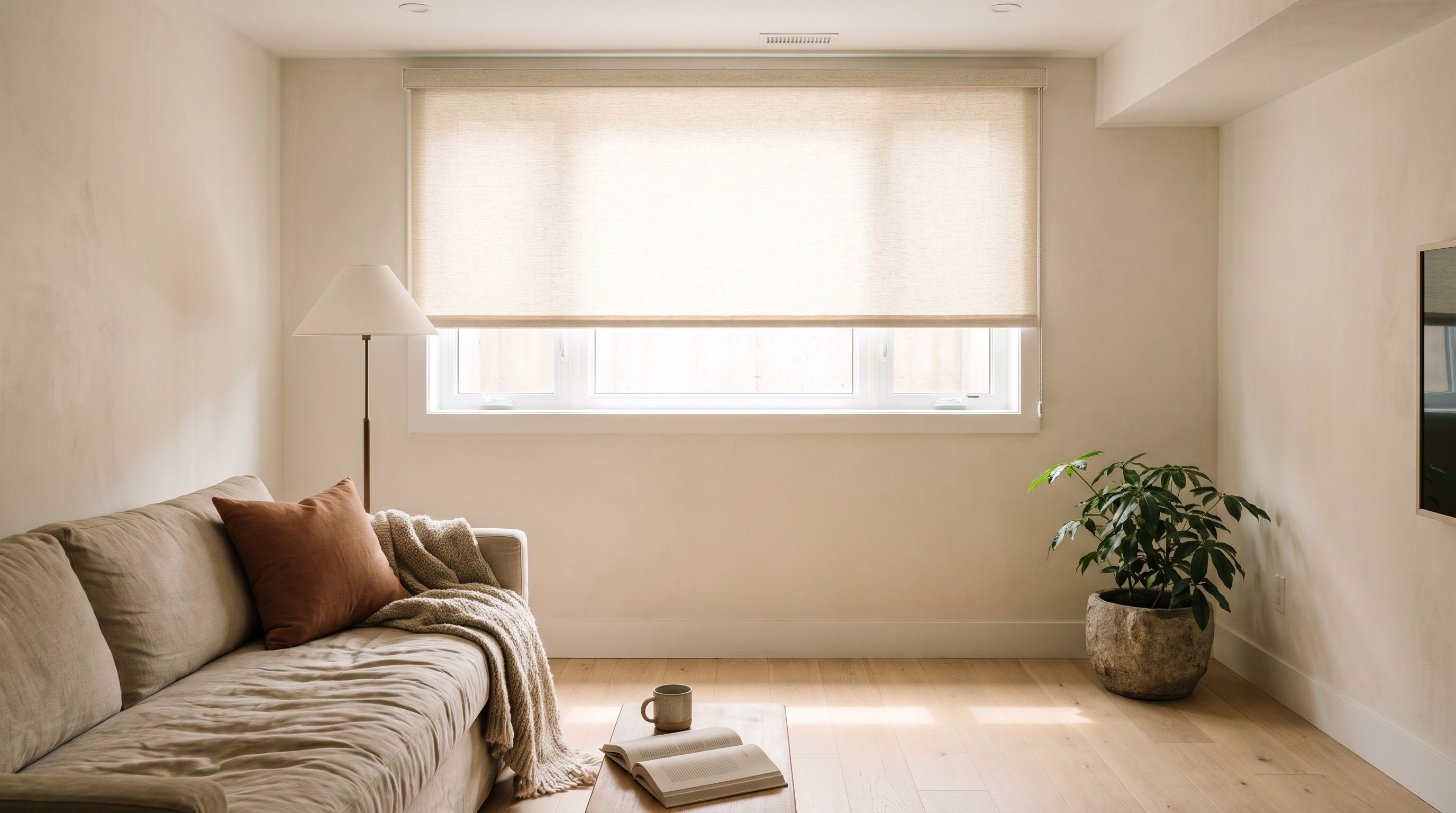
Basement window blinds
Every other page on this site manages an excess of light. The basement is the one page about scarcity: a room that may see a single thin hour of sun on a good day, through a window built to no standard size, that sometimes doubles as the way out. Different problem, different rules.
Blinds Company · Rated 4.8 out of 5 on Google
Free in-home measure · open 8am–9pm, 7 days
- Slim at the head
- On a window under half a metre tall, the stack a blind keeps at the top is the difference between a covered window and a smaller one.
- Exit windows kept usable
- Tell us which rooms are slept in and the covering is specified to surrender the opening in one motion, workable in the dark.
- Materials for a damp wall
- PVC, faux wood, aluminium and coated fabrics, hung clear of the glass so air keeps moving behind the blind and the sill stays dry.
- We will say leave it bare
- A window sunk in its own well is often seen by nobody, and the free measure is where we tell you it needs nothing.
In short
Basement windows want slim, made-to-measure coverings that spend none of a short opening on themselves — a compact roller, a narrow-slat venetian or a cellular shade — in materials that tolerate cool, damp walls, chosen to keep as much daylight as privacy allows. Where a window is a bedroom's emergency exit, the covering must leave it instantly usable. Measured and installed across Toronto and the GTA; the visit is free.
Inside this pageJump to one of 6 topics
The room with the shortest day
Upstairs, this site’s whole business is deciding how much light to refuse. Below grade the arithmetic flips. A basement window is small out of proportion to its room, set high, and often looking at the inside of a window well or the underside of a deck; what daylight it gathers is brief, second-hand and precious. Cover it carelessly and the room pays all day.
So the basement brief reads backwards from every other page here: keep the most light that privacy allows, spend as little of the window on hardware and gathered fabric as possible, and be honest about which openings need covering at all. A blind downstairs has to justify every lumen it takes.
Built to no standard size
Nothing about a basement window is standard. Foundations dictate the opening, so the windows come short and wide, or tall and narrow beside a walkout, or square where a coal chute used to be — set high on the wall, often in a reveal too shallow to hold a bracket, sometimes in a sash that tilts inward to open. Stock blinds are cut for the windows upstairs, and it shows the moment one meets a basement.
Made to measure is not a luxury down here; it is the only way the covering fits the opening rather than approximating it. On a window this small the approximation is expensive — a few centimetres of miss is a lit stripe or a lost slice of scarce glass — and the odd proportions decide products too. A short drop favours mechanisms that hold themselves to a few centimetres at the head; a tilting sash wants a blind mounted clear of its swing; a shallow reveal sends the whole assembly onto the wall above, made wider than the hole so the edges seal the light leak a small window can least afford.
The opening that might be the way out
Some basement windows carry a second job: they are the room’s exit of last resort. Where a lower level holds a bedroom — and finished basements increasingly do — the window somebody sleeps beside has to stay usable as a way out, and a covering can quietly ruin that without anyone noticing until it matters.
The rule we specify by is simple: the covering must surrender the opening instantly. One motion to clear, workable in the dark by feel, nothing fixed across the window, no loops or trailing cords to catch on anything or anyone. That leans the choice toward a simple cordless roller or a shade that lifts clean and away, and it leans the mounting outside the opening so nothing lives inside it.
We are careful not to play inspector — building rules are their own subject and not ours to quote from a web page. What we do promise: tell us which rooms are slept in, and every covering we fit there will treat the window as an exit first and a window second.
Ten o’clock, at ankle height
After dark a grade-level basement window becomes the most public glass in the house — lit from inside, at footpath level, offering its little rectangle of your evening to everyone who walks past. The upstairs windows show the street your ceiling; this one shows the room.
It is also the case where light-filtering fabrics quietly fail. A woven screen keeps its promises only while it is brighter outside than in; the moment the lamps beat the sky, the weave becomes a scrim with you behind it. The evening layer down here should simply be opaque — a solid roller, closed slats, a cellular — and because the same window is rationing daylight, the right arrangement is usually two-state: fully open all day, honestly shut at night, with nothing clever in between.
The bedroom and the desk downstairs
The two rooms basements most often become are the two with real light requirements.
The basement bedroom is the one place below grade where blackout earns its keep — not against the modest window, but for whoever sleeps days: shift workers, students, the visiting in-laws. The window is small, so the fabric wins easily; the perimeter is the real opponent, since on a small opening the edge glow is proportionally loud. An oversized mount outside the opening closes most of it — always arranged so the exit rule above still holds.
The basement office fights glare instead. A high window behind a monitor puts a bright stripe exactly where the afternoon’s focus goes, and the fix is a blind that stops at any height rather than choosing between all and nothing. A venetian’s tilt is worth having here for a second reason: angled up, it throws the window’s brief sunlight onto the ceiling, which is free lighting in the room that needs it most.
The measure, below grade
A basement measure spends as much time on the surroundings as on the opening. What is outside — well, walkway, deck, grade. What the wall does in winter, because a cool damp wall votes for synthetic materials and for hanging the blind clear of the glass so air keeps moving. What is above the frame, where bulkheads and ducting like to live exactly where a bracket wants to go. Which rooms are slept in — the question that reorders all the others.
Then the openings themselves, each one individually, because in a basement no two match. The quote comes back sized to the millimetre, materials named, with the exit windows flagged as such. The visit costs nothing, and down here it routinely saves the price of a blind by concluding that one window should stay bare.
The mechanism
Basement window blinds, part by part
Specified to keep light, not to fight it
Slim mechanisms that leave a short window whole
The opening left instantly usable where it is an exit
Materials that live calmly against a cool wall
Hour by hour
The same window, four times over
7am
Below grade the sun does not arrive so much as get delivered — bounced off the well wall, the fence, the underside of the deck. There is nothing to block at this hour and everything to collect, so the morning setting for almost every basement window is the same one: fully up, on a mechanism short enough at the head that raised means gone.
Noon
This is the hour the room has been waiting for, the sun finally high enough to clear grade and drop into the well, and it lasts about as long as lunch. A blind whose gathered fabric eats five centimetres of a forty-centimetre window has quietly taken a share of the only real daylight the room gets all day.
6pm
Before the light goes, the traffic starts. A grade-level window sits at the height of a passing knee and a metre from the path, so the hour people come home is the hour privacy begins to matter — earlier than at any window upstairs. It is where a blind that stops at any height earns its keep: covered to the sightline, clear above it.
After dark
The room is lit and the street is not, so the window reverses and a woven screen quietly hands you over; the evening layer down here has to be opaque. And where the room is slept in, that same blind must clear the opening in one movement, found by feel in the dark, with no loop or catch to solve first.
Where it belongs
Rooms basement window blinds answer well
Compact roller blinds, which spend almost nothing of a short drop
Cellular shades, where the wall behind the blind runs cold
Faux wood venetians, where the basement air runs damp
In the room
How the choice changes the room
The rest of the range
Everything else, by how it moves
Winds onto a tube
Tilts to aim the light
Folds up out of the way
Slides across the opening
And the fitting itself
Our commitment
We measure it. If it does not fit, we remake it.
The visit is free. See the samples at your own window, get the quote, then decide.
Before you call
Questions worth answering before you book.
What blinds suit small basement windows?
Ones that keep out of their own way. A basement opening is often shorter than half a metre, and on a drop like that a product that gathers its fabric into a stack has eaten a visible share of the glass before it has done any work. Compact rollers, narrow-slat venetians and low-profile cellular shades all hold themselves to a few centimetres at the head, which on these windows is the difference between a covered window and a smaller one.
Does a basement window need a blind at all?
Genuinely worth asking before spending, and the answer depends on what is outside. A window sunk in a well faces a wall of its own; nobody sees in, and a blind there mostly subtracts scarce light. A window at grade level is the opposite case — it offers the sidewalk a view from close range, at exactly the height of a passing glance, and it earns an opaque layer more than most windows in the house. Look at yours from outside before deciding; we do the same at the measure.
Can I put a blind on a basement egress window?
Yes — covered is fine, obstructed is not. Some basement windows are the room's emergency way out, and everything about the covering has to respect that: raised or drawn clear in one fast motion, nothing fixed across the opening, no tangle of cords, nothing that needs thinking about in the dark. Tell us which rooms people sleep in and we will specify with the exit in mind — and we would rather look at the actual window with you than recite rules at a distance.
Our basement runs damp. Which materials survive?
The synthetic side of the range. A below-grade room is cooler than the house above it, its window glass cooler still, and moisture finds cool surfaces — so the blind hanging there should be one that does not absorb: PVC, faux wood, aluminium, coated fabrics. We also hang the blind so air can move behind it rather than pressing it to the glass, which costs nothing and keeps the sill dry. Natural fibre and bare timber belong upstairs.
The window is high on the wall and behind the sofa. How do we reach it?
By choosing the control for the reach, not from the price list. A wand extension brings a venetian's tilt down to hand height. A spring roller can be worked with a pull that hangs to a sensible level. And for the genuinely unreachable window — behind a freezer, above a stair — a small motor on a remote settles it permanently, for less than most people guess. What we avoid is any arrangement where adjusting the blind requires standing on something.
We rent the basement. Can blinds go in without drilling the frame?
Yes — the no-drill systems clamp or tension into the opening and leave no mark on frame or wall, which keeps a landlord happy and a deposit whole. They suit smaller openings well, and a basement's windows are usually within their range. The trade is that tension systems want a reasonably square recess, which older foundations do not always offer — one more thing the free measure settles before anything is ordered.
The last chapter
We bring the samples to your windows.
We come to you, measure at your own windows, and go through fabrics and fits together. The visit costs nothing.
$99 off when you order three or more blindsApplied to your written quote at the measure.
Rather just talk?(437) 782-5452Answered 8am–9pm, 7 days
Free in-home measure
Not sure whether that low window even deserves a blind?
Answered 8am–9pm, 7 days.
Page last checked 16 August 2026.