Guide
The six kinds of blind, told by the way they move
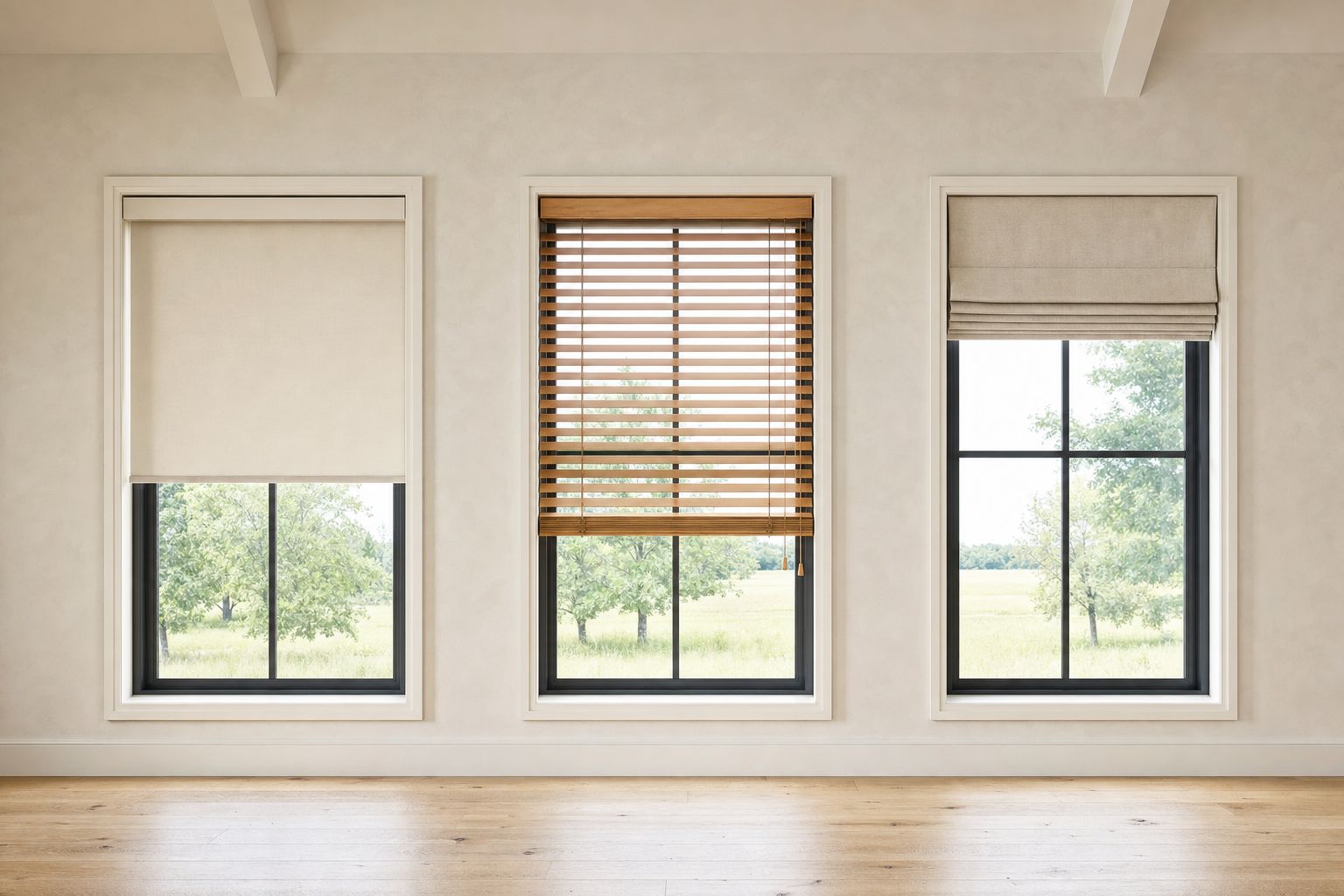
Every blind on the market moves one of four ways, and the movement is the real specification. Rollers and zebras roll — one flat plane, the cleanest look and the smallest bulk, with the zebra adding sliding sheer and solid bands. Venetians tilt — the only mechanism that can aim light instead of merely blocking it. Romans and cellulars fold — the roman into furnished fabric pleats, the cellular into an insulating honeycomb of trapped air. Verticals slide sideways, which is why they still own patio doors and very wide glass. Choose the movement for the job first; the fabric conversation comes second, and it is the easier half.
8 min readUpdated
ByNickolasLead installer & window covering specialist
Movement first, fabric second
Walk into any showroom and the choice appears to be about colour and texture — hundreds of swatches, a handful of finishes, and somewhere behind them six actual machines. The swatches are the easy half. Two of the six machines will suit your window and four will not, and no fabric can rescue a mechanism doing a job it was never built for.
The four movements sort everything. A blind can roll onto a tube, tilt on its slats, fold into pleats or cells, or slide along a track. Each verb buys one ability and charges for it somewhere else, and every entry below is honest about both sides of that ledger — including the window where each mechanism is the wrong answer, because a list without the failures is a brochure.
The ones that roll: roller and zebra
The roller blind is the simplest machine in the range and the hardest to improve on: one plane of fabric, one tube, nothing else in view. When it is up it almost ceases to exist — a slim cassette at the head of the window — which is why modern rooms with good glass tend to end up here. It also carries the widest fabric spectrum of any mechanism, from open solar screens that keep a view while cutting glare, through decorative mid-weights, to full blackout for the rooms where morning is the enemy.
What the roller cannot do is nuance. It is up, or down, or an unsatisfying horizontal compromise between the two; there is no angle, no aiming, no half-truth. A room whose light changes all day will find that limit weekly.
The zebra blind exists precisely at that limit. Alternating bands of sheer and solid fabric run in two layers on one roller, and moving the layers past each other tunes the alignment continuously — solid on solid for privacy, sheer on solid for a soft glow, anything between. It turns the roller’s switch into a dial, which is why it has become the default answer for street-facing rooms that refuse to choose between daylight and dignity. Its limits are two: it is not a blackout product, and after dark, with the room lit, sheer bands show silhouettes to the street. Evening rooms close it fully or back it with something solid.
Both rollers share one practical footnote — the fabric wraps a tube, and the tube needs recess depth. A very shallow window frame can rule the movement out before taste has a say, and a zebra needs more depth again because its double layer fattens the roll.
The ones that tilt: venetians in aluminium, wood and faux wood
Every other mechanism in this guide decides how much window to cover. The venetian decides something different: where the light that enters should go. Its horizontal slats rotate in place, so the same window at the same hour can send its light onto the ceiling — brightening the room while killing glare at seated eye level — or angle it at the floor, or shut flat. Nothing else in the range can redirect light at all, and for dim rooms, north faces and home offices with eye-level glare, that single talent settles the argument.
The material decides the character and the room. Aluminium is thin, inexpensive and moisture-proof — the practical answer over a sink. Real wood brings weight and warmth and reads as furniture, but timber and steam disagree over time, so it stays out of bathrooms. Faux wood copies the timber look in a polymer that shrugs at humidity, at the cost of extra weight on wide spans.
The mechanism’s honest tax is maintenance: several dozen slats are several dozen ledges, and dust treats them as an invitation. A household that will never take a cloth to them twice a year will be happier with a roller, and we say so in living rooms when it is true.
The ones that fold: roman and cellular
Two mechanisms share the folding verb and could not be less alike in purpose.
The roman shade folds for beauty. Raised, it gathers into deep horizontal pleats of real fabric; lowered, it hangs nearly flat. It is the one blind that reads as soft furnishing rather than hardware, and in bedrooms, dining rooms and any space that a flat panel would leave feeling unfinished, that is the entire argument.
Lined well, it also does respectable work on darkness and warmth. Its cost is stack: those pleats have to live somewhere when the shade is up, and they live across the top fifth or so of your glass, permanently shading the highest — and most useful — band of daylight. On a generous window nobody notices. Over a kitchen sink, the roman is how you lose the garden.
The cellular shade folds for physics. Seen from the side its fabric is a row of honeycomb cells, and each cell holds a pocket of still air between the room and the glass — which is to say it is insulation that happens to be a window covering. On a cold Toronto window it is the only mechanism whose warming claim is structural rather than aspirational, and a double-cell version doubles the trapped air for the rooms where February is the actual complaint. Many run top-down as well as bottom-up, covering eye level while daylight enters above. Its cost is plainness: the face is deliberately quiet, and lowered, it is an opaque panel — the view and the warmth take turns.
The ones that slide: vertical blinds and panels
Wide glass defeats everything above. A lifting blind spans its window like a beam, and past roughly two and a half metres the engineering starts arguing back — tubes deflect, weights multiply, and one opening becomes two blinds pretending to be one. Doors are worse: a covering that parks across the top of a doorway has to be raised and lowered every single time anyone passes.
The sliding movements sidestep the whole problem by stacking sideways. Vertical blinds hang free-swinging vanes from a headrail track: drawn, they clear the opening entirely to one side; closed, they tilt like a venetian turned ninety degrees, so a covered door still admits an adjustable amount of light. They remain the most practical object you can put on a sliding door, a fact untouched by two decades of their being called dated. Panel track systems run the same idea through fewer, wider, flat fabric panels and read considerably calmer in a modern room. And drapery — which this company also makes and installs — is the softest member of the sliding family, with the best night privacy of anything on this page when lined and generously stacked.
The family’s shared weakness is the gaps. Light and sightlines pass between vanes and around panels by design, so none of the sliders is a blackout answer, and a draughty room will set unweighted vanes swaying.
Reading your own window before anyone measures it
Four checks, all doable in a minute with no tools, tell you most of what the measure will confirm.
Depth. Look at how far the glass sits back from the wall face. A shallow recess rules out inside-mounted rollers and zebras before anything else is discussed; a deep one opens every option, including the tight blackout fits that make bedrooms genuinely dark.
Width. Pace it. Past about two and a half metres you are shopping the sliding family, or accepting a split into two lifting blinds on one line.
The hour. This site’s favourite question, because it chooses the movement faster than any showroom can. Morning-dark wants rolling blackout or folding cells; all-day adjustment wants zebra bands or tilting slats; evening low sun wants something that aims or drops to a height.
The traffic. If the opening is walked through, it slides. No exception has ever survived contact with a family using a patio door in July.
What the visit adds is the part a page cannot: the millimetres, the squareness, the crank handles and alarm sensors and radiators that ambush stock sizes, and fabric samples held against your own light rather than photographed under somebody else’s. The measure is free, and if the honest answer at your window is the plain roller — the cheapest machine on this page — that is the answer you will hear.
Eliminate mechanisms before comparing finishes
When six families still feel like six too many, use the window to cross names off. The order matters because each answer removes mechanisms for a physical reason, before colour or price can make a poor fit look tempting.
Is the opening used for passage? If people walk through it, begin with sideways movement. Verticals, panels or curtains can park beside the opening; anything that lifts has to clear head height for every trip. A rarely opened balcony door may tolerate that routine. The family patio door used all summer usually will not.
Must the view remain while the covering is working? An opaque roller, roman or cellular gives privacy by replacing the view. A solar screen keeps much of the outlook while reducing glare, and a zebra keeps a partial visual connection in its sheer position. If the view is the reason for the window, this question can remove half the catalogue immediately.
Does the light need to be redirected or merely reduced? Only tilting slats aim a beam. They can send low sun toward the ceiling while leaving the window bright. Rolling and folding products move an edge through the glass; they subtract light but do not steer it. A desk with a precise reflection problem may therefore want a venetian even when the room’s style board started elsewhere.
Is cold glass part of the complaint? If so, cellular moves to the front because its closed pockets add a still-air layer. A lined roman or curtain can also make the room feel less exposed, but it does so with fabric mass rather than the honeycomb structure. If temperature is not a problem, insulation should not be used to justify bulk the room does not need.
How much of the covering may remain visible when open? Rollers hide most completely. Venetians collect their slats at the head. Romans keep a deliberate folded stack, and sliders park at the side. Measure the view you are unwilling to lose before admiring the open-state photograph, because the covering spends part of that view even when it is doing nothing.
What maintenance will actually happen? A flat roller asks for occasional dusting. Slats ask for each horizontal surface to be wiped. Tailored cloth asks for gentler care and dislikes kitchen film. Choosing the product for the owner who will live with it, rather than the owner everyone imagines becoming after renovation, is a legitimate design decision.
At the end of those questions, two mechanisms usually remain. That is the right time for fabric, finish and quote comparisons: not six decorative possibilities, but two machines already proven capable of the room’s work.
If you would rather start from the problem than the machinery, the companion guide chooses the best blind by the hour it has to win — same range, approached from your side of the glass.
Questions
Still asked
What is the difference between blinds and shades?
Trade habit more than physics. "Blind" usually means the products built from slats or vanes — venetians, verticals — and "shade" the continuous surfaces, like rollers, romans and cellulars. Manufacturers blur the words freely, and nothing about a product follows from which one is on the label. Describing the movement you want — tilting, rolling, folding, sliding — gets you to the right object faster than either word does.
Which type of blind gives the most precise light control?
The venetian, and it is not a matter of taste but of geometry. Every other mechanism answers one question — how much of the window is covered. A tilting slat answers a second one: which direction the incoming light is sent. Slats angled upward throw daylight at the ceiling, which brightens the whole room while cutting glare at eye level. The price of that talent is upkeep, because several dozen slats are several dozen surfaces for dust.
Which type is warmest in winter?
The cellular shade, by design rather than accident. Its honeycomb section holds a pocket of still air between the room and the glass, and still air is a genuine insulator — the fabric exists mostly to keep the air where it is. No roller, roman or venetian has an equivalent structure, which is why "energy-saving" claims on those deserve more scepticism than the same words on a honeycomb.
What actually works on a patio door?
The sliding movements — vertical blinds or drapery — because a door needs its covering to vacate the opening completely and return a dozen times a day. Everything that lifts parks its bulk across the top and turns the doorway into a negotiation. Verticals draw fully to one side and tilt for privacy while closed; curtains do the same job more softly where there is wall to stack against.
Is a zebra blind just a roller with striped fabric?
No — the stripes are the mechanism, not a print. A zebra carries two layers of alternating sheer and solid bands moving on one roller, and shifting the layers past each other changes how much sheer aligns with solid. That gives it a continuous range of positions between clear and private, where a plain roller offers only up, down and the awkward middle. It is the difference between a switch and a dial.
Which type should a bedroom get?
Whichever one can actually make the room dark, which narrows the field fast. A blackout roller is the most complete answer, provided the edges are fitted tight, since dawn light exploits the perimeter rather than the fabric. A blackout cellular adds warmth to the same job. A lined roman gets most of the way with far more softness. The sheer-banded and slatted mechanisms are the wrong tools here alone — light finds the bands and the slat gaps — though they pair well with a blackout layer behind them.
About this guide
Nickolas turns the decisions made at real windows — fit, clearance, direction of light, privacy and reach — into these field guides as Blinds Company'sLead installer & window covering specialist. Each article follows one rule: explain where an option wins and where it does not.
The product this one is about: Zebra blinds
Still torn between two movements for one window? That argument usually settles itself in the room, with both samples held up to the actual light.
The last chapter
We bring the samples to your windows.
We come to you, measure at your own windows, and go through fabrics and fits together. The visit costs nothing.
$99 off when you order three or more blindsApplied to your written quote at the measure.
Rather just talk?(437) 782-5452Answered 8am–9pm, 7 days