Where we work
Blinds in Toronto
Custom blinds and curtains, measured and fitted across Toronto — in a housing stock where the window is often a century older than anything being hung in it, and fitting it well means measuring the opening it has become, not the one on the original drawings.
Blinds Company · Rated 4.8 out of 5 on Google
Free in-home measure · open 8am–9pm, 7 days
- Measured as it is today
- A century of settling moves an opening, so the number that matters is this year's rather than the drawing's.
- Deep reveals, properly used
- Solid brick leaves openings deep enough for a blind to sit back where daybreak has almost no edge to leak around.
- Original casing never drilled
- Fixings go up into the head of the opening or back into the reveal, not through the face of hundred-year-old wood.
- Narrow lots shape the light
- A side window facing the neighbour's brick two metres away never sees direct sun, and wants brightness borrowed rather than blocked.
In short
We measure, make and install blinds throughout Toronto, from century semis in Leslieville to the glass of Liberty Village, and we measure each opening as it stands today — settled, patched, slightly off true — so the blind is cut for the window you actually own. The in-home visit is free.
Inside this pageJump to one of 6 topics
The window came first
Most of the windows we measure in Toronto were cut into their walls before anyone now living was born. That is not a romantic observation; it is a specification. A century of freeze and thaw, of a foundation finding its final position, of sills renewed and plaster patched, leaves an opening that is no longer quite the rectangle the builder drew. The top corner disagrees with the bottom corner. The left height and the right height are close — and close is the operative word.
None of this is a defect. It is simply what the job is in this city, and it decides our method: the measurement is taken from the opening as it exists this year, in person, by the installer who will stand in front of it again with the finished blind. A blind cut to a nominal size fits the drawing. A blind cut to the survey fits the window.
Deep reveals, and why they are good news
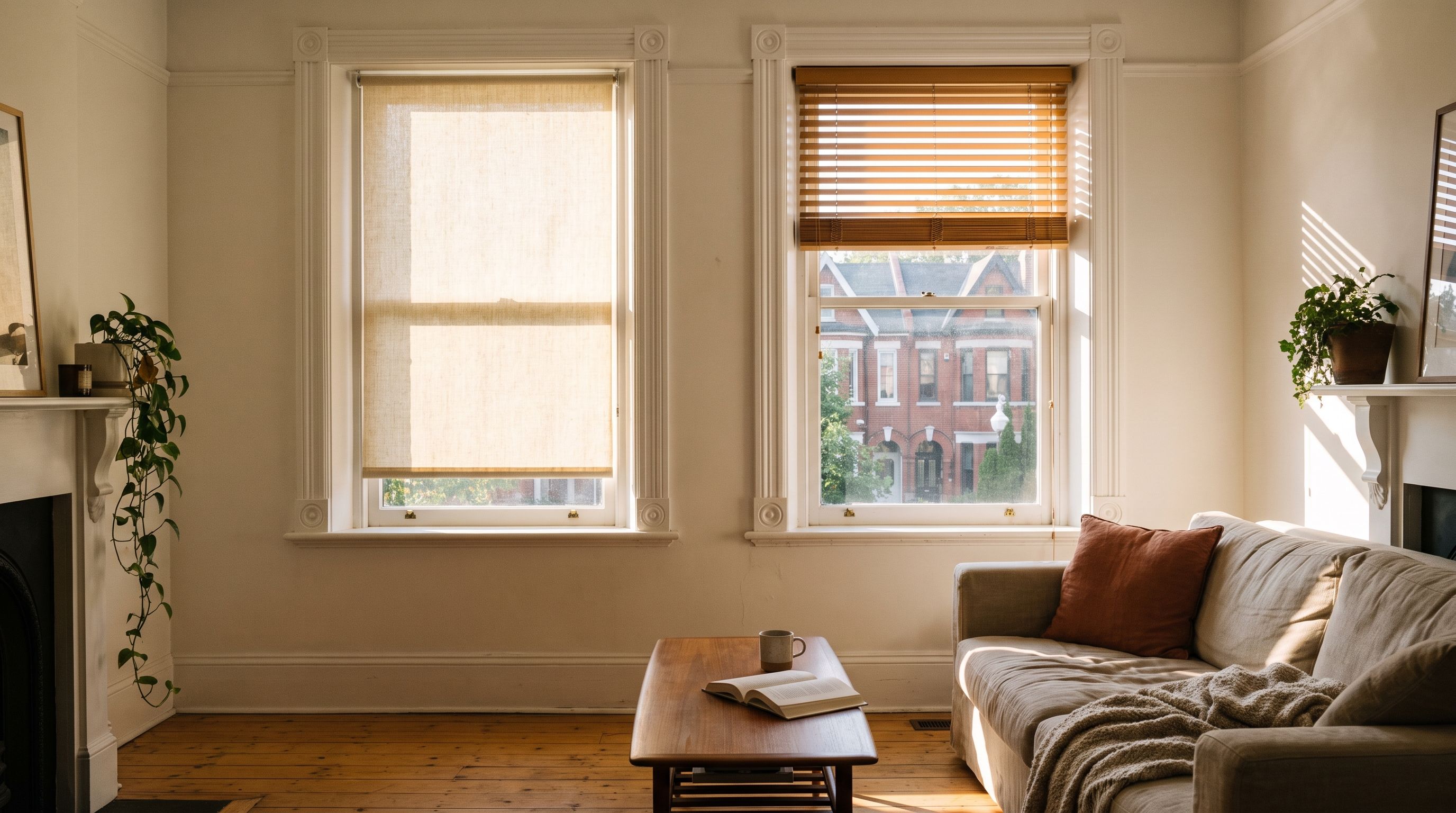
Solid-brick construction gives older Toronto rooms something newer ones rarely have: window openings deep enough for a blind to disappear into. An inside mount in a deep reveal hides its own hardware, sits close to the glass where it can actually govern the light, and leaves the casing and the sightlines of the room exactly as the house intended them.
For bedrooms, this is the detail that matters most. Light does not only come through a fabric’s face — it slips past its edges, and the deeper the blind sits within the opening, the less edge there is to slip past. An east-facing bedroom in Riverdale with a blackout roller set well back into a deep reveal holds its darkness past sunrise in a way the same blind surface-mounted simply cannot.
Woodwork worth working around
A great deal of the city’s original casing survives — painted pine in the east-end semis, stained and varnished wood in Junction and High Park houses that were built proudly and never painted over. Our rule with it is simple: the trim was there before the blind and should be perfect after the blind is gone. Fixings go up into the head of the opening or back into the reveal, where no screw hole will ever be seen, and never through the face of hundred-year-old wood.
Paint forgives a filled hole in pine. Nothing forgives one in varnished oak. So where a window offers no hidden place to fix — or where a lease says no holes at all — the no-drill route earns its place: systems that grip the frame without a screw, honest about their limits, and completely reversible on the day you leave.
Eight neighbourhoods, read by their windows
Leslieville, Riverdale and the streets off the Danforth run to tall, narrow openings and generous bays. The bays are measured facet by facet, each pane getting its own blind, because their angles were set by hand and it shows — in the kindest possible way.
The Junction and High Park were built heavier: thicker brick, deeper reveals, more of that unpainted woodwork. These are the houses where an inside mount is at its very best, and where we are most careful about where a screw goes.
Leaside came a little later, laid out as a planned suburb, with larger sash and sunnier principal rooms; the conversations there are as much about fabric as about fastening.
Yorkville is two cities on one block — Victorian rows holding their ground beneath new towers — and a single street can hand us a heritage sash in the morning and a sealed unit forty floors up after lunch.
Liberty Village is the newest chapter and the least typical: factory conversions with huge industrial windows that want their scale respected, and condo glass that runs wall to wall with no reveal at all, where the blind hangs from the ceiling because there is nowhere else for it to live.
Light on a narrow lot
Toronto’s older neighbourhoods sit on narrow lots, and the lot shapes the light more than the compass does. A side window facing the neighbour’s brick a couple of metres away will never see direct sun; its whole job is borrowed brightness and privacy, and a sheer or a light-filtering cellular serves it better than anything heavy. The front and back rooms take the real hours — morning into one, evening into the other — and they are where the adjustable answers earn their keep.
The street trees complicate this beautifully. On the canopied blocks of High Park or Leaside, summer light arrives pre-filtered through leaves, and the rooms behind rarely struggle in July; then winter strips the branches at exactly the moment the sun drops low enough to reach deep into the house. The room’s difficult hour moves with the calendar, which argues for blinds that adjust — a venetian’s tilt, a zebra’s slide — over any single fixed filter chosen for one season and endured through the other.
When a curtain is the better answer
We make curtains and drapery as well as blinds, which keeps the advice honest: if a room wants fabric, we say fabric. Tall principal rooms in the city’s older houses often do — a long drop reads softer in drapery than in any flat blind — and the draughty original window, the one the storm glass never quite sealed, gains more from a generously lined curtain than from anything mounted inside the opening, because the fabric does the sealing the sash gave up on. Often the right specification is the pair — blind inside the opening, drapery framing it — and a single visit measures for both.
Hour by hour
The same window, four times over
7am
East-facing semis along the Danforth and in Riverdale take the morning straight down the hall. In houses this narrow the front window lights the whole floor, so the fix is usually a screen fabric rather than anything opaque — you want the light, just not the beam.
Noon
Liberty Village and the newer glass downtown have the opposite problem: wall-sized windows with no overhang and a lot of midday heat. Nothing about a century-home solution transfers, which is why we specify by opening and not by neighbourhood.
6pm
West light off Lake Ontario comes in low and hard through High Park and the Junction. Deep original reveals help, and they are also why an off-the-shelf width leaves a finger of glare down one side.
After dark
Street lighting is the part people forget until the blinds are up. On a lit Toronto street a blackout lining earns its money at 11pm rather than at noon, and the leak to watch for is at the edges.
Room studies
Three ways to answer the light
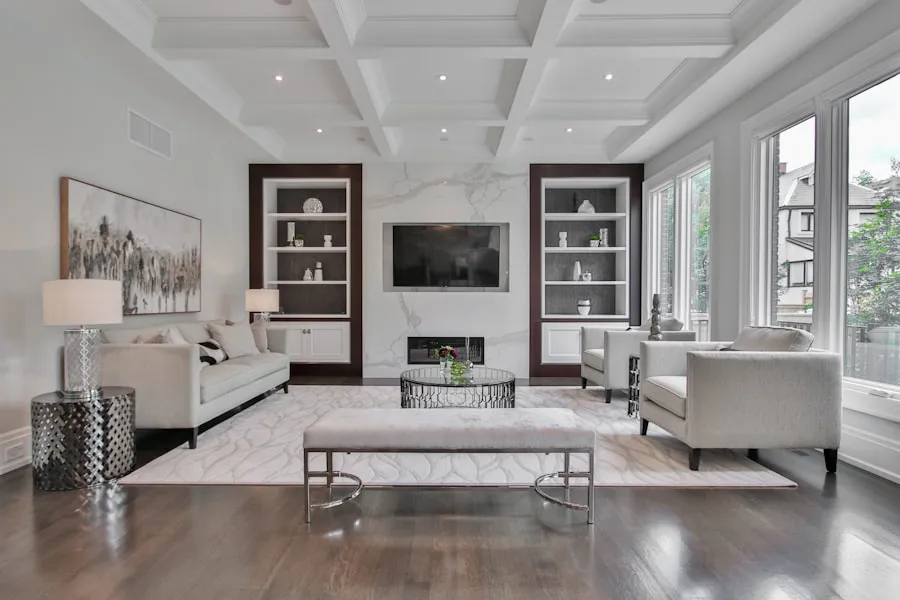
Editorial room studies illustrating the brief — not photographs of client installations.
Inside the city
We measure across Toronto, not from a showroom in it.
- Leslieville
- Riverdale
- The Junction
- Leaside
- Yorkville
- High Park
- Danforth
- Liberty Village
Those are the parts of Toronto we are asked for most often — not the edge of where we go. If your street is not on the list, it is still on the route.
The rest of the range
Everything else we fit in Toronto
Winds onto a tube
Tilts to aim the light
Folds up out of the way
Slides across the opening
And the fitting itself
Our commitment
We measure it. If it does not fit, we remake it.
The visit is free. See the samples at your own window, get the quote, then decide.
Before you call
Questions worth answering before you book.
Do you cover the whole of Toronto?
Yes — the east end from Leslieville and Riverdale along the Danforth, the west from The Junction through High Park, Leaside and Yorkville in the middle, Liberty Village and the downtown towers, and every street between them. One crew handles your job from the first measurement to the finished installation, and the phones are answered 8am–9pm, seven days a week.
What is actually different about Toronto windows?
Age, mostly. A large share of the city's houses have been standing for a century, and in that time the openings have moved — brick settles, sills get replaced, plaster gets patched over older repairs. Two corners of the same window can honestly disagree about its width. None of that troubles a blind that was measured against the real shape; all of it troubles one ordered to a nominal size off a form.
Can you install blinds without drilling into old trim?
Yes, and in a house with original casing we treat that as the first question rather than an afterthought. Most installs can fix up into the head of the opening or back into the reveal, where the screw holes are invisible and the woodwork is never touched. Where there is no discreet place to fix at all, no-drill systems mount without a single screw — and we will say honestly which windows carry them well and which still want the real bracket.
Do you work in condos — Liberty Village, Yorkville, downtown?
All the time. Concrete ceilings and bulkheads are routine to fix into. The thing worth checking before you fall for a fabric is your building's rules: many boards regulate what a window covering may look like from outside, usually the colour of its backing, and that constraint is far easier to design around at the start than to discover after the order is placed.
My frames are visibly out of square. Will a blind ever sit right?
This is the most Toronto question there is, and the answer is yes. An inside mount is cut to clear the narrowest point of the opening so it never rubs; where the gap that leaves would be too visible, an outside mount covers the whole opening and takes the crookedness out of view entirely. Which of the two your window wants is exactly the kind of call that is obvious standing in the room and impossible on paper.
We have a bay window. How is that measured?
As three or five windows that happen to share a view, not as one. Each facet gets its own measurement and its own blind, because the angles between them were framed by hand a long time ago and no two bays agree. Done that way, the blinds meet neatly at the mullions and each sash can still be set to its own light.
Which blinds do you recommend for an east-facing bedroom here?
Blackout, mounted deep. The deep reveals in older Toronto houses are an advantage most cities do not have — the blind can sit far enough inside the opening that daybreak has almost no edge to leak around. In June the sun is up before six, and a blackout roller or blackout cellular shade in a properly recessed fit is the difference between choosing your waking hour and having it chosen for you.
The last chapter
We bring the samples to your windows.
We come to you, measure at your own windows, and go through fabrics and fits together. The visit costs nothing.
$99 off when you order three or more blindsApplied to your written quote at the measure.
Rather just talk?(437) 782-5452Answered 8am–9pm, 7 days
Free in-home measure
An opening the house has quietly bent, or original casing you would rather no one ever drilled?
Answered 8am–9pm, 7 days.
Page last checked 16 August 2026.