The range
Zebra blinds
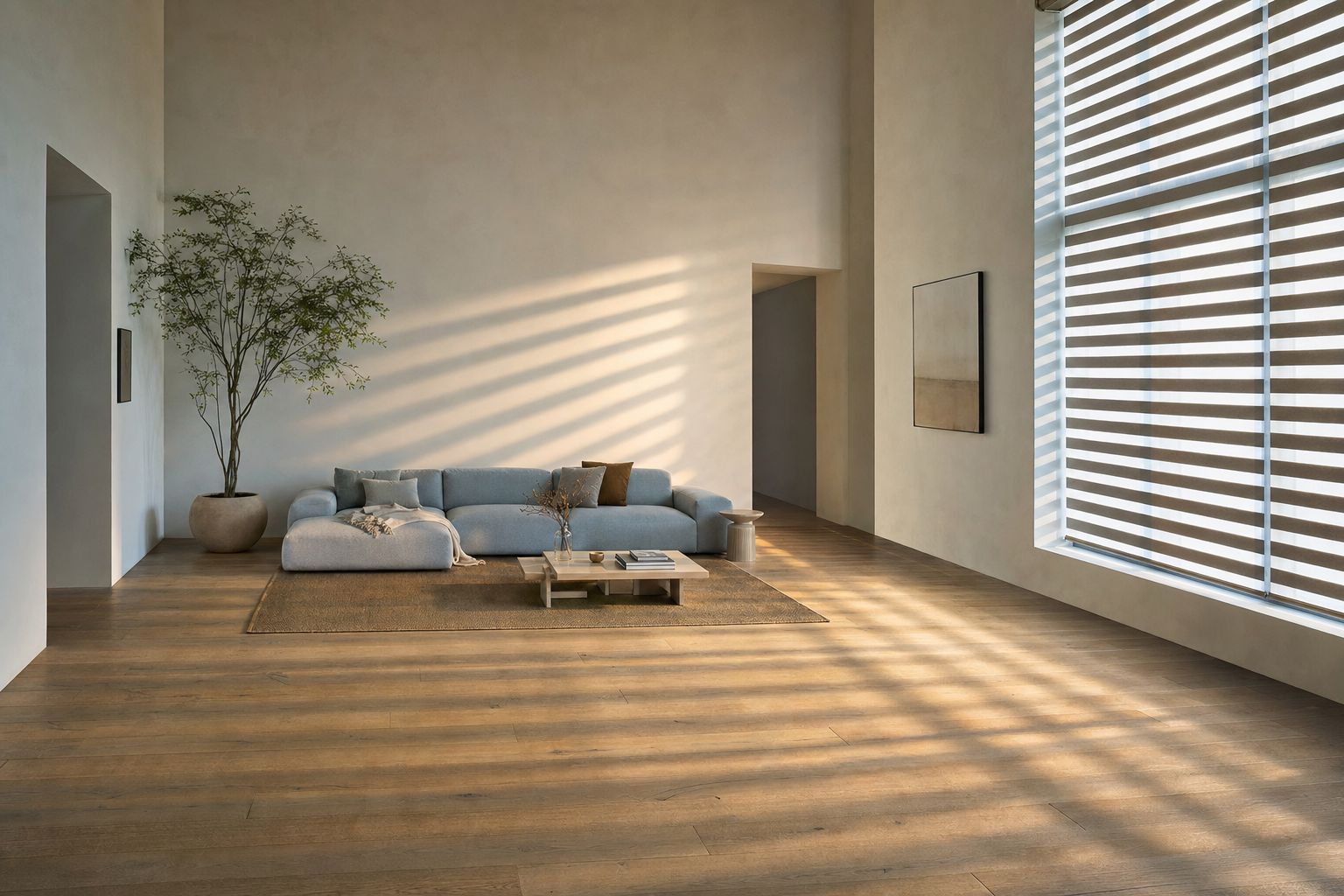
A zebra blind puts two fabrics on one roller — a sheer band and a solid one, stacked and sliding past each other — so a single blind covers the whole distance between a fully open window and a fully closed one, and every position between those two is a real, usable option rather than a compromise.
Blinds Company · Rated 4.8 out of 5 on Google
Free in-home measure · open 8am–9pm, 7 days
- Two fabrics, one roller
- Sheer and solid bands stitched in parallel onto the same tube, moved together by one chain or motor.
- The middle positions are real
- Sliding the bands past each other gives a full range of usable settings instead of a plain roller's two.
- The sheer weave decides it
- A tighter weave holds more privacy at every position; a more open one keeps more daylight.
- Private, but not blackout
- Closed, it blocks light like a solid roller in the same cloth — a room that must be dark wants a blackout roller instead.
In short
A zebra blind is two alternating bands of fabric, sheer and solid, wound onto one roller. Sliding them past each other tunes the room continuously between full daylight and full privacy, instead of the two positions a plain roller gives you — which is why it is the one blind most people, once they own it, say they would have put in every room.
Inside this pageJump to one of 5 topics
The problem it actually solves
Most blinds force a choice: open, and the room is exposed; closed, and the room is dim. A zebra blind exists because that choice is usually wrong at some point in the day. Two in the afternoon wants less glare but not darkness. Nine in the morning, on a front-facing window, wants the daylight in but the street kept out. A plain roller cannot hold either of those positions — it has exactly two states, and both of them are compromises for most of the day a room is actually used.
The mechanism is genuinely simple once it is explained. Two fabric bands — one sheer, one solid — are wound onto the same roller, stitched in parallel strips rather than as two separate blinds. Sliding the whole assembly a few centimetres changes how much of the sheer band sits directly behind a gap in the solid one.
Fully aligned, you get something close to full privacy. Fully offset, you get something close to a sheer curtain. Everything between those two is a real, distinct setting, not an approximation.
Where the fabric choice actually matters
The sheer band’s weave decides almost everything about how the blind behaves day to day, and it is the one thing worth spending real time on at the measure rather than deciding from a photo. A tight weave holds more privacy at every position, including the halfway points, at the cost of slightly less daylight when fully open. A more open weave does the reverse. Neither is “better” — a north-facing home office and a west-facing front room want different answers, and the right one is genuinely obvious once the sample is held against your own glass in your own light, which is most of why the in-home visit exists at all.
The solid band’s opacity is the second decision, and it runs from a light diffuse fabric through to something close to blackout-adjacent — though a true blackout is still its own product, covered on the blackout blinds page, because the sheer/solid contrast a zebra blind is built around is a different job from a total light seal.
Judge the bands in three positions
A swatch shows colour; a working sample shows whether the product makes sense. The useful test has three stops. First align the sheer bands as widely as the blind allows and look through from the chair or desk that matters. The question is not whether daylight enters — it will — but whether the outside scene stays legible enough to be worth preserving. Then move the bands halfway. This is the position a zebra earns its space with: the hard beam should soften while the room still feels connected to the window.
Finally close solid over solid and check the real privacy line. Stand where a person outside would be, when that is practical, or change your viewing angle across the room. A fabric can look convincingly closed from straight on and still reveal more at an angle than the owner expects. The test is particularly important on ground-floor glass and windows facing another building.
Two adjacent blinds add a fourth decision. Their horizontal bands should read as one set from the normal doorway or sofa, even when the windows are not identical heights. That means choosing the shared visual line before ordering, not trying to correct it by nudging one blind after installation. The headrails also need enough depth to sit consistently; a shallow section of trim on one window can force a different mount and break the line unless it is noticed at the measure.
Only after those positions work is colour worth choosing. A zebra that looks perfect in one catalogue photograph but fails the half-open or night-privacy test is the wrong mechanism in the right fabric. Repeat the movement from the place the control will live, too: a useful intermediate setting should be easy to find again without stepping around furniture or guessing from across the room.
Motorized or manual, the same mechanism
Because the two bands move as one assembly, motorizing a zebra blind adds nothing mechanically odd — the motor drives the roller exactly as it would on a plain roller, and the slide-past-each-other behaviour comes along for free. That makes it one of the more common blinds to motorize in practice: a setting that is worth adjusting several times a day is a setting people actually adjust when it is a tap on a phone rather than a walk to the window, which is a large part of why it pairs so often with the motorized blinds service.
What it will not do
It is not a blackout, and treating it as one is the most common disappointment we hear about from anyone who bought a zebra blind on looks alone for a bedroom. It is also not the cheapest way to darken a room — if all a window needs is “dark,” a plain blackout roller does that job for less. What a zebra blind earns its keep on is the room that needs to change its mind through the day, which a single-position blind structurally cannot do.
The mechanism
Zebra blinds, part by part
Sheer and solid bands on one roller, one control
Every position between open and closed is usable, not just the two ends
Cordless and motorized versions, same fabric choice
Reads as a flat plane of fabric, not slats
Hour by hour
The same window, four times over
7am
A front-facing window at breakfast wants two contradictory things — the daylight in and the street kept out — and a plain roller can only offer one of them at a time. Offsetting the bands a few centimetres puts sheer behind the gaps: the room fills with light and the sidewalk gets texture instead of a view of the kitchen.
Noon
Midday is when a single-setting blind stops being right. The glare climbs, the room is at its brightest, and the position worth having is neither end of the range — bands part-aligned, most of the brightness kept, the hard edge taken off it. On this product that middle is a real, distinct setting rather than an approximation of one.
6pm
The glare has gone and the room is still bright, which is the hour a blind set for the worst part of the day gets in the way. Sliding the bands back open takes about five seconds and becomes a habit, where a plain roller's one acceptable position never quite suits two different hours at once.
After dark
Aligned edge to edge, the solid bands block light exactly as a solid roller in the same cloth would — the sheer sits directly behind the solid at that position, not beside it. That is privacy rather than blackout: the fabric range here is built around the sheer/solid contrast, and a room that must be dark wants a dedicated blackout roller.
Where it belongs
Rooms zebra blinds answer well
Living rooms and home offices, where the light changes all day and one setting never lasts
Front-facing windows that want privacy without losing the room to gloom
Anyone tired of choosing between "too bright" and "too dark" on a plain roller
In the room
How the choice changes the room
The rest of the range
Everything else, by how it moves
Tilts to aim the light
Folds up out of the way
Slides across the opening
And the fitting itself
Written for this product
Zebra blinds in the GTA
Our commitment
We measure it. If it does not fit, we remake it.
The visit is free. See the samples at your own window, get the quote, then decide.
Before you call
Questions worth answering before you book.
What is the actual difference between a zebra blind and a normal roller?
A normal roller has fabric on one roller and two real positions — down, or up. A zebra blind has two fabrics, a sheer band and a solid one, layered on the same roller and moved together by the same chain or motor. Sliding them relative to each other changes how much of the sheer lines up with the solid, so the blind has a full range of positions rather than an on/off switch. The mechanism is the whole difference — the fabric itself can be as plain or as textured as any roller fabric.
Does it actually go fully opaque, or does light always leak through?
When the solid bands are aligned edge to edge it blocks light the same way a solid roller in that fabric would — the sheer sits directly behind the solid at that position, not beside it. What it will not do is blackout: the fabric choice for a zebra blind is built around the sheer/solid contrast, and a genuine blackout wants a dedicated blackout roller instead. For a bedroom that wants both effects, the two products are sometimes fitted together rather than one asked to do both jobs.
How much daylight does it actually let through at the halfway point?
This is the setting most people buy it for, and it depends on how open the sheer band's weave is — a tighter weave keeps more privacy at every position, a more open one keeps more daylight. It is exactly the kind of difference that reads correctly in a fabric sample against your own window and reads as a guess on a screen, which is why the visit brings the actual swatches rather than a photograph of them.
Can two people looking at the same window disagree about the right setting?
Constantly, which is the actual argument for the product. A plain roller forces one household to agree on one of two states; a zebra blind's whole range means "a bit more open than this morning" is a real adjustment rather than a debate about whether to compromise. It is motorized just as easily as a plain roller, so the adjustment can be a remote or a phone rather than a walk across the room.
Does the fabric wear out faster because there are two layers moving?
The two bands move together, not against each other — they are stitched to run in parallel down the same drop, so there is no friction between them to wear anything down. What actually ages any roller fabric is UV and handling at the pull point, and a zebra blind sees exactly the normal amount of both. Ten years is a reasonable expectation for the mechanism with ordinary use.
Is it a good fit for a room that gets direct sun for part of the day?
Yes, and it is one of the places it earns its keep over a plain roller. A room that is glary at two in the afternoon and fine by five wants a setting that changes through the day, not a single blind position chosen for the worst hour and lived with the rest of the time. Sliding the bands a few centimetres at 2pm and back again at 5pm is a five-second habit once the blind is there, where finding a single "acceptable" position on a plain roller never quite works for both hours.
The last chapter
We bring the samples to your windows.
We come to you, measure at your own windows, and go through fabrics and fits together. The visit costs nothing.
$99 off when you order three or more blindsApplied to your written quote at the measure.
Rather just talk?(437) 782-5452Answered 8am–9pm, 7 days
Free in-home measure
Still deciding between a zebra and a plain roller for that window?
Answered 8am–9pm, 7 days.
Page last checked 6 September 2026.