The range
Living room blinds
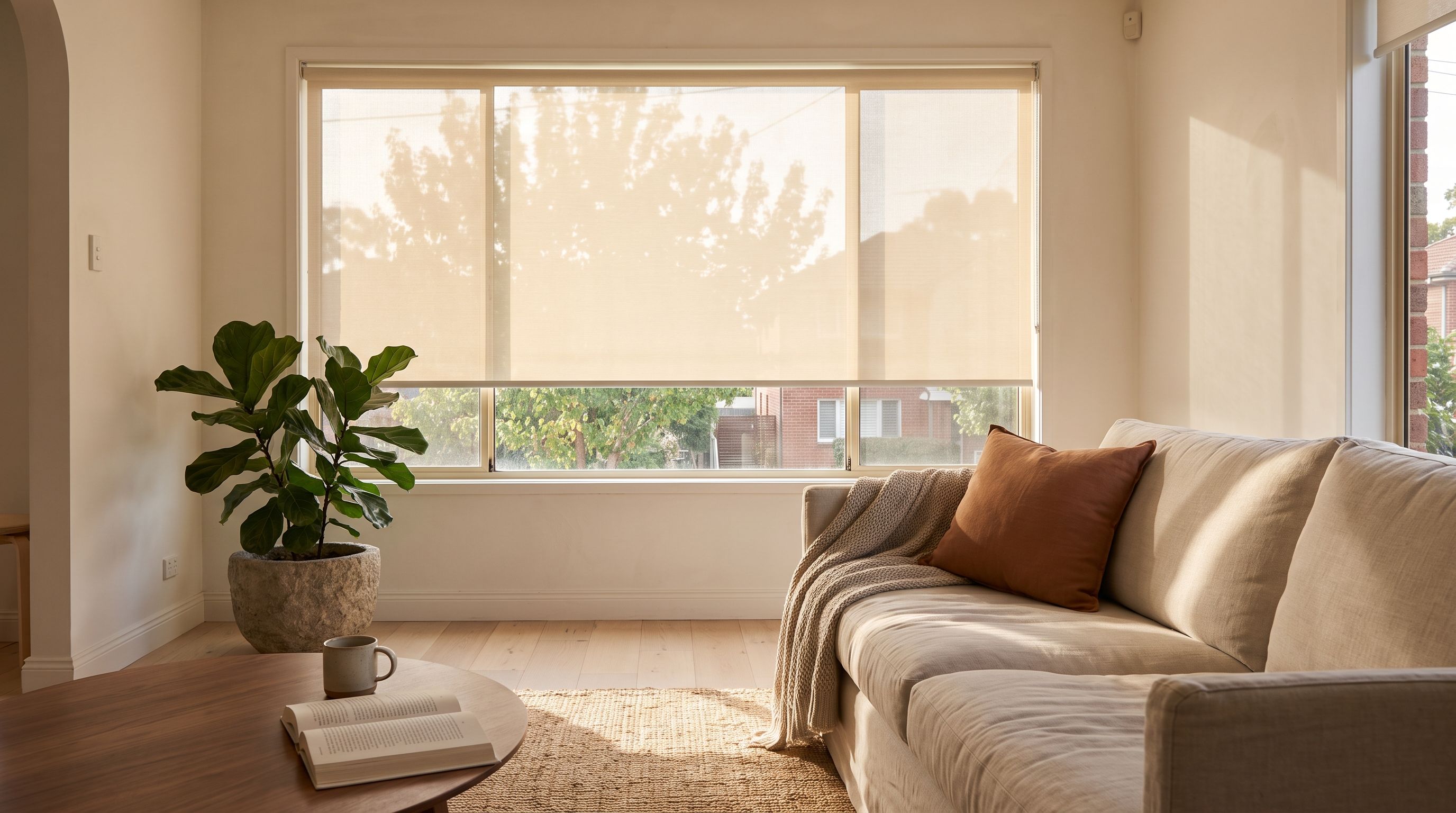
A bedroom has one bad hour. A living room collects the whole set — glare at two, low sun at seven, an audience at ten — because it is the one room on duty at every hour the house is awake. That is why a single blind, chosen for a single moment, so often disappoints here.
Blinds Company · Rated 4.8 out of 5 on Google
Free in-home measure · open 8am–9pm, 7 days
- Specified per window
- A south wall and a west wall live different days, so they rarely want the same fabric.
- One colour, one mounting line
- Mixed products read as a single decision when the tops run level and the tones agree.
- Screen fabric, not blackout
- Glare is a beam problem, and scattering the beam keeps the daylight the room was arranged around.
- Scenes instead of chores
- Motorized, the sunny wall can drop on one press rather than a walk along the window line.
In short
A living room usually needs its windows treated by hour and by direction: a solar screen where the afternoon glare lands, something you can tilt or stop at a height against low evening sun, and an opaque layer for privacy after dark. On multiple windows we mix products deliberately and keep one colour and one mounting line, so the room reads as one decision. Measured and installed across Toronto and the GTA; the visit is free.
Inside this pageJump to one of 7 topics
One room, four problems, four hours
Follow a living room through one bright Saturday.
Nine in the morning, the light is the reason the room exists — nobody wants it filtered. By two, the sun has come around; there is a hot stripe across the sofa and the television has turned into a mirror. At seven the sun is low enough to come in flat, under everything, level with seated eyes. By ten it is dark outside, the lamps are on, and the biggest window in the house is showing the street a documentary about your evening.
Four hours, four different demands, one set of windows. This is the one room where “what is the best blind” has to be answered with another question — at which hour? Specify for only one of them and the other three keep their complaints, which is how living rooms end up with a blind stuck at an apologetic half height, elected by nobody.
Two o’clock: take the glare out of the light
The afternoon problem is not brightness, it is beam. Direct sun carries an image — of itself, of the window — and any glossy surface in its path will happily display it. The fix is not less light but less beam: a solar screen fabric scatters the direct ray into diffuse daylight, and a reflection cannot survive being scattered.
Screen fabrics are graded by openness — how much of the weave is hole — and the grade is the whole decision. More open keeps the view sharp and the room bright; tighter kills more of the glare and more of the summer heat with it. The right grade depends on which way the glass faces and how hard the afternoon hits it, which is why the sample deck comes to your window at the hour it misbehaves instead of being judged from a swatch at noon.
Seven o’clock: the sideways hour
Evening sun is a different animal. It arrives nearly level, under the top half of any partly lowered blind, straight into the eyes of anyone sitting down — the hour picker on this site calls it the hour the room stops being usable, and most west-facing households can name it to the minute.
Level light wants an answer that works by angle or by height, not by opacity. Venetian slats tilt a few degrees and send the beam up at the ceiling, where it becomes free light instead of a nuisance. A roman or a roller stopped at exactly the right height shades the seats and leaves the top of the window open to the sky. Both beat the blunt answer — closing everything — because the blunt answer spends your whole view to fix one angle.
Ten o’clock: the room turns inward
After dark every window reverses. All day the glass belonged to the room; now the light is inside, the dark is outside, and the window works for whoever is passing. A living room takes this harder than most because it is glazed like a showroom and, by evening, lit like one.
The night layer just has to be opaque and easy — easy mattering more than people expect, because a privacy layer that takes effort stops being used by February. A zebra blind slides shut in one motion. A roller drops in one. Roman shades close the window and warm the whole room’s look while they are at it, which is why they keep being chosen for rooms that entertain in the evening. Whatever the product, this is the hour that argues for one motion — or one button — rather than a circuit of the room every night.
Windows that keep different hours
The deeper reason one product rarely fits this room: its windows do not live the same day. A south window works hard from late morning through mid-afternoon. A west window idles until four and then floods. A street-facing window has an audience at all hours; a garden-facing one has none.
So we specify per window, and unify the set where the eye actually looks: one colour family across the room, tops on one line, fabrics matched in tone even where they differ in weave. From the middle of the room that reads as one decision. What we avoid is the tidy-sounding mistake — the same blind everywhere — which guarantees at least one window wearing the wrong answer all year.
One colour does not require one fabric
An open-plan room can keep a consistent face while its windows do different work. A tighter screen on the west wall and a lighter weave on the north wall can share the same room-side colour; a solid night layer can repeat the tone without repeating the construction. The eye reads the aligned headrails, bottom bars and colour before it reads weave density.
That distinction protects the design from the sun. Forcing one identical cloth onto every orientation makes consistency visible on the sample board and inconvenience visible every afternoon. Matching what the room sees while changing what the glass needs is the quieter result.
The measure, booked for the worst hour
A living room is the room we most like to see misbehaving. If the complaint is the two o’clock mirror or the seven o’clock beam, book the visit at that hour and let the room make its own case — a problem you can point at gets a better answer than one you describe from memory.
At the visit we track where the seats face, where the screen hangs, which walls hold glass and which way each pane looks. Samples go against the window at the hour that matters. The quote reads window by window — product, fabric, openness, and the one mounting line that ties the set together — with nothing owed and nothing decided until you have sat with it.
The mechanism
Living room blinds, part by part
Specified hour by hour, not window by window
Screen fabrics that cut glare without going dark
Mixed products unified by colour and line
Motorized scenes where the room runs on a schedule
Hour by hour
The same window, four times over
7am
Only the east glass is working, and it is working hard — low sun straight across the room while the west wall is still asleep. Nothing here needs covering yet except the one seat that catches the beam, which is the first argument for treating the windows separately instead of dropping the whole room a notch.
Noon
The south glass takes over and the complaint changes from beam to heat: a hot stripe across the sofa and a television that has turned into a mirror. A screen fabric scatters the direct ray into flat daylight rather than removing it, so the room keeps the brightness it was arranged around.
6pm
Now the west wall floods, and the light arrives nearly level — under the top half of anything half-lowered, straight into seated eyes. Angle and height beat opacity at this hour: slats tilted a few degrees throw the beam at the ceiling, and a shade stopped at the right height shades the seats without spending the sky.
After dark
Every window in the room reverses at once. The glass belonged to the room all day; now it belongs to the street, and this room is glazed like a showroom and lit like one. It is the hour that argues for one motion or one button, because a privacy layer that means a circuit of the room every night stops being used by February.
Where it belongs
Rooms living room blinds answer well
Solar screen rollers, for the two o'clock glare on the television
Zebra blinds, for a front window that faces the street all day
Wood venetians, for evening sun that arrives too low to block politely
Roman shades, for the hour the room turns inward
In the room
How the choice changes the room
The rest of the range
Everything else, by how it moves
Winds onto a tube
Tilts to aim the light
Folds up out of the way
Slides across the opening
And the fitting itself
Our commitment
We measure it. If it does not fit, we remake it.
The visit is free. See the samples at your own window, get the quote, then decide.
Before you call
Questions worth answering before you book.
What is the best blind for a living room?
The room rarely has one answer, because it rarely has one problem. The window the afternoon sun crosses wants a screen fabric that takes the glare out of the light without removing the light. The window the evening comes through wants slats to tilt or a shade that stops at a chosen height. The window the street sees wants a layer that closes after dark. Sometimes one window holds all three jobs and the answer is layered; more often the jobs are spread across the windows, and so is the answer.
Can I mix different blinds in one room without it looking wrong?
Yes, and in a room with glass on more than one wall it is usually the correct call, because those windows are living different days. What makes a mixed room look intended rather than accidental is discipline in the things the eye actually notices — one colour across every window, and the tops running at one height. Mechanisms read from up close; colour and line read from the sofa. Get those two right and nobody counts the product types.
How do I stop afternoon sun washing out the TV?
With a fabric that filters rather than blocks. A solar screen is woven to an openness — the tightness of its weave — and at the right openness it turns a beam that mirrors on the screen into flat, usable daylight. The room stays bright, the view stays readable through the weave, and the reflection loses its shape. Going darker than that solves the screen and costs the room; going blackout turns a two-hour problem into an all-day gloom.
Are zebra blinds a good fit for a living room?
For the front-facing window they are close to purpose-built. A living room that faces the street spends the day negotiating between daylight and passers-by, and a zebra's sliding bands let you renegotiate in seconds as the hour changes. They are less of an answer for a screen-glare wall — a solar roller holds that job better — which is exactly the division of labour this room tends to end up with.
Should a living room have curtains or blinds?
Decided by which complaint you can actually name. Glare, heat, a neighbour's sightline — those are blind problems, solved at the glass. A room that feels bare, echoing or unfinished once the lamps are on is a curtain problem, solved at the wall. Most living rooms that feel genuinely done run both layers, each doing its own work, and since we make both, neither gets recommended by default.
Can the whole room run from one control?
Yes — motorization is at its most useful in the room with the most windows. Each blind can hold its own position and the set can move together: a morning scene that opens everything, an afternoon scene that drops the screens on the sunny wall only, an evening scene that closes the room down. One remote, a wall switch or a spoken sentence, and the hours stop being chores.
The last chapter
We bring the samples to your windows.
We come to you, measure at your own windows, and go through fabrics and fits together. The visit costs nothing.
$99 off when you order three or more blindsApplied to your written quote at the measure.
Rather just talk?(437) 782-5452Answered 8am–9pm, 7 days
Free in-home measure
Two windows, two directions, and no idea whether they should match?
Answered 8am–9pm, 7 days.
Page last checked 6 September 2026.