The range
Curtains & drapery
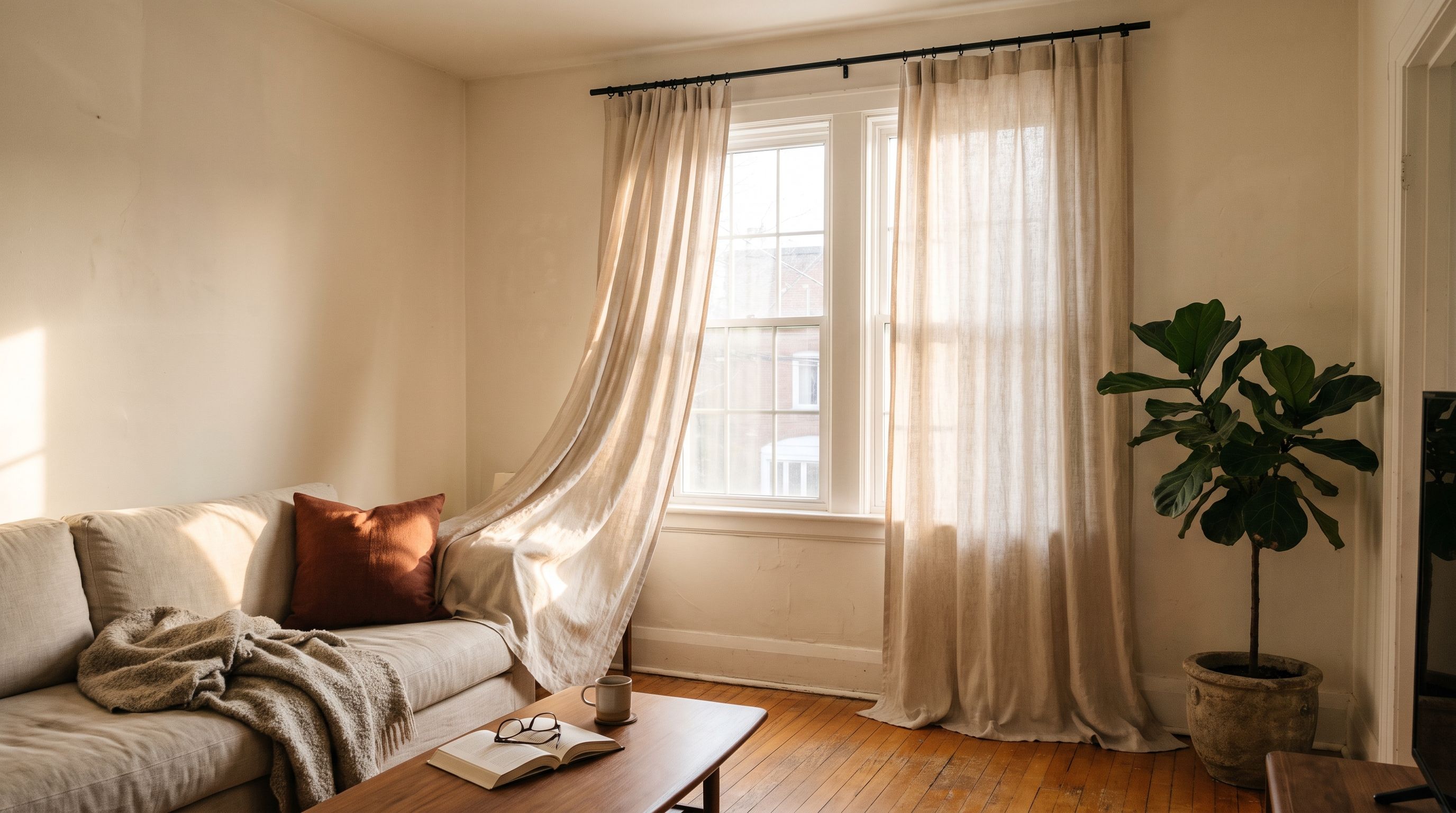
Everything else we make is a mechanism — a sprung tube, a ladder of slats, a folding cell. A curtain is cloth and a rail, and that is precisely why it does the three things no blind can: hold the cold off the glass, soften a hard room, and make a window look dressed instead of fitted.
Blinds Company · Rated 4.8 out of 5 on Google
Free in-home measure · open 8am–9pm, 7 days
- Sewn to your track, not the glass
- The track is set wider and higher than the opening, so the open curtain stands on wall instead of covering window.
- Roughly twice the track in cloth
- Fullness is what turns fabric into folds, and it is the first thing a ready-made panel economises on.
- Lined, blackout-lined or interlined
- The layer nobody sees decides the warmth, the darkness and how fast the face fabric fades.
- Hung and dressed by us
- The crew that measured comes back to fix the track and set the folds by hand.
In short
Curtains are panels of cloth drawn sideways on a track or a pole, sewn to the window rather than sized near it. Because the cloth closes past both edges of the opening and reaches the floor, a lined curtain blocks the cold-air circulation a bracket-hung blind cannot, and its folds soften a room's look and its sound. On most windows it is not a rival to a blind but the other shift: the blind runs the daylight hours, the curtain takes over at dusk.
Inside this pageJump to one of 6 topics
The hours cloth keeps
The blinds on this site are introduced by the hour they fix — six in the morning for blackout, two in the afternoon for solar screens. A curtain’s shift begins when those hours end. It is drawn at dusk and opened at breakfast, and everything it is best at happens in between: the black rectangle a bare window becomes once the lamps are on, the cold sliding off the glass at midnight, the last of a room’s warmth drifting toward a February pane.
A blind is adjusted all day. A curtain is closed once, and then it simply works until morning. That division is why nothing on this page competes with a blind — cloth is the other half of the day.
Cloth and a rail, not a mechanism
Everything else in our range is a machine at heart. A curtain is the exception: fabric cut and sewn to your window, moving sideways on a track or a pole, with nothing to jam and nothing to wear. The engineering has moved into the sewing.
And softness is not only a look. A room floored in wood or tile and walled in drywall and glass is a box of hard surfaces; sound reaches the window and bounces straight back in. Metres of folded cloth absorb some of that return — not soundproofing, nothing so grand, but the difference between a room that rings faintly and one that sits quiet is usually its textiles, and the window is often the last hard surface left.
The same folds are what make a window look furnished. A blind fits a window. A curtain dresses it.
Sewn to the track, not to the glass
The measuring surprise in custom drapery is that the window’s own width is nearly the least important number. A curtain is specified from the track — and the track is set deliberately wider than the opening, so the open curtain has wall to stand on instead of glass to cover, and deliberately higher, which draws the eye up and makes the window read taller than the builder left it.
Then comes the number nobody prints: fullness, the amount of cloth gathered across that width. Proper made-to-measure work runs to roughly twice the width of the track in fabric, which is what lets the cloth fall in real folds; starve the same expensive fabric of metreage and it hangs like a sheet, which is the true reason cheap curtains read as cheap. When we sew a pair, the drop is taken to your actual floor — in more than one place, because floors in this city are rarely level — the pattern is matched so it runs unbroken across the join, and the heading is chosen for the room: pinch pleat where it should look tailored, wave where it should look effortless, eyelet where it should look relaxed.
The layers you don’t see
A curtain is judged by its face fabric and made by its lining. Unlined cloth glows when the sun stands behind it and does nothing against the cold — the right answer for a sheer, and for very little else. A standard lining steadies the hang, shields the face fabric from the sun that would otherwise fade it, and turns the panel opaque at night. A blackout lining does what it says, and because the cloth closes to the wall past both edges of the window, a blackout-lined curtain often ends up darker than a blackout blind, which must leave running clearances a sewn edge does not.
Interlining — a soft blanket layer sewn between face and lining — is the luxury option with a plainly practical core: it traps still air across the whole window, which makes it the warmest thing you can hang indoors, and its weight gives the folds the depth that makes drapery photograph the way drapery photographs. Which layer a room needs is exactly what the in-home visit is for; a north bedroom, a draughty stair window and a formal front room all answer differently.
One window, two treatments
The setup we specify most often is not curtain or blind but both, keeping their separate hours at the same window. The blind — often a zebra or a blackout roller — takes the day: glare as the sun crosses, privacy while the street is awake, adjusted a dozen times without thought. The curtain is drawn once at dusk and takes the night: warmth held at the glass, the window turned back into furniture, real darkness in a bedroom if the lining was chosen for it.
The one requirement is that the two are planned together. Headrail, track and stacked cloth all compete for the same few inches of wall above and beside the glass. Decided at one measure, everything clears by design; decided in two separate purchases, the second one occasionally comes home unable to close over the first. It is a five-minute conversation standing at the window and an expensive discovery any other way.
What a curtain will not do
It will not manage the middle of the day. A curtain has two honest positions, open and drawn, and everything between is decoration — the fine hourly adjustments a room actually wants at two and again at five are blind work, which is why the pairing above exists at all.
It will not hang without proper fixings. A loaded track or pole is a lever, and it needs screws into something solid — cloth is the one member of our range with no no-drill answer, which is worth knowing before a conversation with a landlord.
And it will not leave you the whole window. Even fully open, the stacked cloth stands somewhere, and on a narrow opening in a small room that somewhere may be glass you cannot spare. When that is your window, we will say so at the measure and point you back at a blind — the free visit is where this whole page becomes specific to your rooms.
The mechanism
Curtains & drapery, part by part
Sewn to your measurements — drop, width and fullness all chosen, not nearest-stock
Pinch pleat, wave and eyelet headings, on tracks, poles or a motorised track
Lined, blackout-lined or interlined, decided by what the room lacks
Hung and dressed by the crew that measured them
Hour by hour
The same window, four times over
7am
At breakfast a curtain's job is to be out of the way. Cloth that stacks onto wall rather than onto glass is the difference between a bright room and one wearing a fabric frame all morning — which is why the track is set wider than the opening, a decision made with a tape measure months before any morning it affects.
Noon
Midday sun lands on the face fabric rather than on you, and the fabric is what it costs. A lining is partly a sun shield, taking the fading the face cloth would otherwise take alone. An unlined sheer does the opposite job well: it glows evenly and turns hard noon light into something a room can sit in.
6pm
This is the changeover, and it is a decision rather than an adjustment. A curtain has two honest positions, so the hour it is drawn matters more than anything in between — too early and you have spent the view, too late and the room has already gone flat. A blind holds the middle ground until the cloth takes over.
After dark
The curtain's own shift. Closed past both edges of the window and down to the floor, it shuts off the cold circulation that slips around a blind's running clearances, turns the black mirror back into a wall, and puts metres of folded cloth into a room that had run out of soft surfaces.
Where it belongs
Rooms curtains & drapery answer well
Rooms that turn cold after dark, where the window is the draught
Tall or formal windows a flat blind would leave looking undressed
Echoey rooms with hard floors, where the bare window is one more hard surface
In the room
How the choice changes the room
The rest of the range
Everything else, by how it moves
Winds onto a tube
Tilts to aim the light
Folds up out of the way
Slides across the opening
And the fitting itself
Written for this product
Curtains & drapery in the GTA

Our commitment
We measure it. If it does not fit, we remake it.
The visit is free. See the samples at your own window, get the quote, then decide.
Before you call
Questions worth answering before you book.
Are curtains and drapery different things?
In everyday use the words overlap, and we answer to both. "Drapery" usually means the heavier, more tailored end of the craft — lined or interlined panels, pleated headings, floor lengths — while "curtains" stretches from a kitchen sheer all the way up to exactly that. Mechanically they are the same object: cloth moving sideways along a track or a pole. What changes across the spectrum is weight, lining and formality, and those are decisions made at the measure, not different products with different phone numbers.
Can a curtain and a blind share the same window?
They can, and on many windows it is the arrangement we would argue for, because the two keep different hours. The blind manages the day — glare at two, privacy at nine, adjusted as the light moves. The curtain works the night shift: drawn once at dusk, it seals the cold off the glass, darkens the room properly if it is lined for it, and gives the window a finished face after dark. The one condition is planning both at the same visit. The blind's headrail, the curtain's track and the open curtain's stacked cloth all want the same strip of wall, and there is a layout where everything clears and a layout where the curtain can never close.
Do curtains actually make a room warmer?
A lined curtain, drawn, is the most effective thing you can put between a room and a cold pane — for a reason of geometry rather than fabric science. A blind hangs with running clearance around every edge; room air slips through those gaps, chills against the glass and falls back into the room all night. A curtain closes past the window on both sides and meets the floor, so that circulation has nowhere left to run. On the older windows this city is full of, the difference on a February evening is not subtle.
Why not just buy ready-made panels?
For some windows you should, and if that is your window you will hear it from us at the visit. Made to measure earns its keep when the standard drops either miss your floor or drown it, when the widths on the shelf leave a pair that barely meets in the middle, and above all when you care how the cloth hangs. Fullness — the sheer quantity of fabric sewn across the width — is what separates folds from a flat sheet, and it is precisely the thing ready-made panels economise on. A pattern matched across the pair, a lining chosen for the room and a hem levelled to your actual floor are the rest of the argument.
Track or pole — how do we choose?
By whether the hardware should be seen. A pole is furniture: visible, finialled, right in a room with mouldings and some period character, and the natural partner for an eyelet heading. A track is infrastructure: a slim channel at or near the ceiling that disappears behind the cloth, the only choice for a wave heading, the only one that bends around a bay, and the only one a motor can drive. A ceiling-hung track also lets the curtain run the full height of the wall, which quietly makes the whole room read taller than it is.
Do you install curtains, or only supply them?
The same crew measures, has the panels sewn to those numbers, then comes back to fix the track and hang the cloth — curtain installation is the last step of the product, not a separate trade you have to arrange. It ends with dressing: setting the folds by hand so the cloth remembers where to fall, the unglamorous ten minutes that decides whether a curtain drops into place for years or hangs vaguely forever. If you already own curtains and need them hung properly, ask — that is work we know.
Can the curtains be motorised like the blinds?
Yes. The motor lives in the track and walks the leading edge along it, and on a wide span of glass it is genuinely useful rather than a toy, because drawing a large pair by hand means visiting both ends of the room twice a day. It schedules and groups alongside motorised blinds, so "evening" can mean the blinds drop and the curtains draw in one gesture. It needs a track — a pole cannot be driven — and power at one end, both of which are easy to plan at the measure and awkward afterwards.
The last chapter
We bring the samples to your windows.
We come to you, measure at your own windows, and go through fabrics and fits together. The visit costs nothing.
$99 off when you order three or more blindsApplied to your written quote at the measure.
Rather just talk?(437) 782-5452Answered 8am–9pm, 7 days
Free in-home measure
Torn between a curtain, a blind, or both on the same window?
Answered 8am–9pm, 7 days.
Page last checked 16 August 2026.