The range
Commercial blinds
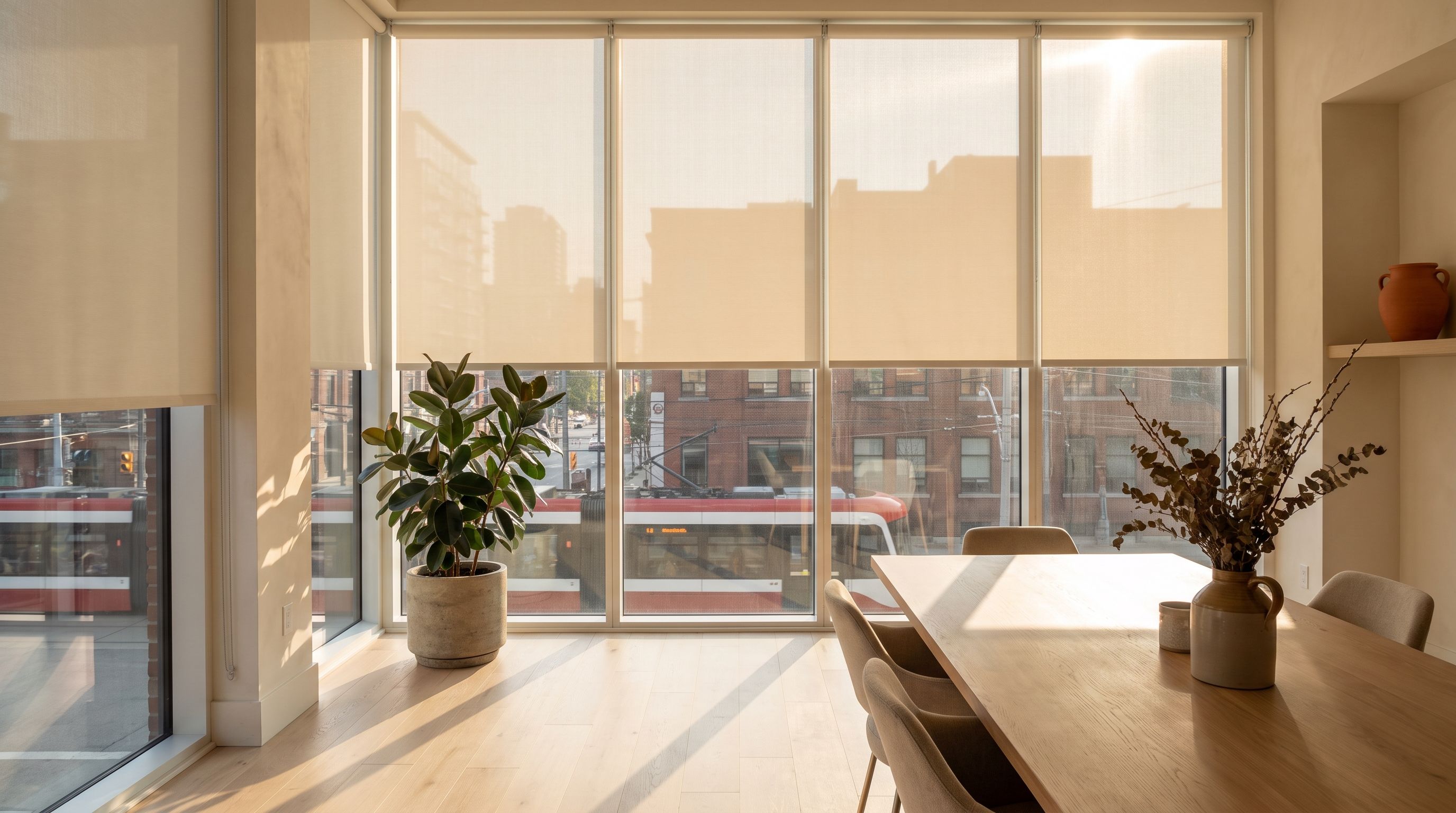
Offices, storefronts, clinics, studios — spaces where a window problem arrives on a schedule and repeats down a whole run of glass. The blind is the same trade as everywhere else on this site. Everything around it changes: the count, the matching, the hands that will operate it, and the hours anyone can be in the building at all.
Blinds Company · Rated 4.8 out of 5 on Google
Free in-home measure · open 8am–9pm, 7 days
- Every opening measured on its own
- Windows that look identical rarely measure identical, and one stock size across a wall produces exactly the unevenness the job exists to avoid.
- One specification, one run
- The whole space is ordered together so the fabric reads as a single colour from the desks and from the sidewalk.
- Built for repetition
- Mechanisms are chosen to tolerate many hands a day rather than for the lightest possible touch.
- Fitted around your hours
- Early mornings, evenings and weekends, phased an area at a time, so a live space never has to stop entirely.
In short
Commercial blind work differs from a home in three ways that decide everything. Consistency — many near-identical windows must carry blinds that read as identical, inside and from the street, which means measuring every opening individually and specifying once. Duty — a workplace blind is operated many times a day by people who did not choose it and will not baby it, so the mechanism is selected for repetition rather than delicacy. And access — the work is scheduled around the business, in phases if the space stays live. Licensed and insured, which a business hiring a contractor should hear before the quote rather than after.
Inside this pageJump to one of 5 topics
One problem, multiplied down the glass
At home, the two o’clock glare is one room’s complaint. On an office floor it lands on every monitor along the window line in the same minute, and it will do so again tomorrow, because a building’s light problems run on a timetable. The storefront meets the same low morning sun at every open; the meeting room goes unusable at the same hour of every clear afternoon; the west elevation heats up on schedule. Nothing about the sun changes when the building is commercial — what changes is that the problem repeats across dozens of openings at once, and so must the fix.
That repetition is the real subject of this page. Choosing a blind for one window is a decision; putting the right blind on forty of them, identically, without closing the business to do it, is an operation — and the operation is what a commercial client is actually hiring.
Matching is the specification
In a house, two slightly different blinds in two rooms is a shrug. In a workplace it reads as a mistake, twice over. From inside, a run of glass wants a run of identical blinds — same fabric, same line, same hardware — because an office wall is seen as a whole in a way a home never is. From outside it matters more: a storefront or a glazed elevation is the building’s face to the street, and mismatched coverings at different heights read as neglect to every person who walks past.
Getting there is less obvious than it sounds. The specification is made once — one fabric, one opacity, one mounting approach — and the order goes through as a single run so the material arrives consistent. But the openings themselves are measured one by one, because near-identical windows are a builder’s intention, not a guarantee, and a single stock size pushed across a wall of real-world openings produces exactly the unevenness the whole exercise exists to avoid. Every blind is made to its own window and indistinguishable from the rest. That combination is the craft.
Built for hands that did not choose it
The quiet difference between residential and commercial work is who touches the blind. A homeowner operates their own blind carefully, because they picked it and they paid for it. A workplace blind belongs to nobody and answers to everybody: staff, customers, patients, cleaners — many operations a day, at whatever speed the moment demands, by people with no reason to be gentle.
The specification has to respect that. Mechanisms are chosen for their tolerance of repetition and indifference rather than for the lightest possible touch, fabrics for their ability to shrug off a working environment, and the whole assembly for being operated wrongly sometimes without turning that into a service call. This is also where motorization stops being a comfort and becomes a management tool: a schedule closes the west glass at the hour it needs closing whether anyone thought of it or not, moves a whole elevation together, and reduces the number of hands on the hardware to zero. The case for it is laid out on the motorized blinds page, and it is strongest in exactly the rooms — boardrooms, high glass, public areas — where no individual person owns the window.
Around your hours, not through them
A business cannot close so its windows can be dressed, and it should not be asked to. The fitting is planned from the building’s own rhythm: before a shop opens, after an office empties, across a weekend, or in phases that move through a live space one contained area at a time while the rest keeps working. A clinic’s treatment rooms rotate out of use one by one; a floor of desks is done wing by wing; a storefront is done before the first customer.
Every phase ends with the space handed back in working order — glass covered, mess gone, nothing waiting on the floor for Monday. And because someone else’s building has rules of its own, the practical groundwork is ours to carry: we are licensed and insured, and the proof a landlord or property manager asks for before trades enter a building is available before they ask. The fitting standard itself is the same one described on the blind installation page — level, square, fixed into the real material, tested through the full travel — applied thirty times without a thirtieth of the patience lost.
What a quote needs from you
Two things start the job usefully: roughly how many openings there are, and when the space is empty — or emptiest. A walk-through or a floor plan is enough for the first conversation; the measure that follows covers every opening individually, because the matching described above is built on real numbers, not on the plan’s optimism.
What comes back is a written quote, and with it the commitment a business can actually build on: the installation date, confirmed in writing at the quote. Not an estimate that drifts — a date, on paper, that a reopening or a fit-out schedule can be planned against. The visit that starts all of this costs nothing, and it books you into nothing.
The mechanism
Commercial blinds, part by part
Every opening measured individually, including the ones that look identical
One specification, matched across the whole run — inside and from the street
Mechanisms selected for daily operation by many different hands
Fitting phased around the business, not driven through it
Hour by hour
The same window, four times over
7am
Before the doors open is when the work gets done — a shop floor, an empty office, a clinic ahead of the first appointment. It is also the hour the low east sun crosses an entire row of desks at once, which is how a commercial light problem announces itself: not one complaint, but the same complaint down the whole glass line in the same minute.
Noon
Midday belongs to the storefront rather than the office. High sun off the sidewalk and the parked cars bounces into a display, and whatever fixes it still has to leave the merchandise visible from outside — which is why a screen weave, not an opaque blind, is usually the answer at street level, with the fading taken care of at the same time.
6pm
The west elevation takes the last two hours of the day head on, at exactly the time a boardroom is booked and the desks nearest the glass stop being usable. Nobody owns that window, which is the whole difficulty — the person it bothers was not at the measure. A schedule closes the elevation whether anyone thought of it or not.
After dark
A lit floor behind bare glass is the building's face to the street all evening, and mismatched blinds at mismatched heights are never more obvious than when they are backlit. It is also the hour the fitting itself happens: a floor that has emptied, done an area at a time and handed back working before morning.
Where it belongs
Rooms commercial blinds answer well
Office floors where the afternoon sun crosses every monitor along the glass
Storefronts balancing display against glare and fading
Clinics, treatment rooms and waiting areas, where privacy is not optional
In the room
How the choice changes the room
The rest of the range
Everything else, by how it moves
Winds onto a tube
Tilts to aim the light
Folds up out of the way
Slides across the opening
And the fitting itself
Our commitment
We measure it. If it does not fit, we remake it.
The visit is free. See the samples at your own window, get the quote, then decide.
Before you call
Questions worth answering before you book.
Can you make every window on a floor match exactly?
Yes — and that is most of what commercial work actually is. The blinds are specified once and ordered as a single run so the fabric reads as one colour across the whole space, mounted to one consistent line, and aligned so a row of windows presents a row of identical blinds. The quiet complication is that windows which look identical rarely measure identical: buildings move, tolerances stack, and two openings on the same wall can differ enough to matter. So every opening is measured on its own, and every blind is made to its own numbers while looking indistinguishable from its neighbours. Uniformity is the finish; individual measurement is how it is achieved.
Do you install outside our business hours?
We schedule the work around the business rather than through it — early mornings before a shop opens, evenings after a floor empties, weekends when an office stands quiet. Drilling next to a sales call or a patient consultation serves nobody, and a fitting crew working an empty space moves faster anyway. Our phones are open 8am–9pm seven days, which makes the planning conversation easy to have around your own schedule too.
How is a commercial specification different from what you'd put in a house?
Duty, mostly. A blind at home is operated by the person who chose it, gently, out of self-interest. A blind in a workplace is operated by whoever sits nearest — many times a day, with varying patience, by people who were not at the measure and owe the mechanism nothing. So the specification leans toward hardware that tolerates repetition and indifference, fabrics that stand up to a working environment, and, where it earns its keep, motorization on a schedule — which removes the human operation entirely and closes a whole elevation at once.
Are you licensed and insured?
Yes. For a business this is more than reassurance — landlords and property managers routinely require proof of insurance before any trade works in a building, and a contractor who cannot produce it stalls your project at the property manager's desk. We state it up front so that conversation is already over when the scheduling starts.
Do you take small commercial jobs, or only full floors?
There is no minimum. A café with three windows or a two-room practice is a normal job, done normally — measured, made and fitted the same way a house would be. The commercial way of working described on this page — single specifications, phasing, out-of-hours fitting — earns its keep as the count grows, but nobody is turned away for being small, and we will not dress a small job in big-job process it does not need.
Can we keep operating while the work happens?
Usually, yes. The fitting is phased — an area at a time, a room at a time — so the space never has to stop entirely, and rooms that genuinely cannot pause during hours are sequenced for before opening, after close or the weekend. Each phase ends tidy: no live workspace should spend a night with tools in it or hand its morning staff a room that is not working.
How far ahead do we need to plan?
We will not quote a universal lead time here, because an honest number depends on the job in front of us. What we commit to instead is the part a business can actually plan around: your installation date is confirmed in writing at the quote. A season, a reopening or a fit-out can be scheduled against a date that is fixed on paper rather than floated in conversation — which is worth more than an optimistic estimate that moves.
The last chapter
We bring the samples to your windows.
We come to you, measure at your own windows, and go through fabrics and fits together. The visit costs nothing.
$99 off when you order three or more blindsApplied to your written quote at the measure.
Rather just talk?(437) 782-5452Answered 8am–9pm, 7 days
Free in-home measure
Counting windows on a floor plan and wondering how disruptive this is going to be?
Answered 8am–9pm, 7 days.
Page last checked 16 August 2026.