The range
Cellular shades
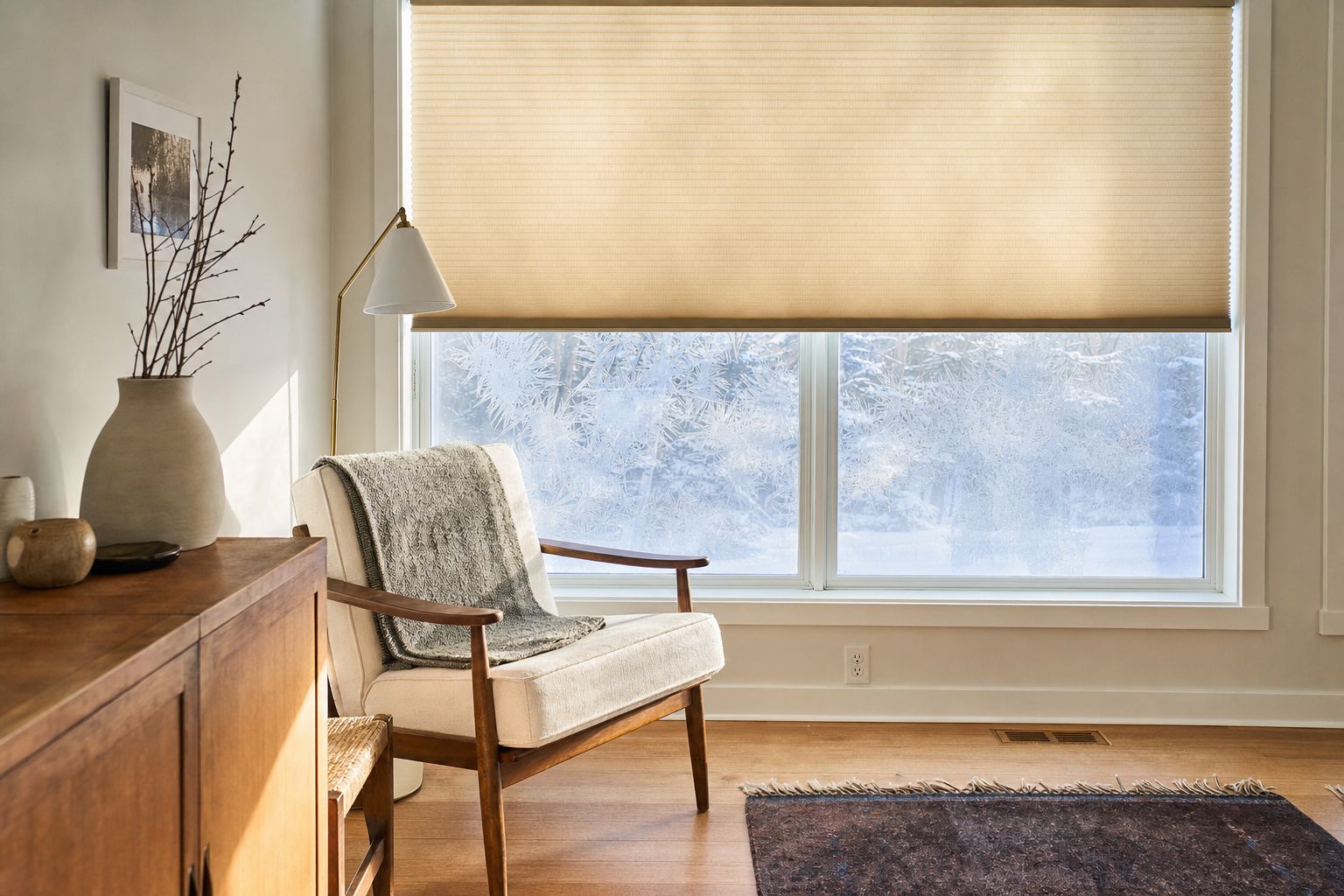
Look at a cellular shade from the side and you see the whole idea: rows of hexagonal fabric cells, bonded into a honeycomb that holds a layer of still air against the window — and that captive air, not the cloth around it, is the entire point of the product.
Blinds Company · Rated 4.8 out of 5 on Google
Free in-home measure · open 8am–9pm, 7 days
- Air is the working material
- The fabric is the container; what slows the heat is the still air sealed inside each cell.
- Single cell or double
- Two offset rows of smaller cells stack more separate air pockets into the same depth, for the coldest rooms and the largest glass.
- Packs down to almost nothing
- Raised, the cells fold into each other and the whole drop compresses to a slim stack at the head.
- Filtering through to blackout
- The same honeycomb structure carries fabrics from a soft even glow to a fully opaque bedroom cloth.
In short
A cellular shade is built from honeycomb-shaped fabric cells that trap still air in front of the glass, and since still air resists the flow of heat, the shade behaves as soft insulation for the window — the one covering in the catalogue whose first job is thermal rather than visual.
Inside this pageJump to one of 7 topics
The cross-section is the product
Most window coverings are best understood face-on. This one is best understood from the side. Two runs of fabric are bonded into a ribbon of hexagonal cells, and when the shade hangs, every cell closes around a column of air that has nowhere to go. Pull the shade up and the geometry collapses flat, cell folding into cell, until the whole drop compresses into a stack at the head slim enough to overlook.
That accordion structure explains nearly everything else about the product. It is why a honeycomb weighs so little for its size. It is why it vanishes so completely when raised. And it is why it insulates: the fabric is merely the container, and the working material is the air standing still inside it.
What a wall of still air actually does
Heat is an escape artist, and in a Toronto winter the window is its favourite exit — warm air reaches the cold glass, dumps its heat, sinks, and pulls more warm air in behind it, a slow conveyor running all night. Still air breaks the conveyor. Trapped in small closed pockets, air cannot circulate, and without circulation it becomes a genuinely poor carrier of heat — which is the working secret of most insulation ever made, from parkas to attic batts. A honeycomb shade parks a few dozen such pockets directly in the escape route.
There is a smaller, pleasant side effect: softness is quiet. A surface of fabric cells takes a little of the hardness out of a room’s acoustics and moves without any mechanical noise at all — no slats to click, no chain to rattle against glass. It is the covering you can adjust beside a sleeping person.
Single cell, double cell
The catalogue splits along one line: how many layers of cells stand between the room and the glass. One row of large cells makes the classic single — lighter, simpler, with a broad pleat that reads calm and architectural. Two offset rows of smaller cells make the double, which multiplies the count of separate air pockets and with it the insulating work done per centimetre of depth.
The choice is honestly a thermometer question. A well-sealed newer condo asking for a tidy shade with a thermal bonus can take the single and never look back. The bay window that grows a cold pool every January, the big north slider, the bedroom over the garage — those are double-cell windows, and the difference is felt from the first cold snap.
The shade for the tenth hour
Every covering in this catalogue has an hour it was born for, and the honeycomb’s arrives late: the last lap of the evening, when the day’s light business is finished and the window’s job flips from letting things in to keeping things in. Lowering a honeycomb at dusk in January does two kinds of closing at once — the room stops being on display to the street, and the glass stops drinking the room’s warmth quite so greedily. By ten o’clock the difference is the one your feet report near the window.
The morning belongs to it too, in the blackout build: cells that hold darkness the way they hold air, for the bedrooms that want June to begin at seven rather than at first light.
The fit decides whether the cells reach the edges
The honeycomb only works where it actually covers. A narrow shade may leave a clean-looking border of exposed glass, but that border is also an uninterrupted path for cold, light and sightlines. A very tight shade risks brushing uneven trim and crushing the outer cells each time it moves. The useful fit sits between those failures, based on the smallest measured width of the opening rather than the most convenient one.
Depth matters at the head as well. The folded stack and its rail must clear the glass, locks and handles without being pushed so far forward that the side gaps grow. On an outside mount, overlap replaces recess depth: the shade covers past the frame and the wall carries the hardware. That can be the stronger thermal answer on an old, irregular opening, even though an inside mount looks quieter.
At the sill, a level landing lets the bottom rail close without bowing the cells or leaving a bright wedge at one corner. That is why three widths and three drops matter here. The fabric may provide the insulation, but the measurement decides whether the insulating layer is continuous enough to feel intentional.
Where it is the wrong answer
A honeycomb surrenders the view whenever it is down, full stop — the room with a lake, a garden or a skyline on the other side of the glass should be looking at screens and zebras, which manage light while keeping the world. It is not the product for drama either: the cell fabrics are engineered textiles, orderly and reserved, and a formal room hunting for texture and presence will find more of both in a roman shade. And nobody needs its signature trick on a window that is never cold — an interior hallway pane or a well-shaded south room can take the cheapest thing that does the light job.
What it will not fix
A honeycomb slows heat moving through the glass. It does nothing for air moving around the frame — a draughty sash wants caulk and weatherstripping, not fabric, and if you can feel wind indoors, no shade is the repair. It will not substitute for failed glazing or make single panes into double. And its insulation works when it is down: a shade left raised all winter insulates a rectangle of nothing. What it does, it does honestly — it makes the coldest surface in the room less hungry, every evening it is used.
The mechanism
Cellular shades, part by part
Honeycomb cross-section that holds captive air against the glass
Single- and double-cell constructions — more layers, more trapped air
Cell fabrics from light-filtering through to full blackout
Compresses to a slim stack at the head when raised
Hour by hour
The same window, four times over
7am
The coldest hour of a winter night is the one just before this, and the honeycomb has been working through all of it. Raising it now is a real trade, because the insulation stops the moment the cells fold flat at the head — the one time of day you want the sun on the glass more than the captive air standing in front of it.
Noon
Lowered at midday a honeycomb shows you light and not the world; there is no open weave in a cell to look through. In a filtering fabric the whole surface becomes an even glow, which is a fine bargain for a bathroom or a north-facing room and a poor one for a window with a view worth keeping.
6pm
The street fills up and the sightline problem starts, which is where this product's top-down lift earns its cost: the covered band sits at head height while the daylight above it keeps arriving. A street-facing bedroom or a main-floor bathroom gets to keep its modesty and the last of the afternoon at the same time.
After dark
January, ten at night, and the glass is the coldest surface in the house. Warm air touches it, gives up its heat, sinks and draws more in behind it — a circuit that runs until morning. A lowered honeycomb stands a few dozen sealed pockets of air in that route. This is the hour it was built for, and the only one that asks you to remember it.
Where it belongs
Rooms cellular shades answer well
Rooms that run cold through a Toronto winter, especially behind big glass
Bedrooms that want dark and warm delivered by the same shade
Windows where the covering, once raised, should all but disappear
In the room
How the choice changes the room
The rest of the range
Everything else, by how it moves
Winds onto a tube
Tilts to aim the light
Folds up out of the way
Slides across the opening
And the fitting itself

Our commitment
We measure it. If it does not fit, we remake it.
The visit is free. See the samples at your own window, get the quote, then decide.
Before you call
Questions worth answering before you book.
Single cell or double cell — how do I choose?
A single-cell shade is one row of larger honeycombs; a double-cell packs two offset rows of smaller ones into a similar thickness. More cells means more separate pockets of captive air stacked between the room and the glass, which makes the double the stronger insulator — the same principle that makes two thin sweaters beat one thick one. The single answers back with a cleaner, larger pleat and a simpler look. Our rule of thumb runs on the window, not the brochure: the colder the room and the larger the glass, the harder the case for double; on a window that only wants the look and a modest thermal nudge, single is plenty.
Do cellular shades genuinely reduce heating costs?
The physics is real and worth stating plainly: heat leaves a warm room through cold glass, and a pocket of still air in the way slows that leak — trapped air is what most insulation is, whatever the material around it. A snugly fitted honeycomb, lowered through the cold hours, measurably calms the window as a heat sink. What we will not do is hand you a percentage, because the honest number depends on your glazing, the fit, and how faithfully the shade is actually lowered. What you notice first is not the bill anyway — it is that sitting near the window in January stops feeling like sitting near a window.
Can you see outside through a cellular shade?
No — and it is better to know this walking in. A lowered honeycomb in a light-filtering fabric glows pleasantly with the day, but it shows you light, not the world; the cell structure has no open weave to look through. A window whose view is the whole point wants a different product with the shade down — a solar screen [roller](/roller-blinds/) keeps the outlook, a [zebra](/zebra-blinds/) alternates it with privacy. The honeycomb's answer to the view is different: raised, it packs down small enough to leave the glass almost entirely clear.
Are cellular shades good in a bedroom?
They are quietly excellent there, because the blackout version fights on two fronts at once: opaque cell fabric holds the morning back, and the honeycomb keeps the sleeping room warmer beside the glass on a winter night. The usual edge caveat applies as it does to every covering — the fabric can be lightproof while the perimeter still traces a thin dawn outline, so the recess and the fit get decided at the measure. For the room where absolute darkness outranks warmth, the [blackout page](/blackout-blinds/) covers the sterner options.
What is top-down bottom-up, and is it worth having?
It is a lift arrangement this product is particularly known for: the shade can lower from the top of the window as well as rise from the sill, so the covered band sits wherever you place it. In practice it solves one problem superbly — privacy at person-height with daylight pouring in above. A street-facing bedroom or a main-floor bathroom keeps its modesty and its morning at the same time. Whether it is worth having is a question about sightlines: if nobody can see in, the simple lift does everything you need.
How do you clean a honeycomb shade?
Gently, and mostly with air. Regular dusting with a soft brush or a vacuum on its lowest setting keeps the surface right; a lightly damp cloth handles marks on most cell fabrics. The structure is the thing to respect — the cells are the product, and crushing or soaking them is the main way owners shorten a shade's life. Open cell ends can collect the odd curious insect over the years; a burst of compressed air along the channels clears them without drama.
Roman shades fold too — what makes cellular different?
The fold serves opposite masters. A [roman](/roman-shades/) folds for the eye — broad soft pleats whose whole purpose is how they look in a furnished room. A honeycomb's folds are structural: each crease is one wall of an air cell, engineered to spring open and hold a pocket of insulation, and the crisp accordion texture is a by-product of that job. Choose by what the room lacks. Short on warmth and utility, take the honeycomb. Short on softness and character, take the roman.
The last chapter
We bring the samples to your windows.
We come to you, measure at your own windows, and go through fabrics and fits together. The visit costs nothing.
$99 off when you order three or more blindsApplied to your written quote at the measure.
Rather just talk?(437) 782-5452Answered 8am–9pm, 7 days
Free in-home measure
Curious whether a honeycomb would take the chill off that room?
Answered 8am–9pm, 7 days.
Page last checked 6 September 2026.