The range
Patio door blinds
The patio door is the biggest glass in the house, so every hour's problem arrives here at full size — and then the door adds a demand no window makes: whatever covers it has to get out of the way, on request, several times a day, without being negotiated with.
Blinds Company · Rated 4.8 out of 5 on Google
Free in-home measure · open 8am–9pm, 7 days
- Clears sideways, not upward
- The drawn stack parks beside the frame, so the doorway is open again in one motion.
- Sized to the panel that moves
- We slide the door at the measure and record which half is fixed and which side the stack parks on.
- Nothing hanging in the walkway
- No chain and no cord across an opening people cross with their hands full.
- Blackout only where it is real
- Vanes cannot seal, so a bedroom door gets a wide blackout roller or blackout panels instead of a fabric promise.
In short
A patio or sliding door needs a covering that clears the opening sideways — a vertical blind, a panel track, or, on doors used only occasionally, a wide roller raised clear. Anything that must stack upward before you can walk through, a standard venetian above all, ends up permanently in the way or permanently damaged. Made to measure and installed across Toronto and the GTA; the in-home measure is free.
Inside this pageJump to one of 6 topics
Every hour, at full size
Take the problems this site sorts by hour and run them through the largest pane in the house. The two o’clock glare is not a stripe here, it is a climate — a patio door usually faces the garden, which usually means south or west, and on a summer afternoon it is a radiator running in reverse. The seven o’clock sun enters at floor level and crosses the whole room. And at ten, no window in the house shows more of your evening to the outside.
So the door needs everything a big window needs. But designing for those hours first is exactly how patio doors end up with the wrong blind — because the door has one requirement that outranks light, heat and privacy put together, and it is the reason this page exists apart from the ordinary product pages.
The requirement that does the choosing
The door opens. Several times a day, in season — hands full of barbecue plates, a dog underfoot, a child mid-sprint. Whatever covers the glass is standing in a doorway, and a doorway judges everything by one standard: how fast it stops being covered.
Run the range past that test and most of it leaves the room. A covering that must be fully raised before anyone can walk through fails by the second day — it will simply be left up, permanently, and the money spent on it becomes a pelmet. The standard venetian fails hardest of all: it stacks the wrong way, hangs exactly where the sliding panel travels, and collects damage the way doorways collect traffic. We remove more venetians from patio doors than we could ever be paid to put on.
What passes the test is anything that moves aside rather than up. Sideways is the whole secret of this page.
The three that live comfortably on a door
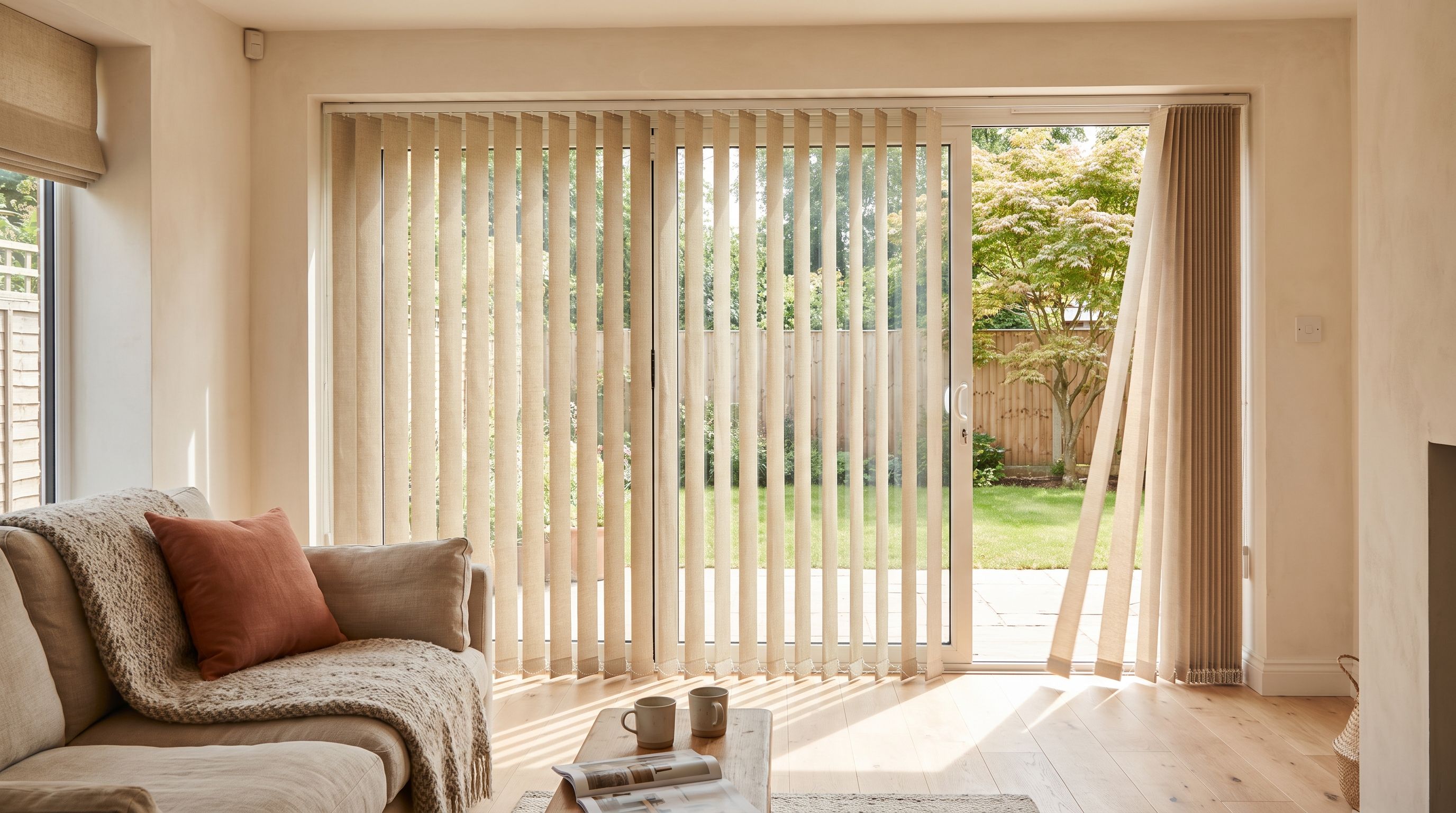
Vertical blinds. The purpose-built answer. One draw clears the doorway; the tilt manages light without moving the vanes off the glass; width is no enemy, because the track carries the weight. Their limits: the joins between vanes pass seams of light, so they cannot make a bedroom dark, and their look is a strong flavour — some rooms want it, some do not. The mechanism itself has its own page: vertical blinds.
Panel track. The same sideways logic in a calmer form — broad flat panels gliding behind one another on a multi-channel track. It carries any fabric in the book, including full blackout, and it reads as architecture rather than window furniture. Its cost is parking space: the stacked panels need somewhere to be, on wall or over the fixed pane, and that is a measured decision rather than a hopeful one.
A wide roller. The exception that proves the rule. It stacks upward — and it earns its place only on doors where opening is rare: the dining room onto the deck, the door used eight weekends a year. In exchange it offers the cleanest sightline of the three and the only true blackout. On the family’s main route to the garden it is the wrong answer, and we say so before quoting it.
The panel that moves, and the side that parks
A sliding door is half fixed, half moving, and the covering’s drawn stack belongs in front of the fixed half — always. Parked over the slider, it stands in the doorway’s way forever, which defeats the entire sideways argument. It sounds too obvious to state; it is the most common fault we inherit from other people’s installations.
Which half is fixed is not always obvious from indoors, and “the blind should stack on the left” means nothing until someone says which side of the glass they are standing on. At the measure we operate the door and settle it in seconds — direction of draw, side of stack, and how the handle’s swing clears the fabric. Three small facts, and the difference between a door that works and a door that argues.
When the door is a bedroom wall
Condos hand many bedrooms a balcony door instead of a window, and the door’s usual answers stop being enough — a vertical’s seams of light are charming in a lounge and hopeless at six in the morning.
For a sleeping room the covering has to close to real dark and still release the door on demand. Two arrangements do it: a wide blackout roller mounted above and beyond the frame, oversized so the edges go quiet, raised fully on the mornings the balcony is in use; or a panel track in blackout fabric, which keeps the sideways convenience and closes tight enough for a bedroom. Which one wins usually comes down to how often the door opens — the roller suits the door used sometimes, the track suits the door used daily.
Measured as a door, not as a glass
The visit treats the door as machinery. We slide it, note which panel moves and where its handle swings, measure the clear wall on both sides, and ask the question that decides more than any measurement: how many times a day does someone walk through here, and in which months?
From that, the product usually chooses itself, and what remains is fabric — openness against the afternoon, opacity for the evening, blackout if a bed is behind it. The quote records the draw direction and the parking side in writing, because those are the two decisions nobody should discover on installation day. The measure costs nothing, and it is the difference between covering a door and disabling one.
The mechanism
Patio door blinds, part by part
Cleared sideways, because the opening is a doorway
Sized around the panel that actually moves
Blackout answered honestly — not every product can
No chain or cord hanging in a walkway
Hour by hour
The same window, four times over
7am
The first crossing of the day is usually the dog, and it happens before anyone has an opinion about light. This is the hour that disqualifies half the catalogue: a covering that must be hauled to the top before the latch can be reached gets left up on the second morning, and stays up. Sideways clears the opening in one motion, half awake.
Noon
The garden side of a house is usually south or west, so by midday the door is less a window than a radiator running in reverse — heat arriving across the largest pane in the building. Vanes or panels angled against it knock the direct sun down while the doorway stays usable, which a covering drawn fully across cannot claim.
6pm
Now the door is open and staying open: plates going out, people coming back in, a breeze crossing the room. Anything left hanging in the opening answers that breeze. The useful position is fully parked — a vertical or a panel track compresses to a fraction of the door's width beside the frame and spends the busiest hour of the day out of the way.
After dark
The glass turns into a black mirror and the room goes on show at full size; no window in the house exposes more. This is also where the honest limit sits. A vertical's vanes overlap without sealing, so a bedroom behind a balcony door wants a wide blackout roller or blackout panels rather than a promise the geometry cannot keep.
Where it belongs
Rooms patio door blinds answer well
Vertical blinds, the sideways answer built for daily use
Panel track blinds, the same idea in flat contemporary planes
A wide blackout roller, on doors opened rarely enough to raise
In the room
How the choice changes the room
The rest of the range
Everything else, by how it moves
Winds onto a tube
Tilts to aim the light
Folds up out of the way
Slides across the opening
And the fitting itself
Our commitment
We measure it. If it does not fit, we remake it.
The visit is free. See the samples at your own window, get the quote, then decide.
Before you call
Questions worth answering before you book.
What actually works on a sliding patio door?
The products that move the way the door moves. A vertical draws to the side in one action and tilts for light in another. A panel track slides its panels behind one another like doors on a wardrobe. A wide roller works where the door's daily traffic is low — a dining room onto a deck used at weekends — because it must be fully raised each time the door is. Ranked by how often the door opens: verticals and panel track for the family thoroughfare, the roller for the occasional exit.
Why is a venetian wrong for a patio door?
Because everything about it assumes a window. It stacks upward, so the whole blind must be hauled to the top before the doorway is a doorway again. It hangs in the path of the sliding panel, where it gets brushed, caught and bent. And a venetian wide enough for a door is heavy enough that nobody enjoys the hauling. It is the covering we most often take off patio doors, usually bearing the scars of the arrangement.
Can a patio door be made blackout, for a bedroom or a condo?
Yes, with the right mechanism. What cannot do it is a vertical — its vanes are separate strips, and every join passes a fine seam of light that no fabric choice can close. For a genuinely dark room the answer is a wide blackout roller mounted above the opening and oversized past its edges, or a panel track carrying blackout panels. Both give the door back by day; both close to true dark at night.
How much wall does the blind need beside the door?
Enough for the drawn stack to have somewhere to live. A vertical or a panel track compresses to a fraction of the door's width when open, and the question is whether that fraction lands on wall or on glass. Where there is clear wall beside the frame, the covering can open fully off the glazing. Where there is none, the stack parks over the fixed pane, which still leaves the walkway clear. Which of those your wall allows is a tape-measure fact, settled at the visit rather than assumed.
What about French doors?
A different problem wearing the same name. French doors swing, so nothing beside or above the opening can serve them — the covering has to travel with the door, fitted to the glazed panel itself and held at top and bottom so it cannot swing on its own. The no-drill perfect-fit systems were more or less invented for this case, and they leave the door's frame unmarked. Ask at the measure and we will bring that system alongside the rest.
The door stands open all summer. Will the blind swing and knock?
Anything hanging in an open doorway answers the breeze — that is honest physics, and no product escapes it entirely. What helps: weighted hems, which give a draught more to argue with; drawing the covering fully clear whenever the door is parked open, which the sideways products do in one motion; and deciding in the door's busiest season rather than its quietest. A blind that lives beside the opening in July and across it in January is the arrangement that actually works.
The last chapter
We bring the samples to your windows.
We come to you, measure at your own windows, and go through fabrics and fits together. The visit costs nothing.
$99 off when you order three or more blindsApplied to your written quote at the measure.
Rather just talk?(437) 782-5452Answered 8am–9pm, 7 days
Free in-home measure
Has everything you've been offered so far gotten in the way of the door?
Answered 8am–9pm, 7 days.
Page last checked 16 August 2026.