Where we work
Blinds in Burlington
Burlington runs from the water up to the escarpment, and its light runs with it — doubled by the lake along the shoreline streets, trimmed short where the town climbs the hill. We specify blinds for the end of town you actually live in, measured at your own windows.
Blinds Company · Rated 4.8 out of 5 on Google
Free in-home measure · open 8am–9pm, 7 days
- Light from below as well
- A room near the shore is lit twice over, and the lower delivery passes under a blind positioned for ordinary sun.
- Winter is the hard season
- Low afternoon sun crosses open water for weeks and lands at eye level, so lakeshore fabrics are better chosen in January than in July.
- The hill deletes an hour
- The escarpment occupies the western sky, so the streets beneath it lose their evening early and often need less than their orientation suggests.
- Afternoon slots by the water
- We suggest a later appointment on the lakeshore, because that is the hour the water tells the truth.
In short
Which horizon you live against decides what your Burlington windows need. Along the lake — Aldershot, Roseland, the downtown towers — light arrives twice, once from the sky and once off the water, and the low winter sun crossing the lake is the hardest glare of the year. Up under the escarpment in Tyandaga and Brant Hills the evening ends early and the mornings carry the day. The subdivisions between behave like neither end. The free visit is how the right answer gets matched to the right street.
Inside this pageJump to one of 6 topics
A town between two horizons
Most towns have one relationship with the sun. Burlington negotiated two. At its southern edge lies the biggest mirror in Ontario; along its northwestern shoulder stands a ridge tall enough to end the day early. Between them, a few kilometres of streets slope gently from water to rock, and the character of the light changes measurably as you climb.
That gradient is the most useful fact in this page. The same blind, in the same fabric, on the same west-facing window, is doing a different job in Roseland than it is in Brant Hills — and a specification copied from a friend at the other end of town is the most common way Burlington windows end up slightly wrong.
The shoreline: light that arrives twice
Walk the streets of Roseland or the lakeside blocks of Aldershot on a bright afternoon and the light has a particular quality people notice without naming: it comes from below as well as above. The lake takes the sky and serves it again — off the water, up under eaves and porch roofs, onto ceilings, into the undersides of rooms that face it.
For windows this means the usual defences are aimed slightly too high. A blind half-lowered against the sky does nothing about the second delivery rising off the water, and a fabric openness that reads perfectly on an inland street lets the doubled version straight through. Shoreline rooms want their weave chosen a step tighter, their blinds run lower, and — where the view is the point of the house — a screen that can hold both jobs without erasing the water.
Winter belongs to the lake
The shoreline’s hard season is not August. It is the stretch of the year when the sun stays low, the trees have resigned, and the afternoon light crosses kilometres of open water picking up shine the whole way before it lands in a living room at eye level.
Summer visitors to a lakeside room rarely believe this; winter residents never doubt it. It is why we suggest choosing fabrics near the water against the January light, and why something adjustable — a venetian that tilts a few degrees, a zebra shifted a hand’s width — beats a fixed filter here. The right setting in July and the right setting in February are not the same setting, and the blind should be able to hold both.
The middle of town: Millcroft, Alton Village, The Orchard
North of the older streets the housing turns familiar-modern: larger rooms, larger glass, back yards that in Millcroft often open onto fairway rather than fence, and in Alton Village and The Orchard onto streets whose trees are still in their first decade.
These are the classic subdivision hours — the long west afternoon in the great room, the east bedroom at sunrise — with the volume turned up by open sightlines and young shade. Screens carry the living spaces; proper blackouts carry the bedrooms; and where a back garden faces open ground, the evening adds a privacy chapter, because a lit room with nothing behind it reads a long way. Fabrics that change state — sheer by day, shut by night — were practically invented for these streets.
Against the hill: Tyandaga and Brant Hills
Climb toward the escarpment and the day changes shape. The ridge occupies the western sky, so the sun leaves these streets before it leaves the rest of Burlington — the golden hour is shorter, the summer evenings cooler, and the west-facing glare that torments the shoreline arrives here diluted or not at all.
The working hours of a Tyandaga window are the morning ones. East and south rooms carry the brightness, and it is often the breakfast side of the house, not the sunset side, that needs the real answer. It is also the part of town where we most often talk someone down from the heavy option their compass suggested — a genuine saving, and the kind a measured visit exists to find.
Downtown, and glass over the water
The towers and mid-rises near the shore live with the lake at full scale: a wall of glass, the horizon, and the water’s reflection delivered without a tree or a rooftop to interrupt it. Glare there peaks in the late afternoon, when sun and mirror-image converge, and the evening adds the standard tower chapter — a lit interior, visible from the promenade and every balcony opposite.
Screen rollers keep the view while stripping the shine; opaque layers close the sleeping end; and the building’s own rules about what may show from outside get read by us rather than discovered by you.
Wherever on the slope you are, the visit runs the same way: free, seven days a week, phones open 8am–9pm. Windows measured individually, fabrics held up in the room’s own light — by the lake we will suggest an afternoon appointment, because that is when the water tells the truth — and a written quote, line by line, with your installation date committed on it. No deposit, no card, no hurry.
Hour by hour
The same window, four times over
7am
Under the escarpment in Tyandaga and Brant Hills the morning is the working shift. The ridge stands where the last hour of sun would be, so those streets hand their evening back early and take their brightness at breakfast — east and south rooms are where the real answer belongs, not the sunset side the compass points at.
Noon
Millcroft backs onto fairway, and the newer streets of Alton Village and The Orchard onto open ground, with nothing opposite to throw shade — so the middle of the day runs long and unmoderated. Screens carry those rooms, because the sightline out is the reason the house faces that way at all.
6pm
The shoreline's hour. In Roseland and the lakeside blocks of Aldershot the late sun arrives with its own reflection underneath it, coming up off the surface rather than down from the sky, so a blind set against daylight from above leaves half of the problem untouched.
After dark
The downtown towers over the water reverse at dusk. A lit unit behind bare glass reads from the promenade and from every balcony opposite, which is why the sleeping end of a glass wall takes an opaque layer while the view side keeps its screen.
Room studies
Three ways to answer the light
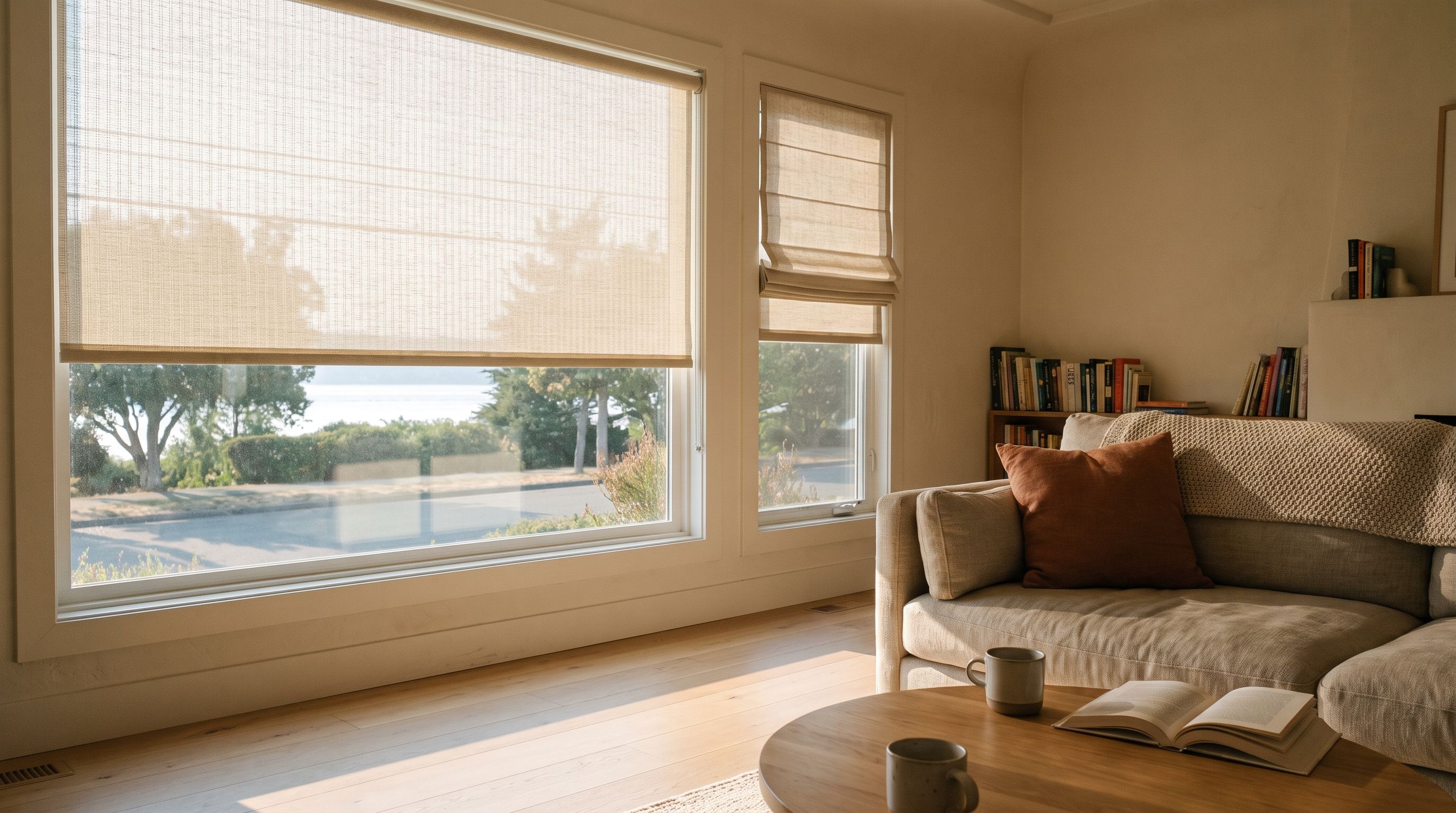
Editorial room studies illustrating the brief — not photographs of client installations.
Inside the city
We measure across Burlington, not from a showroom in it.
- Aldershot
- Roseland
- Downtown Burlington
- Millcroft
- Alton Village
- Tyandaga
- The Orchard
- Brant Hills
Those are the parts of Burlington we are asked for most often — not the edge of where we go. If your street is not on the list, it is still on the route.
The rest of the range
Everything else we fit in Burlington
Winds onto a tube
Tilts to aim the light
Folds up out of the way
Slides across the opening
And the fitting itself
Our commitment
We measure it. If it does not fit, we remake it.
The visit is free. See the samples at your own window, get the quote, then decide.
Before you call
Questions worth answering before you book.
Does living near the lake genuinely change which fabric to choose?
It does, and the mechanism is simple: water is a mirror lying flat. A room near the shore receives its light from the sky and then again from below, bounced off the surface — and that second, lower delivery slips under blinds positioned for ordinary sun. Near the water we usually land one step tighter in the fabric's weave than the identical room would take inland, and the way to be sure is to hold the two candidates up at your own glass on a bright day.
Why is winter the difficult season on the lakeshore?
Because the sun spends it low over open water. For weeks at a time the afternoon light crosses the lake at a shallow angle, picks up its reflection, and arrives at sofa height with the leaves long gone and nothing left to strain it. Rooms that behaved all summer become the complaint. It is the one part of the GTA where we tell people to shop for their windows in January, not July.
We are in Tyandaga, against the hill. Are west windows still a problem?
Less than the compass suggests. The escarpment stands where the last hour of sun would be, so the streets tucked closest beneath it give up their evening light early — which quietly deletes the worst of the classic west-facing complaint. Many rooms there need a softer answer than their orientation predicts, and finding that out before paying for the heavy option is worth the visit on its own.
Our Millcroft house backs onto open ground. Light or privacy first?
Light by day, privacy by night — because open ground behind a house changes both at once. Nothing opposite shades you, so the afternoons run long and unmoderated; and after dark the same openness means a lit room reads clearly from a distance. A day-night arrangement suits these backs well: woven and open while the sun is the issue, closed and solid once the lights come on.
What about a condo downtown, over the water?
Glass-walled units facing the lake collect the reflection at full scale, and glare there peaks later in the afternoon than people expect, when the sun and its double line up. Screen rollers preserve the water view while cutting the shine; bedrooms behind the same glass take an opaque layer. Where the building has rules about what shows from outside — many do — we read them and fold them into the quote.
An older Roseland or Aldershot house — do you do curtains as well?
We do, made to measure like the blinds, and those streets are where they earn their keep. Generous older windows in leafy rooms often want a layered answer — a blind to run the daylight, drapery to close the evening and take the edge off winter at the glass. One visit measures for both, and one installer hangs both.
Is there any charge for the measuring visit in Burlington?
None, anywhere between the water and the hill. You get the measure, fabrics tried against your own light, and a written line-by-line quote with the installation date committed on it. No deposit is taken, and the quote does not expire the moment we leave.
The last chapter
We bring the samples to your windows.
We come to you, measure at your own windows, and go through fabrics and fits together. The visit costs nothing.
$99 off when you order three or more blindsApplied to your written quote at the measure.
Rather just talk?(437) 782-5452Answered 8am–9pm, 7 days
Free in-home measure
If the winter sun off the lake finds your sofa every afternoon, that is the window to tell us about first.
Answered 8am–9pm, 7 days.
Page last checked 16 August 2026.