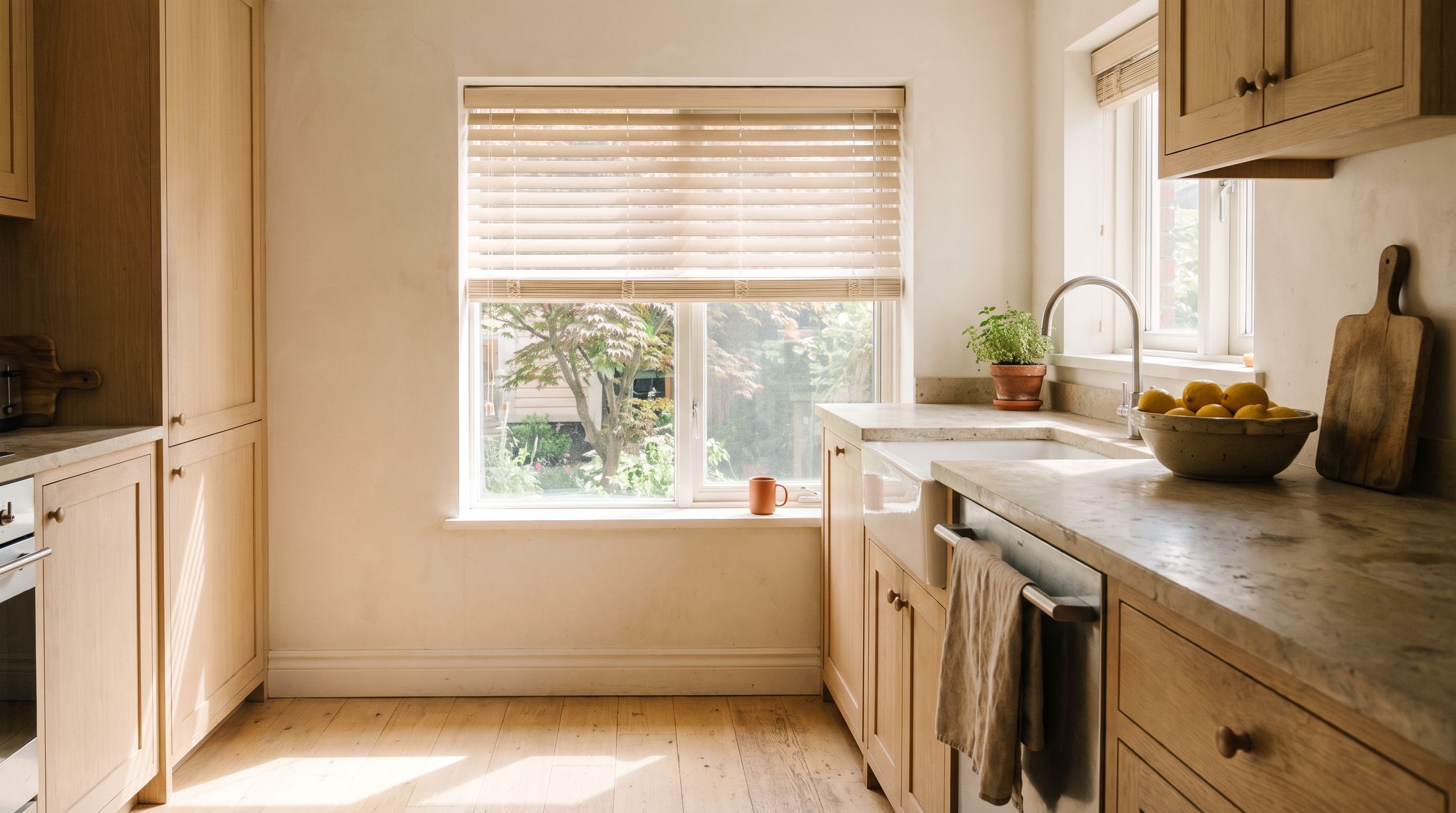
The range
Kitchen blinds
Every kitchen owns a six o'clock: burners on, kettle up, the window fogged from the bottom rail to the top. Whatever hangs on that window lives in this weather every single evening — which is why the kitchen's shortlist is short, and why the prettiest answer is so often the wrong one.
Blinds Company · Rated 4.8 out of 5 on Google
Free in-home measure · open 8am–9pm, 7 days
- Three materials, not a style
- Faux wood, aluminium and coated or PVC roller fabric are the shortlist anywhere near a sink or a stove.
- Wipes clean, repeatedly
- Grease settles as a film on everything a kitchen owns, so the surface has to take a damp cloth as often as the counter does.
- Cordless as standard
- Nothing loops down beside a burner or a kettle, which is a kitchen reason as much as a child-safety one.
- Built to the odd sizes
- Kitchen glass is placed to suit the cabinets, so short and wide over the sink is the normal case rather than the exception.
In short
Kitchen blinds need to be wipeable and indifferent to steam, which in practice means faux wood venetians, PVC or coated-fabric rollers, and aluminium venetians. Real wood belongs away from the cooking — humidity bends timber slats and they stay bent. We make them to measure for the odd, small, over-the-sink windows kitchens actually have, across Toronto and the GTA, and the in-home measure is free.
Inside this pageJump to one of 7 topics
Six o’clock, when the room makes its own weather
No other room manufactures its own climate. At six the burners go on and the room turns humid in minutes; the window — the coldest surface in the room — fogs first, and everything hanging near it gets a light steaming that will happen again tomorrow. Between dinners, cooking releases a fine mist of grease that settles on every surface with the patience of dust.
None of this is a problem to fix. It is the room working as intended, and the only sensible response is to hang things that do not care: materials that shed moisture instead of drinking it, and surfaces that wipe clean in one pass. That single requirement writes most of this page.
The shortlist
A faux wood venetian. The one we specify most in kitchens. The slats are a composite that reads as painted timber from a step away, tilts to manage light, closes for privacy, and wipes flat like a counter. Steam is simply not among its concerns.
A roller in a coated or PVC fabric. The tidiest of the three — one plane of material, a slim cassette, nothing to catch drips or dust. It wipes with a damp cloth and it stacks to almost nothing, which matters here because kitchen windows are small enough that every centimetre of glass is doing real work.
An aluminium venetian. Nobody’s first thought and frequently the right one. Modern slats are crisp, quiet and current-looking, and aluminium regards steam, grease and scrubbing with total indifference. For the window nearest the stove, it is the strongest answer on the page.
Real wood, and the no we give freely
We sell wood blinds happily — in dens, bedrooms, living rooms. In a kitchen we will talk you out of them, and the reason is physics rather than taste.
Timber is absorbent, but a kitchen’s humidity never arrives evenly: one end of a slat sits nearer the kettle, one face is toward the glass. Uneven moisture means uneven movement, and a thin slat that has moved does not move back — the bend becomes part of the blind. The wood blinds page tells you the same thing, because it is true from both directions: real timber is a beautiful answer to a question this room is not asking.
If the look matters, take the faux wood. Its whole reason to exist is to carry the appearance into rooms the original cannot survive.
The window over the sink
Kitchen windows are unlike the rest of the house’s: short, often wider than tall, placed to suit cabinets rather than sightlines, and guarded by a counter, a sink and a tap. You do not walk up to this window; you lean toward it, usually with wet hands.
That geography decides two things. The control wants to be at the side and within a lean — a tilt wand on a venetian, or a motor on a wall switch for the window nobody can reach — because a control at the bottom bar means stretching across a wet counter, and a blind that is annoying to adjust simply stops being adjusted. And nothing should dangle: a looped cord near a burner or a kettle is its own bad idea, quite apart from the child-safety rule that makes cordless our standard anyway.
The window itself is usually smaller than the room deserves, which is an argument for keeping it whole — slim cassettes, tight fits, and no fabric gathered where glass could be.
Eight in the morning, the other end of the day
The kitchen’s second hour is gentler. East and south-east kitchens take strong light at breakfast, and it lands exactly where you work — flat on the counter, bright off the white surfaces, occasionally straight into eyes at the table.
Morning light is worth keeping, so this is tilt territory rather than blackout territory: venetian slats angled a few degrees keep the room bright and take the counter out of the beam, and on a roller a mid-height stop does the same. It is a small problem with a small answer. The reason it makes this page is that the material which survives six in the evening should also be pleasant at eight in the morning — and the shortlist above happens to be good at both.
Test the window open, not only closed
Kitchen glass is ventilation as well as light. A casement handle must turn without striking a bottom rail, and the sash must open far enough that the blind does not become the stop. On a tilt-and-turn window, the top movement needs its own clearance at the headrail. These checks take seconds with the window in motion and prevent years of choosing between fresh air and a protected blind.
The same test finds splash risk. Open glass can move the covering closer to a sink, kettle or pan than it appears when shut. Hardware placement follows the window through its full routine, not the neat position shown in a photograph.
What the measure asks in a kitchen
Where the heat and the water actually are — stove, kettle, sink, tap — since distance from them decides materials before taste enters. Which way the window faces and what the light does at breakfast and at dinner. Whether the window opens, which way, and with what handle, because a blind should never be the reason a boiling kitchen stays sealed. And who reaches the control, across what.
Samples come to the window and get held in its own light, steam and all. The quote names the material, the control and the fit per opening, and it leaves nothing owed — the measure is free, and so is the advice to keep the timber for the den.
The mechanism
Kitchen blinds, part by part
Materials chosen to shrug off steam and grease
Wipe-clean surfaces, because everything in a kitchen is
Made to the odd sizes kitchen windows actually are
Cordless as standard, with nothing dangling near a burner
Hour by hour
The same window, four times over
7am
Breakfast light lands flat on the counter and bounces off every white surface into whoever is at the table. This is tilt work rather than blackout work — a few degrees off level keeps the room bright and takes the counter out of the beam. The control has to be reachable from a lean over a wet sink, or it stops being used.
Noon
Nothing is cooking and the room is doing its quiet damage: airborne grease from breakfast settling with the dust onto the one surface nobody thinks to wipe weekly. Midday is also when a kitchen window shows how small it is, which is why a slim cassette and a fit to the millimetre matter here more than anywhere in the house.
6pm
Burners on, kettle up, and the coldest surface in the room fogs first — the glass, and by extension whatever hangs on it. The blind above the sink is damp most evenings whether it looks it or not. Faux wood, aluminium and coated fabric treat that as weather; timber and open-weave cloth take it as instructions.
After dark
The cooking is done, the room is lit, and the window that showed a garden all day is now showing the kitchen to the street. Closing it should be one motion, made with wet hands, with nothing looping down near a burner or a kettle — which is most of why cordless is the standard on every kitchen window we fit.
Where it belongs
Rooms kitchen blinds answer well
Faux wood venetians, the material that treats steam as weather
Coated roller blinds, wiped clean in the same pass as the counter
Aluminium venetians, for the window closest to the cooking
In the room
How the choice changes the room
The rest of the range
Everything else, by how it moves
Winds onto a tube
Tilts to aim the light
Folds up out of the way
Slides across the opening
And the fitting itself

Our commitment
We measure it. If it does not fit, we remake it.
The visit is free. See the samples at your own window, get the quote, then decide.
Before you call
Questions worth answering before you book.
What is the best blind for a kitchen?
Judged by where it hangs. Close to the sink or the stove, the field narrows to three — a faux wood venetian, a roller in a coated or PVC fabric, and an aluminium venetian — because all three wipe clean and none of them minds steam. Further from the cooking, in a breakfast corner or across an eating area, the field opens back up and fabric becomes reasonable again. A kitchen is less one room than a weather map, and the blind follows the weather.
Can I put real wood blinds in a kitchen?
We will make them for you anywhere in the house, and we will advise against them here, in writing if it helps. A timber slat drinks the room's humidity a little unevenly, and over enough dinners it bends — then holds the bend after the steam is gone. It is slow, it is permanent, and it has nothing to do with the quality of the wood. Faux wood carries the same look at a glance and treats a kitchen's air as no information at all.
How do you clean grease off kitchen blinds?
The realistic answer is often, lightly, and with materials that allow it. Airborne grease settles as a fine film on everything a kitchen owns, and a blind is just the surface nobody thinks to wipe weekly. On faux wood or aluminium, close the slats flat and wipe them as one plane, then tilt and do the other face. On a coated roller, a damp cloth over the drawn fabric does it. This is the honest reason fabric near the cooking fails — not that it looks worse, but that it cannot be cleaned once it does.
Will steam actually damage a blind?
It sorts materials into two piles, quickly. Steam condenses on the coldest nearby surface, which is the window — so the blind above the sink is regularly damp whether or not it looks it. PVC, faux wood, aluminium and coated fabrics sit in the pile that does not care. Timber, natural-fibre cloth and anything with an open weave sit in the other, and a season of dinners is enough to show which pile a material was in.
Blinds or curtains for a kitchen window?
Near the cooking, blinds — for the plain reason that cloth is a filter and a kitchen gives it plenty to hold. A curtain hung over a sink collects steam and the memory of every fried onion, and it cannot be wiped down the way a slat can. Where a kitchen opens into an eating area, curtains come back into play and we fit plenty of them there; the rule is distance from the stove, not the name of the room.
The window over my sink is small and an odd shape. What fits?
That window is the whole case for made-to-measure. Builder kitchens put glass wherever the cabinets allow — short and wide over the sink, tall and narrow beside a door, occasionally a shape no catalogue admits exists. A blind cut to the millimetre uses all of a small opening instead of most of it, and on a window that size the difference is visible from across the room. Stock sizes are what leave the strip of naked glass down one side.
The last chapter
We bring the samples to your windows.
We come to you, measure at your own windows, and go through fabrics and fits together. The visit costs nothing.
$99 off when you order three or more blindsApplied to your written quote at the measure.
Rather just talk?(437) 782-5452Answered 8am–9pm, 7 days
Free in-home measure
Torn between the look of wood and the sense of faux wood over the sink?
Answered 8am–9pm, 7 days.
Page last checked 6 September 2026.