Where we work
Blinds in Mississauga
Made-to-measure blinds, shades and curtains across Mississauga — a city built mostly in the decades after windows grew large, from picture windows and patio walls to two-storey family rooms, and edged along its bottom by a lakefront whose light plays by its own rules.
Blinds Company · Rated 4.8 out of 5 on Google
Free in-home measure · open 8am–9pm, 7 days
- Width changes the mechanics
- Fabric has weight, and past a certain span two blinds meeting on a shared line is the honest answer rather than one asked to do too much.
- The join is a decision
- Where two blinds meet across a wide opening gets chosen standing in the room, not discovered on installation day.
- Southern exposure, nothing in front
- A window facing the lake in Port Credit or Clarkson takes light off open water all day, and in winter it arrives low and doubled.
- Patio doors decide themselves
- Which side the door stacks to, and how often it actually gets used, are the two facts that pick the system.
In short
We measure, make and install window coverings across every part of Mississauga, from Streetsville's village core to the lakefront streets of Port Credit and Clarkson. Spans run wide here, so much of the craft is handling size well — splitting long runs sensibly, motorizing what is out of reach — and the measure that starts it costs nothing.
Inside this pageJump to one of 5 topics
Six decades share one street map
Streetsville still keeps the main street of the village it once was, and the houses nearest it are among the oldest in the city. Cooksville and Clarkson carry the postwar layers. Lorne Park went its own way in mid-century, winding big lots under trees that have since grown enormous. Erin Mills and Meadowvale were master-planned through the seventies and eighties, and Churchill Meadows filled in the western edge recently enough that its first owners still live there.
Each of those eras had its own idea of what a window should be, and all of those ideas are still hanging in their walls. The tape measure does not care which decade it is reading — but the recommendation should, because a village-core sash, a seventies picture window and a brand-new builder unit are three different problems wearing the same name.
Where the spans get wide
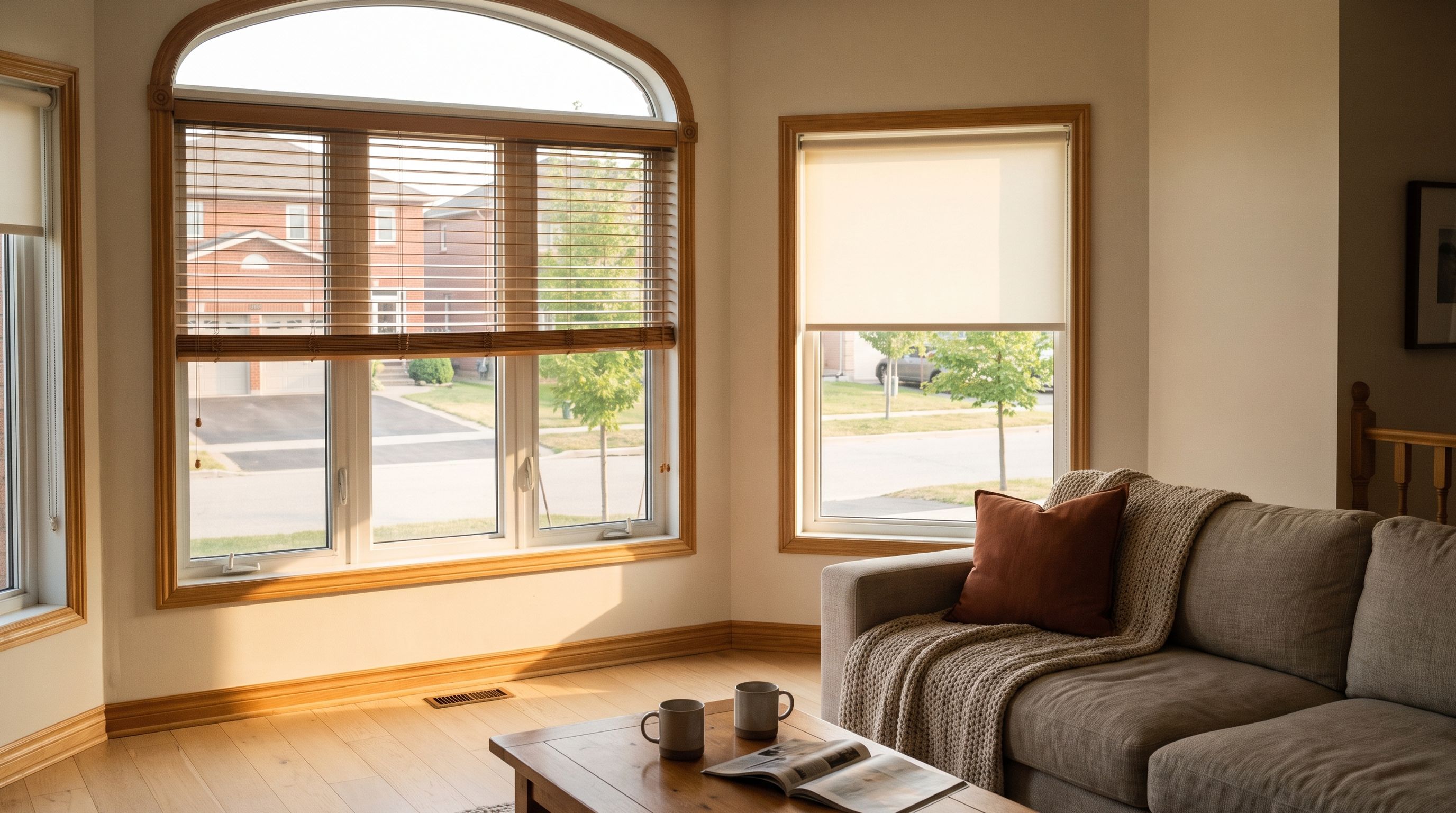
From the eighties onward, Mississauga’s builders liked glass at scale: the broad window over the front garden, the breakfast room sliding straight into the yard, the family room glazed high above head height. Width changes the mechanics. Fabric has weight, and a very wide roller needs a stiffer tube to run true; past a certain span, the honest answer is two blinds meeting on a shared line rather than one asked to do too much — and where that join falls is a decision to make standing in the room, not a surprise on installation day.
Motors carry what chains would struggle with, and on the tallest glazing they are simply how the window gets used at all. None of this is exotic; it is the ordinary engineering of a city whose windows are larger than its residents tend to realize until the samples come out.
The lakefront plays by different rules
A window in Port Credit or Clarkson that faces the water is looking at something rare in the GTA: a southern exposure with nothing in front of it. No tree line across the street, no neighbouring roof — the light comes off the horizon all day, and in winter it arrives low and doubled, once from the sky and once off the surface of the lake. It is glorious, and it is relentless on everything it touches inside the room.
The specification that works is the one that refuses to choose between the lake and the living: a screen fabric open enough to keep the water in view, woven tightly enough to take the sting and the ultraviolet out of the afternoon, with an opaque layer behind or beside it for the evenings — because after dark, the same glass that gave you the horizon starts working in the other direction.
Inland, the west owns the afternoon
In Erin Mills, Meadowvale and Churchill Meadows the difficult hour is predictable enough to set a clock by: late afternoon, west-facing kitchen or great room, sun at counter height. Subdivision trees are still growing into their job, so not much stands between the glass and the horizon at five o’clock.
The fix is adjustability rather than sacrifice. A zebra day-night slid a notch when the glare starts, a screen roller that makes the counter usable while dinner is cooked, a cellular shade where the heat itself is the complaint — all of them give the bad hour away without giving up the room. What we advise against is choosing a permanently dark fabric for one hard hour and then living in its dusk for the other twenty-three.
Lorne Park, and the rooms the trees already shade
Lorne Park’s canopy does for its houses what fabric has to do everywhere else: high summer arrives already gentled, filtered through a ceiling of leaves that took sixty years to build. The briefs there run softer — privacy between neighbours who are close but screened, romans and drapery in rooms that want dressing more than dimming.
The season to plan for is the one nobody shops in. When the leaves drop, low winter sun reaches rooms that spent the whole summer shaded, and a covering chosen in July for a July problem can be the wrong one by January. It is worth choosing for both halves of the year at once — which is easier done standing in the room with samples against the glass than guessing from a screen.
Hour by hour
The same window, four times over
7am
Streetsville and the older corners of Clarkson and Cooksville start the day small — village-core openings from an earlier century of building, real casings, and the quirks that age brings. Those windows get measured one at a time, because what a frame will take is decided by the decade it was made in.
Noon
Across the wide glass this city likes, midday is a heat question before it is a glare one: the picture window over the front garden, the breakfast room sliding into the yard, the family room glazed above head height. A cellular shade answers heat where a heavier fabric only answers light.
6pm
Five o'clock in Erin Mills, Meadowvale and Churchill Meadows is predictable enough to set a clock by — west kitchen, sun at counter height, subdivision trees still growing into the job. Adjustable beats permanent here, because the other twenty-three hours have to be lived in too.
After dark
On the lakefront the glass changes direction. A Port Credit window that held the horizon all day starts working outward the moment the lights are on, with no tree line and no neighbouring roof to interrupt it either way, which is why the screen wants an opaque layer beside it.
Room studies
Three ways to answer the light
Editorial room studies illustrating the brief — not photographs of client installations.
Inside the city
We measure across Mississauga, not from a showroom in it.
- Port Credit
- Lorne Park
- Streetsville
- Erin Mills
- Meadowvale
- Cooksville
- Clarkson
- Churchill Meadows
Those are the parts of Mississauga we are asked for most often — not the edge of where we go. If your street is not on the list, it is still on the route.
The rest of the range
Everything else we fit in Mississauga
Winds onto a tube
Tilts to aim the light
Folds up out of the way
Slides across the opening
And the fitting itself
Our commitment
We measure it. If it does not fit, we remake it.
The visit is free. See the samples at your own window, get the quote, then decide.
Before you call
Questions worth answering before you book.
Which parts of Mississauga do you serve?
All of them. Port Credit and Clarkson along the water, Lorne Park's wooded streets, Streetsville, Erin Mills and Meadowvale, Cooksville and its towers, Churchill Meadows out on the newer western edge — and everywhere in between. The measure, the samples and the written quote are free wherever in the city you are, and the phones are open 8am–9pm every day.
What is different about windows in Mississauga?
Scale, mainly. Most of the city went up in eras that liked glass — living rooms with one broad picture window, kitchens over patio sliders, family rooms glazed a storey and a half high. Big openings change the engineering before they change the look: fabric weight, roll diameter, whether one blind can honestly span the width or the job wants two meeting on a mullion. That is the conversation the in-home measure is for.
Our house faces the lake. Will the sun ruin the furniture?
Unsoftened south light does bleach fabrics and floors over the years, and a lakefront window has no houses across the road to blunt it. The good news is that nobody has to choose between the view and the sofa. A solar screen roller cuts the ultraviolet and the glare while staying visually open toward the water, and it pairs with a blackout or a drape for the nights. What we will not do is hang an opaque blind on a window you bought for the view and call that a solution.
Can you cover a two-storey family-room window?
Yes. Height is a ladder problem for us and an operating problem for you, and the second one matters more — a blind nobody can reach is a blind nobody adjusts. Tall glazing is where motorization stops being a luxury: one remote, or a schedule that lowers the shades through the hottest stretch of the afternoon and lifts them again before you are home.
What actually works on a sliding patio door?
More than the vertical blind that probably came with the house — though verticals have earned their place, and we fit modern versions of them. Panel-track systems slide the way the door slides, a pair of rollers or zebras can split the opening, and drapery remains the honest answer where softness matters more than machinery. The deciding facts are which side the door stacks to and how often it actually gets used, two things best observed standing in front of it.
Streetsville and the older pockets — do those houses need different treatment?
Often, yes. The village core and the older corners of Clarkson and Cooksville hold houses from an earlier century of building, with smaller openings, real casings and the quirks that age brings. The blind does not care what the neighbourhood is called; it cares whether the opening is true and what the frame will take — which is why every job here starts with the same tape measure, whatever the decade.
The last chapter
We bring the samples to your windows.
We come to you, measure at your own windows, and go through fabrics and fits together. The visit costs nothing.
$99 off when you order three or more blindsApplied to your written quote at the measure.
Rather just talk?(437) 782-5452Answered 8am–9pm, 7 days
Free in-home measure
A span you suspect is too wide for one blind, or lakefront glass you refuse to trade the view for?
Answered 8am–9pm, 7 days.
Page last checked 16 August 2026.