Guide
Blinds for condos: the Toronto glass-wall guide
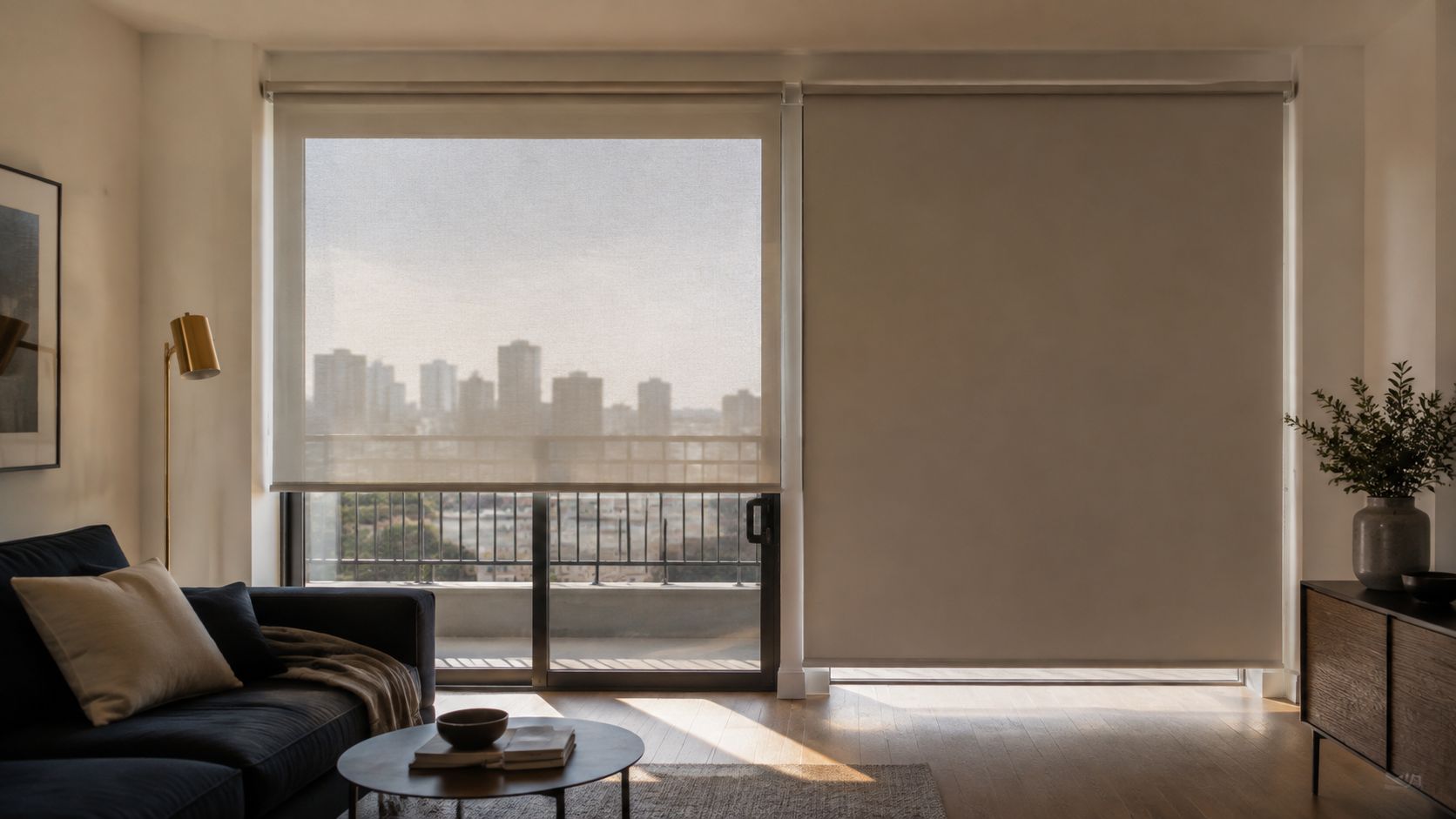
For most Toronto condo living rooms, start with separate roller shades aligned across the glass: a solar-screen fabric where daytime glare and view matter, and a solid layer wherever nighttime privacy is non-negotiable. Split a wide wall at mullions or doors so each section remains usable. Before choosing the mount, ask management what the declaration, by-laws and rules say about visible backing colour, drilling, common elements, contractor access and work hours. Then measure the usable fixing surface, handles and opening path in person.
9 min readUpdated
ByNickolasLead installer & window covering specialist
Start with the building, not the sample book
At street level, a blind belongs to a room. In a condominium, it also belongs to a corporation with legal documents, shared structure, neighbours and a route from loading bay to unit door. That does not make the job difficult. It changes the order in which sensible questions are asked.
The Condominium Authority of Ontario explains that a corporation’s declaration, by-laws and rules help define what owners and residents may do, while the declaration identifies unit boundaries and common elements. A window frame or ceiling that looks like part of your room is not proof that it is yours to alter. The documents for your own corporation are the answer.
Before ordering, send management one compact request:
- Is an exterior-facing backing colour required for window coverings?
- May brackets be fixed into the frame, bulkhead, wall or concrete ceiling?
- Is any proposed fixing surface a common element?
- Does an installer need a certificate of insurance or other registration?
- Must a service elevator or loading area be booked?
- Which work hours and noise rules apply?
Ask for the answer in writing and keep it with the quote. “Other units have white blinds” is useful observation, not permission. One clear email is much cheaper than choosing fabric twice.
Renters have a second document to read: the lease. A condo rule may permit a fixing that a landlord does not, or the reverse may be irrelevant because the corporation still controls the surface. The safe route satisfies both.
The glass wall keeps four different hours
Blinds for condos make more sense when the day is divided by what the window is doing. “Too bright” is not one condition.
| Hour | What changes at the glass | What the covering has to do |
|---|---|---|
| Early morning | Low light reaches deep into an east-facing room | Soften the beam without deleting the whole morning |
| Afternoon | Direct sun and reflected sky compete with screens | Cut glare while preserving useful daylight and view |
| Sunset | Low west light slips under furniture-height sightlines | Stop or redirect one hard band at the difficult hour |
| After dark | The condo becomes brighter than the exterior | Provide true opacity where privacy matters |
A south- or west-facing glass wall may make a screen roller the hero at three in the afternoon. At ten that same open weave is the wrong answer, because the room has become the bright side. An east bedroom may need almost no help after lunch and complete edge control before breakfast.
Write down the troublesome hour and what you are doing then: working at a monitor, watching television, sleeping, eating or walking to the balcony. This is more useful than starting with colour. A swatch cannot tell you which side of the glass will be brighter.
Daytime privacy disappears when the lights come on
A solar screen is a woven filter. During a bright day, the eye on the darker side can often see through it better than the eye on the brighter side. That is why a screen can preserve a skyline while making the room less legible from outside.
Night reverses the contrast. Switch on the lamps and the interior becomes the view. The weave has not changed; the direction of visibility has. No honest screen percentage can promise privacy in both conditions by itself.
There are three clean strategies:
Accept two modes. Use a screen roller by day and a separate solid roller or curtain layer after dark. Each material does one job well.
Use one adjustable surface. A zebra blind alternates sheer and solid bands. It can tune daylight, then close solid-on-solid in the evening. It is still not the same as a sealed blackout system, but its privacy state is visibly understandable.
Choose opacity all day. In a bedroom or a unit facing a close neighbouring tower, a solid roller blind or cellular shade may be the right trade. You give up the view whenever it is lowered and gain a simple answer at night.
Test samples against the actual window, not under showroom lighting. Hold a screen toward daylight, then stand on the room side after sunset with the lights on. The second test is the one most displays cannot perform.
Openness is a trade, not a quality score
Screen fabrics are often described by an openness percentage. In practical terms, a more open weave usually preserves a clearer outward view and admits more daylight; a denser weave usually controls more glare and makes the scene beyond less distinct. Colour, yarn and the direction of the light also affect what the eye experiences, so the percentage is a comparison tool within a sample range, not a universal performance promise.
Dark screen fabric can make the view read more crisply because the eye notices less reflection from the cloth. A pale exterior-facing surface may suit a building’s visual rule. Those needs can coexist in some fabrics and conflict in others. This is why the exterior requirement belongs at the beginning of the selection, not in an email after the order.
An interior shade can make direct sun and screen glare easier to live with. It does not turn interior glass into exterior shading, replace air conditioning or guarantee a temperature change. If heat is the main complaint, compare the room at the difficult hour and ask what the proposed fabric is designed to do, rather than treating “solar” as an energy certificate.
Split the wall where the room already splits
A tape measure sees one enormous width. Daily life sees a fixed pane, an opening door, a sofa, a desk and two people who may want different light. The second view is the better specification.
Use mullions and door lines as candidate divisions. Separate shades can align their headrails and bottom bars while moving independently. That allows the balcony door to stay usable, a television bay to close while the dining area keeps its view, and one damaged mechanism to be serviced without removing an entire wall.
Every split introduces a gap, so it should land over an existing frame member where possible rather than over clear glass. Photograph the whole elevation straight on, mark which panels move, and draw each proposed shade as a rectangle. Then operate the door. A beautiful symmetrical layout that catches a lever handle is still wrong.
Do not assume the widest technically available roller is the best roller. Tube diameter, fabric weight, motor or chain limits and the manufacturer’s allowed size all change by system. The custom blinds page explains why the product and the opening have to be selected together rather than forcing one catalogue size over every pane.
Where the bracket can actually live
Condo glazing often reaches a drywall bulkhead or concrete slab with very little traditional wood reveal. The mounting choice is therefore a survey of real surfaces.
Inside the reveal is visually quiet when there is enough clear depth. Measure at the intended headrail line and subtract handles, vents, sensors and any sash that tilts inward from the usable space. A cassette that fits by its bracket may still project beyond the wall face.
Face-mounted on a bulkhead or wall can create the coverage a shallow frame cannot. The finished blind has to clear trim and hardware, and the fixing must reach material that can carry it rather than stopping in a decorative skin.
Ceiling-mounted can make a glass wall read as one deliberate elevation, but concrete, embedded services and corporate rules turn the ceiling into something to confirm before drilling. A professional can identify a fixing method; only the corporation’s documents and management can answer whether it is permitted.
No-drill systems are a category, not magic. Tension needs parallel bearing surfaces and enough depth. Clip systems need a compatible frame profile. Magnets need steel. Adhesive needs a sound finish and may still mark it on removal. The no-drill blinds page lays out those limits; bring the frame profile and lease rule to that decision.
Never fix into glass, gaskets, an operable track or an unknown cover plate. If a surface cannot be identified, the measurement is not finished.
Which blind earns which condo job
The useful shortlist is small when each product has a named task.
| Condo problem | Strong starting point | What to check before saying yes |
|---|---|---|
| Afternoon glare with a view worth keeping | Solar-screen roller | Night privacy, openness, exterior colour |
| Bedroom darkness | Solid blackout roller or cellular shade | Edge gaps, headrail depth, sunrise direction |
| Daylight and adjustable street-facing privacy | Zebra blind | Solid evening position, band alignment across bays |
| Cold-feeling glass near a bed or desk | Cellular shade | Loss of view while lowered, depth and width limits |
| Tall or obstructed glass used every day | Motorized roller | Power, charging access, grouping and service access |
| Lease or rules prohibit holes | Compatible no-drill blind | Frame profile, load, surface condition and permission |
| A living room that needs softness after dark | Roller plus curtains | Stack space, sprinkler and vent clearance, fixing line |
This is a starting table, not a verdict. A west-facing bedroom with a balcony door can occupy three rows at once. The answer may be two coordinated shades, not one supposedly perfect product.
Motorization should solve a daily reach problem
Motorized blinds make sense when glass is tall, furniture blocks access or several shades should move together at the same hour. Their best moment is repetitive: every west-facing roller lowers before the glare arrives, or every bedroom blind closes without climbing behind a headboard.
Plan the unglamorous parts before the remote. Where does each motor get power? If it uses a rechargeable battery, can a person reach the charging point without moving a sectional sofa? If several shades form one scene, can they still be operated individually? What control stays available if a phone changes or a remote is misplaced?
Keep manual and motorized headrails visually aligned if they share a wall. There is no prize for motorizing a narrow reachable pane whose neighbours genuinely need it. Spend the complexity where it removes a repeated inconvenience.
Three rooms, three honest specifications
Living room with west glass. Start with separate screen rollers at mullion lines, then decide whether evening privacy requires solid rollers behind them or drapery at the room edge. Keep the balcony-door shade independent. Put the television in the glare test, not only the sofa.
East-facing bedroom. Begin with the darkness target. Blackout cloth controls light through the material; the mount and perimeter control light around it. A solid outside-mounted roller may cover edges better where an inside reveal is shallow. A cellular shade adds a different texture and trapped-air structure, but it still needs a privacy and edge check.
Home office facing another tower. Daylight, screen visibility and camera background matter together. A denser screen or zebra can soften the exterior without making every video call look like night. Sit at the desk during the free measure; the useful viewing angle is from the chair, not from the centre of an empty room.
The condo worksheet before a quote
Bring one page with six answers:
- Corporation and management contact.
- Written restrictions on exterior appearance and fixing surfaces.
- Room orientation, if known, and the difficult hour.
- True night-privacy requirement for each room.
- Every operable pane, balcony door, handle and obstruction.
- Access requirements for contractors, loading and elevator use.
Add a straight photograph of each full glass wall and one side view of the headrail area. Do not crop out the ceiling, sill or door handle; those are where the installation decision lives.
At the measure, settle the number of shades, split locations, fabric state by day and night, mount surface, control side, power method and finished alignment. Blinds Company offers a free in-home measure across Toronto and the GTA, and the installation date is confirmed in writing at the quote.
The point is not to make a condo order complicated. It is to make every hidden constraint visible while changes are still pencil marks. Once the building, the glass and the difficult hour agree, the fabric choice becomes the easy part.
Questions
Still asked
What blinds are best for a Toronto condo?
A solar-screen roller is a strong starting point for a bright living room because it reduces direct glare while preserving some view through the weave. It is not nighttime privacy. Bedrooms usually need a solid or blackout layer, and a living room used after dark may need a second layer too. The best specification follows the room's exposure, privacy and door use rather than the fact that the address is a condo.
Do condo boards control which blinds I can install?
Rules vary by corporation, so do not rely on a neighbour's answer. Ontario condos are governed by their declaration, by-laws and rules, which can set restrictions and define unit boundaries and common elements. Ask management in writing about exterior-facing colour, drilling, window frames, ceiling fixing, contractor documents, service-elevator booking and work hours before placing a made-to-measure order.
Do solar shades give privacy at night?
No. A screen works best when the outside is brighter than the room. After sunset, interior lights reverse that contrast and people outside can see through the weave toward the brighter side. For reliable night privacy, close a solid roller, zebra blind in its opaque position, cellular shade or curtain layer.
Can one blind cover an entire wall of condo windows?
Sometimes a product can be made very wide, but capability is not the only test. A single blind can block balcony-door access, become heavy to operate and force the whole room into one light setting. Splitting at structural mullions or the door line usually gives better control and serviceability. The selected system's size limits and the actual glass layout decide.
Can condo blinds be installed without drilling?
Only where the frame and opening suit a compatible tension, clip, magnetic or adhesive system. Many condo windows have shallow aluminum frames, handles and little parallel reveal surface, so no-drill is not automatic. Confirm what the lease or corporation permits, then check the exact frame profile and product limits. Never attach to glazing or assume adhesive is harmless to a finished surface.
Are motorized blinds worth it in a condo?
They are most useful on tall glass, behind furniture or across several bays that should move together every day. Decide how each motor is powered, where charging or service access remains, how groups are controlled and what each shade does if a remote is unavailable. A reachable narrow window rarely needs a motor merely because the neighbouring glass has one.
About this guide
Nickolas turns the decisions made at real windows — fit, clearance, direction of light, privacy and reach — into these field guides as Blinds Company'sLead installer & window covering specialist. Each article follows one rule: explain where an option wins and where it does not.
The product this one is about: Roller blinds
The right condo blind is rarely one product name. It is a small plan for a whole wall, an evening and a building that all have to keep working.
The last chapter
We bring the samples to your windows.
We come to you, measure at your own windows, and go through fabrics and fits together. The visit costs nothing.
$99 off when you order three or more blindsApplied to your written quote at the measure.
Rather just talk?(437) 782-5452Answered 8am–9pm, 7 days