The range
Outdoor blinds
Indoors, a blind's whole job is light. Outside the glass the job changes: the same sun, plus wind that pushes on everything, rain that must drain somewhere, and a winter that finishes anything specified for a gentler climate. An outdoor blind that works here was chosen for all four — which is why this page spends as much time on wind and January as it does on shade.
Blinds Company · Rated 4.8 out of 5 on Google
Free in-home measure · open 8am–9pm, 7 days
- Heat stopped before the glass
- Sunlight becomes heat where it lands, so shade on the outside keeps it out of the room entirely.
- Edges captured, never loose
- Side channels or tensioned cables let the panel brace against wind instead of flogging like a flag.
- Fixed to the structure
- Posts, beams and joists carry the load, so what you already have is measured alongside the opening.
- Retracted for the winter
- Wet snow is a structural load, and how your system winters is written into the quote.
In short
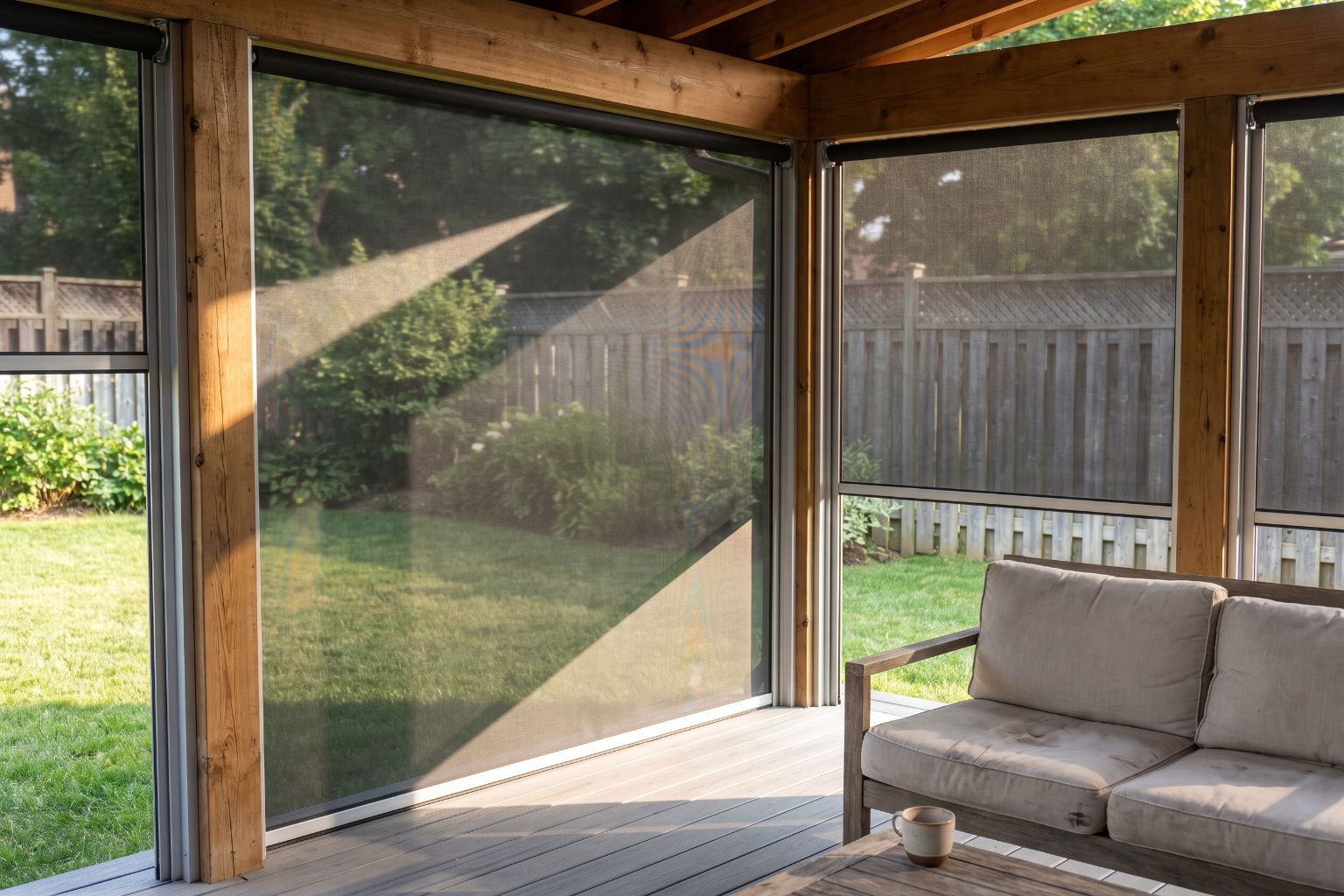
Outdoor blinds are shades mounted on the exterior — over a patio, a deck, a porch or the outside face of a window — in mesh, clear PVC or solid weatherproof fabric, fixed to the structure of the building rather than to a window frame. Their advantage over any interior blind is order of operations: they stop the sun's heat before it passes through the glass, instead of arguing with it afterwards.
Inside this pageJump to one of 6 topics
Two o’clock, outside
Indoors, this site sorts blinds by the hour they rescue. The patio has an hour too. A west- or south-facing deck is at its best at ten in the morning and surrendered by two — chairs migrated into the one strip of building shade, the table too hot to rest an arm on, the whole afternoon handed back to the sun. An outdoor blind exists to keep that appointment. It is shade put where the heat actually is: on the outside of the glass, over the space the house was partly bought for.
The argument is won before the glass
The physics is a matter of sequence. Sunlight passes through glass, lands on floors and furniture, and becomes heat — and once it is heat, it is indoors, where the best any interior blind can manage is to hold it near the window. An exterior shade interrupts the sequence one step earlier: the sun is stopped before the glass, the heat it makes disperses into open air, and the room behind simply never receives it.
On a wall of west-facing glass this is the most effective move available short of changing the windows themselves, and it is why exterior shading is the unremarkable default across the hot half of Europe. It is also why an outdoor blind earns its keep even on days nobody sits outside — the room behind it is the other beneficiary.
Wind writes the specification
The sun is why people call. Wind is what we specify for. Fabric hung in the open takes wind the way a sail was designed to, and the arithmetic is unkind: double the wind speed and the push on the panel roughly quadruples. An uncaptured edge will whip until the stitching, the hardware or the fixings surrender.
Every system worth fitting answers this the same way: the fabric’s vertical edges are captured, in side channels or on tensioned cables, so the panel can take load without ballooning. The rest of the answer is where that load goes. An indoor blind hangs off a window frame; an outdoor blind is bolted to the building — posts, beams, joists — and the structure is part of what we measure, because a blind is only as strong as what carries it. So, quietly, is the water: an extended blind sheds rain somewhere, and on a deck, where that water lands is the difference between a shaded space and a permanently damp one.
Three fabrics, three different patios
Mesh is what most people picture: a woven screen that cuts glare and a large share of solar heat while the garden stays visible through it and the breeze keeps moving. It is the answer when the space is too bright and too hot but should stay recognisably outdoors.
Clear PVC is the opposite tool. It stops wind and rain nearly outright and keeps nearly all of the view, which stretches a porch’s season weeks past both ends — and it does nothing about heat. On a sun-struck side it builds some, the greenhouse effect being indifferent to your intentions, which is why porches that get PVC for the shoulder seasons often want mesh or solid for July.
Solid fabric gives complete shade and complete privacy at the price of the entire view — right where the sun or the neighbours are the whole problem, wrong on the one side the view justifies.
Many spaces want two of the three on different faces. Almost none is well served by choosing on looks, which is the error this product forgives least.
What January asks
Ontario is the part the glossy photographs skip. The distance between a July afternoon and a February night is enormous; freeze-thaw works on fittings the way it works on roads; wet snow is heavy out of all proportion to how it looks; and the UV that slowly ages an indoor fabric arrives outside undiluted, several times the dose, because the glass it never passed through is itself a filter.
Hardware and fabric are chosen for weather, but the honest operating rule is the one the rest of the patio already follows: retractable shade is retracted for the winter, and anything left extended under a snow load is carrying weight it was never asked to quote for. How your particular system winters — raised and secured, taken down, or rated to stand — is settled at the measure and written into the quote, not discovered in the first storm.
What an outdoor blind will not do
It will not keep insects out. Shade mesh is woven for sun, not sealed against mosquitoes, and the bottom edge of an outdoor blind does not seal at all — if the patio’s real complaint is bugs, this is the wrong product and we will say so.
It will not shade you from above. A vertical panel manages sun arriving at an angle; a bare-sky patio at noon needs cover overhead before its sides matter.
And it will not hand you evening privacy through mesh — the daytime one-way effect reverses after dark, as the FAQ above explains, and lit evenings want solid fabric decided before the order, not after.
The indoor half of the same problem — heat and glare that already crossed the glass — belongs to the roller blinds and blackout blinds pages, and the two halves are often specified together on the same elevation, in the same free visit.
The mechanism
Outdoor blinds, part by part
Mesh, clear PVC or solid fabric — three different jobs, not three looks
Edges captured in side channels or on tensioned cables, because wind finds loose fabric
Fixed into posts, beams and joists — the structure is measured, not just the opening
Crank or motor, with a plan for wind and for winter either way
Hour by hour
The same window, four times over
7am
Morning is the hour a west-facing deck is at its best, and the blind should be nowhere — rolled up, the space entirely open. That is worth saying because it decides the hardware: something you will retract most mornings and every time weather comes wants a motor or an easy crank, not a wrestle at the top of a ladder.
Noon
Overhead sun is the one case a vertical panel cannot answer. A blind on the weather side manages light arriving at an angle; at noon on a bare-sky deck the sun is coming from above, and that space needs cover overhead before its sides matter at all. Saying so early saves somebody the wrong product.
6pm
Late afternoon is the appointment this product exists to keep — the hour a west or south deck hands itself back to the sun. Mesh on that side stops the heat before it lands, in open air rather than in the room behind the glass, and the garden stays visible through the weave while the breeze keeps moving.
After dark
A lit evening reverses a mesh exactly as it reverses an indoor screen fabric. All day you sit in the darker space and see out; after dark the patio lighting turns the mesh into a lampshade with you inside it. Where the neighbours are close, that is a solid-fabric decision, and it belongs in the order rather than in August.
Where it belongs
Rooms outdoor blinds answer well
West- and south-facing patios that hand themselves back to the sun by mid-afternoon
Porches that want April and November added to their season
Glass walls that overheat the room behind them despite good blinds inside
In the room
How the choice changes the room
Editorial product studies illustrating the specification — not photographs of client installations.
The rest of the range
Everything else, by how it moves
Tilts to aim the light
Folds up out of the way
Slides across the opening
And the fitting itself
Our commitment
We measure it. If it does not fit, we remake it.
The visit is free. See the samples at your own window, get the quote, then decide.
Before you call
Questions worth answering before you book.
Wouldn't a better indoor blind solve the heat?
Not on a seriously hot elevation, because of where the heat is created. Sunlight becomes heat when it lands on something, and if it crosses the glass before landing, it becomes heat inside your house — at which point an indoor blind can only shuffle it around the room. An outdoor blind moves the landing outside. That one change of address is why a mesh shade on the patio side routinely beats a far more expensive blind on the room side of the same window, and why the two are often specified together: the outdoor layer for the heat, the indoor one for privacy and evenings.
How does it survive wind?
By never being allowed to billow. The systems worth fitting hold the fabric's vertical edges — in side channels or on tensioned cables — so the panel takes wind as a braced surface rather than as a flag, and the load runs into posts and beams that were measured for it. Beyond that it is management: a motorised blind can carry a wind sensor that retracts it on its own past a set gust, and a manual one should simply be raised when weather is coming. What no honest fitter sells is an outdoor blind with free-hanging edges. That is not a product; it is a countdown.
What do I do with it in January?
Plan on retracting and securing it before the snow, because wet snow and ice are a structural load rather than a weather detail, and a fabric panel left extended under them is holding weight nobody specified it for. Whether your particular system winters up, comes down entirely, or is rated to stay put depends on what is fitted and how it is mounted — one of the questions the free visit settles, and one your written quote answers specifically rather than by implication.
Mesh, clear PVC or solid — how do I pick?
Ask what the space is short of. Short of shade: mesh, which cuts glare and a large share of the sun's heat while the garden stays visible and the breeze keeps moving. Short of season: clear PVC, which blocks wind and rain, keeps almost the whole view, and buys the porch April and November — while doing nothing about heat. Short of privacy, or facing a sun that nothing softer manages: solid fabric, which is shade, screen and wall in one, minus the view. The mistake we undo most often is a choice made on appearance that gave the patio the wrong superpower — a windbreak where shade was needed, shade where wind was the problem.
Can people see in at night?
Through mesh, yes — and it surprises somebody every summer. Screen mesh is directional the way an indoor screen fabric is: by day you sit in the darker space, so you see the garden and passers-by see fabric. After dark, with the patio lit, the direction flips and the mesh becomes a lampshade with you inside it. If the space hosts lit evenings and the neighbours are close, that is a solid-fabric requirement, and it belongs in the specification conversation rather than in an August discovery.
Is a motor worth it outdoors?
More clearly than anywhere indoors. Outdoor blinds are large, often mounted past comfortable reach, and want moving in response to weather rather than on a tidy schedule — three properties that make a crank a chore and a motor a habit. A motor also enables the wind sensor, which is the difference between a blind that protects itself while you are at work and one that depends on somebody noticing the sky. The planning cost is power: the motor needs a supply where it is mounted, and getting one to a freestanding pergola is an electrician's line on the plan, not an installation-day improvisation.
Will it fit a pergola or a gazebo?
If the structure can carry it. The blind's loads — its own weight plus every gust it braces against — run into whatever it is bolted to, and a built cedar pergola and a catalogue aluminium gazebo are very different answers to that question. A wind-loaded blind on a frame too light for it does not merely fail; it works the frame loose on the way. This is the least phone-quotable thing we fit for exactly that reason: somebody has to stand in the space, look at the posts, the spans and the weather side, and specify to what is actually there. That visit is free.
The last chapter
We bring the samples to your windows.
We come to you, measure at your own windows, and go through fabrics and fits together. The visit costs nothing.
$99 off when you order three or more blindsApplied to your written quote at the measure.
Rather just talk?(437) 782-5452Answered 8am–9pm, 7 days
Free in-home measure
Weighing mesh, clear panels or solid shade for a patio that gives up at two o'clock?
Answered 8am–9pm, 7 days.
Page last checked 16 August 2026.