The range
Vertical blinds
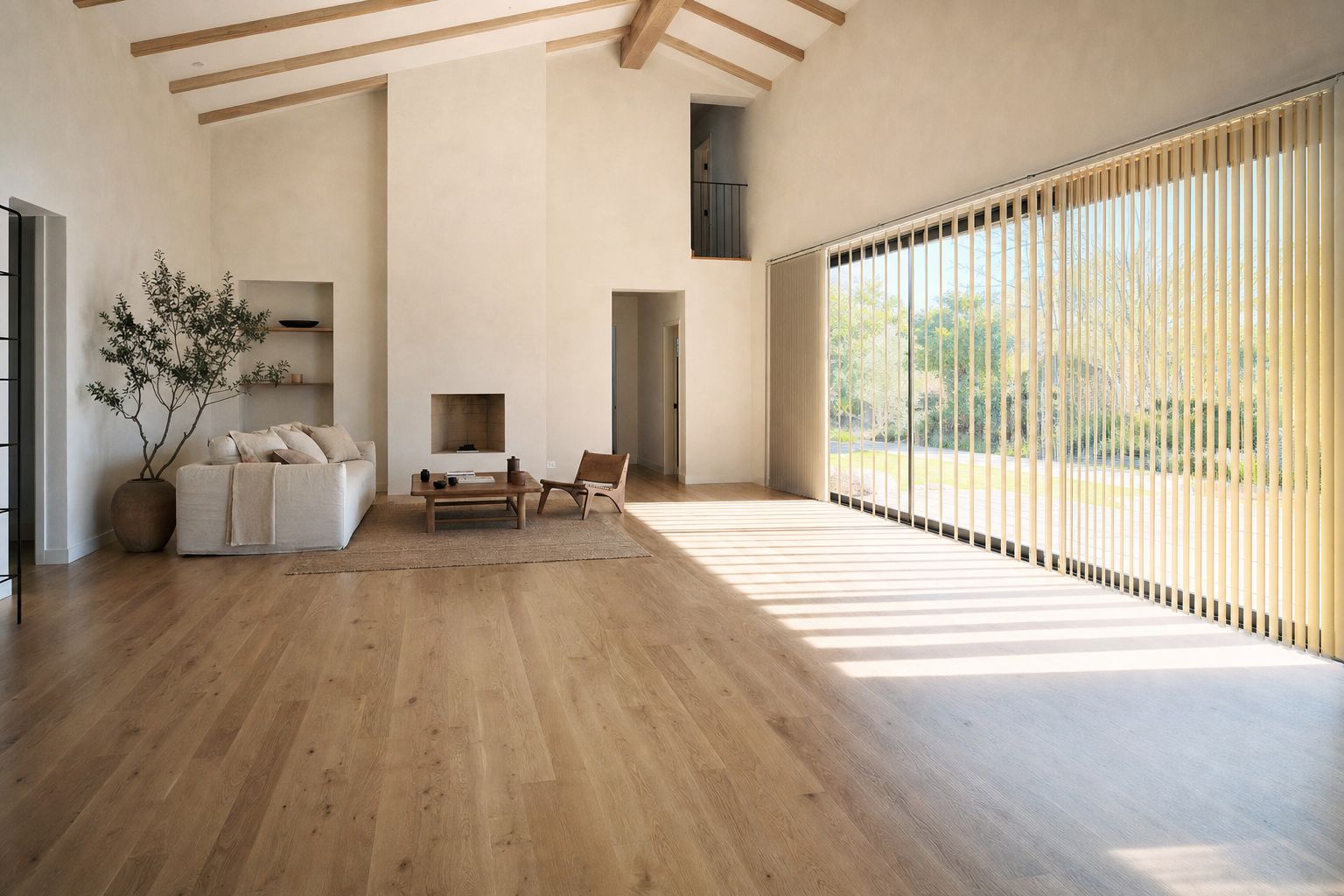
Fabric vanes hung from carriers in a top track, tilting in place for the light and drawing to the side for the doorway — the one covering whose travel matches the door it usually serves, and the honest answer for openings too wide for anything hung from a tube.
Blinds Company · Rated 4.8 out of 5 on Google
Free in-home measure · open 8am–9pm, 7 days
- The stack sits beside the frame
- Drawn open, the vanes gather into a narrow pleat on the wall instead of standing across the glass.
- Width is where it wins
- The track is fixed along its whole run, so there is no unsupported tube left to bow on a wide opening.
- Fabric or PVC, one track
- Woven vanes for rooms that are lived in, wipe-clean PVC for basements, laundries and offices.
- One vane swaps out alone
- A creased or chewed vane unhooks by hand and a fresh one clips on in seconds — no tools, no appointment.
In short
A vertical blind hangs upright vanes from a track: tilt them to manage light and sightlines, draw them aside to clear the opening completely. It solves the two problems wide glass creates — a doorway needs its covering gone, not raised, and a horizontal blind's tube starts to sag once the span grows — because a track fixed along its whole length has nothing to bend.
Inside this pageJump to one of 6 topics
The blind that moves like the door
Everything else we fit travels up and down. A vertical blind travels sideways: a row of vanes hanging from carriers in a top track, tilting in place to manage the light and drawing to the side to clear the opening entirely. That direction of travel is not a quirk — it is the product’s reason. A patio door is walked through a dozen times a day, and a covering that must be fully hoisted out of the way each time loses the argument by lunchtime. Drawn aside, a vertical gathers into a narrow pleat of vanes beside the frame, and the doorway is simply open.
The tilt matters as much as the draw. Vanes are slats turned upright: set them at an angle and a wall of glass admits daylight without sightlines, which is the same trade a venetian offers an ordinary window, at door scale.
Why width defeats every horizontal blind
There is a plain mechanical reason verticals still own the widest openings, and it deserves stating without mystique. A horizontal blind — roller, zebra, anything wound on a tube — hangs its entire fabric from a slim cylinder supported only at its two ends. That cylinder is a beam, and a beam loaded along its length by its own weight bows in the middle; stretch the span and the sag grows far faster than the extra width does, which is simply how long, thin things behave. A tube that has begun to bow no longer rolls its fabric square: edges wander, the roll creeps toward one end, and the blind fights you a little more every season. Slatted products fare no better stretched wide — every slat crosses the same distance, and the lift hauls all of them at once.
A track escapes the problem rather than solving it. It is fastened to the window head along its whole run, so there is no unsupported span left to bend, and each vane hangs from its own carrier bearing nothing but itself. Width — the dimension that quietly breaks horizontal products — is the dimension a vertical is most at home in.
Fabric or PVC vanes
Fabric is the version that surprises people out of their memory of the product. A wide, matte, woven vane in a colour that belongs to the room hangs with some of the manner of drapery, and fabric comes in weaves from light-filtering to nearly opaque, so the wall of glass can be dosed rather than switched. In a big glazed room this is the one to see before deciding anything.
PVC is the working version: wiped clean in a minute, unbothered by a damp basement or a laundry room, and the right specification where the window works harder than it decorates. The vane that gave the product its office reputation was a specific narrow, glossy louvre; the material survives that memory by being chosen in a wider, flatter, quieter form.
Decided at the measure
Three choices shape how a vertical lives, and all three are set before manufacture — which is why we make them standing at your door rather than at a desk. Which side the vanes stack: toward the fixed pane of a slider, clear of the handle, or split to both ends — the difference between a blind that cooperates with the door and one that argues with it, and the answer appears in ten seconds of watching how you actually walk through. Where the controls hang follows the same logic. And the drop is set so the vanes swing just clear of the floor: hems that brush the ground catch, drag and fray, and a blind ordered “right to the floor” is a blind ordered to age badly.
Where a vertical is the wrong answer
A window with a view you prize. Even tilted fully open, vanes stand in the outlook as a rhythm of verticals. Over a slider to a yard this reads as texture; across a picture window facing something worth watching, it is a tax on the reason the window exists, and a zebra blind or plain roller keeps the frame cleaner.
A bedroom slider that must go dark. Vanes overlap; they do not seal. A sleeping room behind glass doors needs a genuinely opaque product across the opening, and we will specify that instead — or as well — rather than promise a darkness this geometry cannot deliver.
A door that stands open all summer. Moving air moves vanes. Weighted hems calm them; nothing silences a breeze entirely, and a household that lives with the door wide from June to September should hear that ticking honestly described before ordering, not discover it after.
What it will not do
It will not black out, for the reason above. It will not hold perfectly still over an open door. And it will not do anything special for a window of ordinary width — every virtue it has is a width virtue, and on a modest opening a product with fewer moving parts does the same job with less machinery. What it will quietly keep doing is forgive damage: a vane creased by a dog or a moving sofa lifts off its carrier and a fresh one clips on in seconds, no visit required — which, on the most-trafficked opening in the house, is worth more than it sounds.
The mechanism
Vertical blinds, part by part
Draws sideways — the stack sits beside the frame, not across the glass
Vanes tilt like slats turned upright
Fabric or PVC vanes on the same track
One damaged vane swaps out alone, in seconds
Hour by hour
The same window, four times over
7am
Wide glass takes the morning all at once — there is no small part of a patio wall to leave uncovered. The draw is the wrong control this early, because pulling the vanes aside gives the whole opening away in one motion. Tilted a few degrees instead, they keep the sightline closed and let the room fill with light.
Noon
The largest glass in the house collects the most heat, and the midday question is how much of the room you give up for it. Fabric vanes run from light-filtering weaves to nearly opaque ones, so a wall of glass can be dosed by degrees — closing against noon does not have to mean switching the room to dusk.
6pm
The door is open and the vanes are drawn clear beside the frame, which is where a vertical spends the best hour of a summer evening. It also answers the breeze, as anything hanging in an open doorway does: a weighted hem gives a draught more to argue with, and parking the whole stack out of the opening does the rest.
After dark
Vanes close by overlapping, and every overlap admits a bright seam, with a little more at each end of the run. For a lounge that is privacy enough and always has been. For a bedroom behind sliding doors it is not, and the answer is a genuinely opaque product across the opening rather than a fabric asked to seal something it cannot.
Where it belongs
Rooms vertical blinds answer well
Sliding and patio doors, where the covering has to clear the opening entirely
Windows too wide for a tube-hung blind to span without complaint
Big glazed rooms that want the afternoon sun dosed, not blocked
In the room
How the choice changes the room
The rest of the range
Everything else, by how it moves
Winds onto a tube
Tilts to aim the light
Folds up out of the way
Slides across the opening
And the fitting itself
Our commitment
We measure it. If it does not fit, we remake it.
The visit is free. See the samples at your own window, get the quote, then decide.
Before you call
Questions worth answering before you book.
Why not just put one wide roller across the patio door?
Two reasons, one about the door and one about physics. The door first: a roller covering a doorway must be fully raised before anyone walks through, and a covering you operate end to end a dozen times a day is a covering you learn to hate. The physics second: a roller hangs its fabric from a tube held only at its two ends, and past a certain span that tube begins to bow under the load — after which the fabric no longer rolls square and the edges wander. A vertical's track is fixed along its entire length, so there is nothing to sag, and drawing it aside is one easy motion.
Aren't vertical blinds dated?
The memory is real and it attaches to one specific object: the narrow, shiny, greyish-cream PVC vane of every waiting room of a certain era. The mechanism deserves none of that — sideways travel is as useful as it ever was — and a current fabric vane, wide and matte and in an actual colour, presents so differently that most people do not connect it to the thing they remember. Whether it suits your room is a fair question; whether it will look like an office is no longer the risk it was.
Fabric vanes or PVC?
Fabric where the room is lived in: it hangs more softly, comes in weaves that filter light by degrees rather than switching it, and does most of the work of rescuing the product's looks. PVC where the room works: basements, laundries, offices, anywhere a wipe-down matters more than a drape. The two run on the same track, so the choice is entirely about the vane and can be made with samples held up at your own glass.
Which way should they stack, and does it matter?
It matters more than any other single decision about this product, and it is fixed at manufacture. Stacked to the wrong side, the gathered vanes hang in front of the panel that slides, and the blind obstructs the door forever; stacked over the fixed pane, or split to both ends, the doorway clears completely. The right answer falls out of watching which way your door opens and which side you pass on — which is a thing we do standing at the door during the free measure, not a thing we guess from a sketch.
Will one make the bedroom dark?
Not on its own. Vanes close by overlapping, and each overlap admits a bright seam, with a little more at the two ends of the run — the geometry cannot seal, whatever the fabric. Over a bedroom slider the workable answers are a genuinely opaque product across the whole opening instead, or a blackout layer paired with the vertical so the vanes keep the daytime job. Which of those suits the room is exactly the sort of question the visit exists to settle.
What happens when a vane gets damaged?
The easiest damage story of anything we fit. Each vane hangs independently from its own small carrier, so a creased, stained or dog-chewed vane unhooks by hand and a replacement clips on in a few seconds — no tools, no appointment, and the other vanes never know. Compare that with any one-piece blind, where localized damage means a whole new blind. On a family patio door, which takes more incidental knocks than any window in the house, that difference is a real part of the product's case.
What does tilting the vanes do that drawing them doesn't?
Drawing is for passage; tilting is for the hours in between. A west-facing wall of glass spends the late afternoon throwing low sun deep into the room, and vanes angled against that beam knock it down while the room keeps its daylight and much of its outlook — the same steering a venetian's slats give a window, turned upright and scaled to a door. As the sun drops further, the angle adjusts in a second. Fully open, fully shut and everything between are all real positions, which on the largest glass in the house is the difference between managing the light and surrendering the room for an hour.
The last chapter
We bring the samples to your windows.
We come to you, measure at your own windows, and go through fabrics and fits together. The visit costs nothing.
$99 off when you order three or more blindsApplied to your written quote at the measure.
Rather just talk?(437) 782-5452Answered 8am–9pm, 7 days
Free in-home measure
Measuring a patio door and finding every blind you know gets in its way?
Answered 8am–9pm, 7 days.
Page last checked 15 September 2026.