The range
Skylight blinds
Every other window on this site keeps hours — an east bedroom at six, a west living room at seven. A skylight keeps all of them. Overhead glass takes sun from first light to last, drops it into the room from the one angle no wall ever shades, and puts the blind somewhere gravity and your arm both argue with. Covering one properly is a small engineering problem, and this page is honest about that.
Blinds Company · Rated 4.8 out of 5 on Google
Free in-home measure · open 8am–9pm, 7 days
- Held, not hung
- Side channels and tension keep the fabric flat to a slope, where gravity pulls a blind out of position instead of into one.
- The window nothing shades
- Roof glass faces the whole arc of the sun, and no eave, roofline or tree stands in front of it at any hour.
- Pole, crank or motor
- The control is chosen by how far overhead the glass sits, and on a high skylight it decides whether the blind gets used at all.
- Specified at the opening
- Pitch, frame profile, recess depth, fixing surface and reach are five facts a photograph flattens, so the channels are cut from numbers taken on site.
In short
A skylight blind is a shade built for a sloped or horizontal roof window, held flat to the opening by side channels or tension rather than hanging from a headrail — because on a slope, gravity stops being the force that keeps a blind in position and becomes the force pulling it out of one. It is operated by pole, crank or motor depending on reach, and specified from the skylight's pitch and frame at the in-home visit, never from a photograph.
Inside this pageJump to one of 6 topics
The window that keeps every hour
This site introduces each blind by the hour it fixes, and the skylight defeats the format: it keeps all of them. A wall window takes sun for the hours its compass direction allows and is then finished for the day. The sky-facing pane is never finished.
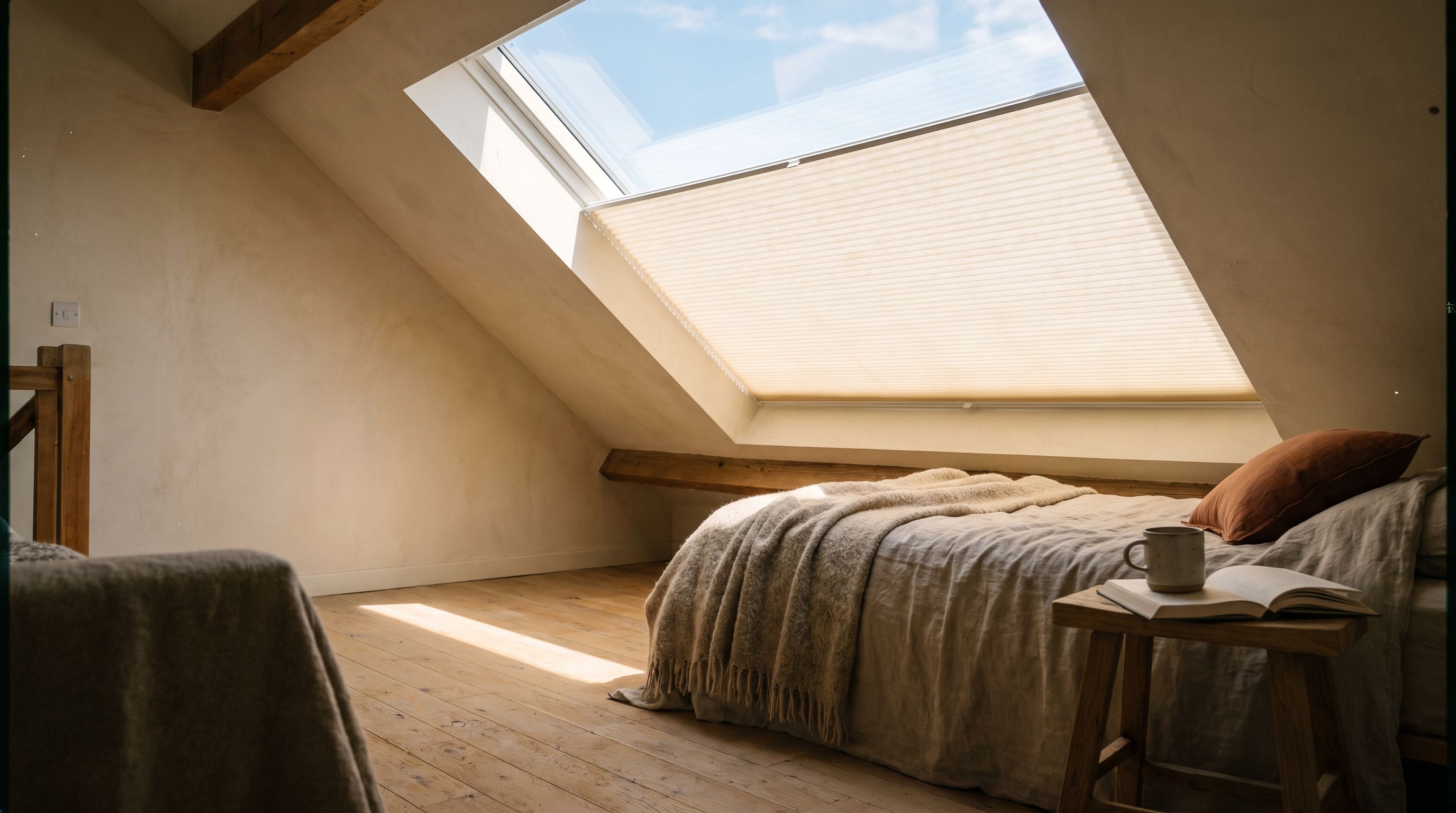
In June the sunrise does not creep across the floor of a loft bedroom — it lands on the pillow before five. At noon it admits the one angle of sun no wall window ever sees, straight down. All afternoon the heat compounds, because the room’s warm air rises to the glass and the glass keeps feeding it.
A skylight is the best light in the house and the least optional window to cover. It is also, mechanically, the hardest — which is what the rest of this page is about.
Gravity changes sides
Every blind downstairs is a quiet partnership with gravity. Weight is what pulls a roller’s fabric taut, what settles a shade’s folds, what keeps the whole assembly hanging where it was put. Tip the window toward the sky and the partner switches teams. Now weight pulls the fabric away from the glass so it bellies into the room, drags the bottom bar down the slope, and turns “half closed” into a position nothing will hold.
So a skylight blind carries its own discipline instead. The fabric’s edges run in side channels fixed along the opening; tension along the run keeps the cloth flat to the glass and parks it wherever you stop it. The channels do double duty — they are also what closes the light gap at the edges, which is why overhead blackout works at all. None of it is exotic, but all of it is built to the opening’s exact dimensions, which has consequences for how this product is bought: measured, not guessed.
The heat under the roof glass
Two facts gang up on the room below a skylight. Overhead sun is the most direct sun a house receives — no eave, no neighbouring roofline, no tree shades a pane that faces straight up the sky’s arc. And warm air rises, so the skylight sits in the hottest layer of air the room owns, adding its own gain on top all afternoon.
That is why an upper room under bare roof glass runs hotter than the floor plan says it should, and why shading the skylight gives back more comfort per square foot than shading almost any wall window. A reflective-backed or cellular fabric intercepts the direct sun before it lands in the room; the cellular kind holds a pocket of still air against the glass that works both seasons, July and January alike. The winter half of that argument is in the FAQ above, and it is not the smaller half.
Pole, crank or motor
A skylight is the one window where “how will you actually move it” is half the purchase. Within reach, no decision to make. Past reach, three honest options, in rising order of cost and convenience: a telescopic pole, fine for a blind adjusted a few times a day; a crank, easier on larger runs; and a motor — battery or wired — which is the only answer that keeps a genuinely high skylight adjustable rather than theoretically adjustable.
The unglamorous truth from installations: a blind that is awkward to operate settles into one position within a month and stays there for years, at which point the money bought a fixed panel. If the skylight is high, say so when you call, and have the motor conversation before the fabric one — it pairs naturally with the motorized blinds service, schedules included, so the bedroom can go dark at ten without anyone fetching a pole.
Why this one is specified at the visit
Most blinds are a width, a drop and a bracket. A skylight blind is a pitch, a frame profile, a recess depth, a fixing surface and a reach — five facts a photograph flattens and a phone call cannot carry. The channels are cut to the opening’s real dimensions; the mounting depends on what the surrounding surface is made of; the control depends on height nobody measures by eye.
So this is the page where our standard offer does its heaviest lifting: the in-home visit costs nothing, the measuring is ours and so is the responsibility for it, and the written quote that comes out of it names the system, the fabric and your installation date. If a skylight cannot be covered well — it happens, and the FAQ names the shapes — you hear that at the visit too, which is worth more than a hopeful order form.
What a skylight blind will not do
It will not fix the skylight itself. A unit that leaks, fogs between panes or has failed seals needs a glazier before it needs fabric — a blind fitted under a failing skylight is upholstery on a problem.
It will not turn roof glass into a ceiling. The room below gets cooler and darker on command; the physics between fabric and glass keeps a little of the heat regardless, and the honest claim is a large difference, not abolition.
And it will not work as a loose covering. Without its channels the system has nothing to hold position with — asked to dress a dome, a curb with no recess or an opening with nothing to fix into, it has no grip to offer, and we will say so at the window rather than leave a sagging compromise screwed to your ceiling.
The mechanism
Skylight blinds, part by part
Held in side channels or under tension, so the fabric stays where you set it on the slope
Blackout and insulating cellular fabrics for bedrooms and hot upper rooms
Pole, crank or motorised control, chosen by how far overhead the glass sits
Specified from the pitch and the frame at the visit — never guessed from a photo
Hour by hour
The same window, four times over
7am
A wall window waits for its compass direction to come round. A roof window does not — it faces the sky, so it takes the sun the moment the sun exists. In June that means a loft bedroom is lit before five, and the light arrives from overhead onto the pillow rather than creeping across the floor. Blackout fabric in side channels is what stops it.
Noon
This is the angle no wall window ever sees: the sun directly overhead, the pane aimed straight up at it, and nothing outside standing in between — no eave, no neighbouring roofline, no tree. A fitted blind intercepts that beam before it lands in the room below, which is most of what makes an upper floor liveable in July.
6pm
The heat arrives late and from the inside. The room's own warm air has been rising all afternoon to the highest point it owns, and the highest point is glazed, so the skylight keeps feeding the room long after the direct sun has moved on. A cellular fabric held close to the opening traps a pocket of still air and slows that exchange both ways.
After dark
Gravity is still working, which is the difference this product lives with. On a slope, weight pulls fabric away from the glass and walks the bottom bar downhill, so a blind left half closed does not stay there. Side channels and tension hold the position — and the same channels close the edge halo that makes overhead blackout possible at all.
Where it belongs
Rooms skylight blinds answer well
Bedrooms under a roof window, where June sunrise lands on the pillow before five
Upper rooms, lofts and stairwells that collect heat all day under overhead glass
Skylights out of reach, where the control method is half the decision
In the room
How the choice changes the room
The rest of the range
Everything else, by how it moves
Tilts to aim the light
Folds up out of the way
Slides across the opening
And the fitting itself
Our commitment
We measure it. If it does not fit, we remake it.
The visit is free. See the samples at your own window, get the quote, then decide.
Before you call
Questions worth answering before you book.
Why won't a normal blind work on a sloped ceiling?
Because every normal blind quietly employs gravity. A roller's fabric hangs flat because weight pulls it taut; a shade stays down because down is where weight wants it. Tilt the window toward the sky and gravity changes teams: the fabric bellies away from the glass, the bottom bar wanders down the slope, and anything set half-way slides to wherever weight takes it. A skylight blind replaces the borrowed force with its own — side channels that hold the fabric's edges flat to the opening, and enough tension along the run that the blind stays precisely where you set it, whether the glass is pitched, vertical or flat overhead.
Will a blackout skylight blind really darken a bedroom?
Done properly, yes — and a bedroom under a roof window is the most common reason this page gets read at all. Blackout fabric running in side channels sits close to the opening with its edges enclosed, which controls the halo that leaks around an ordinary blind's free sides. The caveat is the one we give at every blackout conversation: "dark" is a specification, not an adjective. Say how dark the room must be and whether that includes a June sunrise arriving before five, because the channelled fit is exactly what makes overhead blackout achievable — and exactly why it is not a product to improvise from stock parts.
How do I operate a blind three metres overhead?
You choose the reach before you choose the fabric — it is half the specification. Within arm's height, ordinary controls work as they do anywhere. Above that, a telescopic pole drives the blind well enough for a skylight used a few times a day; a crank makes larger or stiffer runs easier; and past a certain height — stairwells, double-height landings, the skylight over a void — a motor stops being a luxury and becomes the difference between a blind that gets used and one that holds a single position for years. We will say plainly at the visit which side of that line your skylight sits on.
Do skylight blinds actually help with summer heat?
More than the same square footage at any wall window, because a skylight works the entire day: it faces the sky, so no part of the sun's arc misses it, and the room's own warm air rises to meet the glass. A fitted blind stops the direct sun that would otherwise land in the room below, which is most of what makes a loft unbearable by mid-afternoon, and a cellular fabric adds a pocket of trapped air that slows the exchange in both directions. What it cannot do is turn roof glass into an insulated ceiling — on the worst days some warmth still builds between fabric and glass — but the change in the room underneath is immediate and large.
Can you quote from a photo of the skylight?
We can talk from a photo; we cannot specify from one. A photograph flattens exactly the facts the blind is built from — the pitch of the opening, the depth of the recess, the frame's actual millimetres, whether the corners are square, what the surrounding surface offers the fixings, and how the blind will be reached. A skylight blind is a machined fit rather than a hung rectangle, because the channels are cut to the opening, so the numbers have to be taken at the opening. That is what the free visit is for. Send the photo anyway when you call — it tells us which ladder to bring.
Do they fit every skylight?
Most, not all, and the frame decides. A framed roof window with a usable recess takes side channels happily, and because the blind is made to measured dimensions rather than to one manufacturer's catalogue, an unfamiliar frame is a measuring job, not a refusal. The genuinely hard cases deserve naming: domed and bubble skylights with no flat plane to run a channel along, openings with no recess and nothing around them to fix into, and glass so far past reach that the control conversation has to be settled before the fabric one. If yours is one of those, you will hear it at the visit, together with whatever the workable alternative is.
What about winter?
Roof glass is where a house sheds heat most enthusiastically — warm air collects at the highest point of the room, and the highest point is glazed. A blind cannot re-insulate a skylight, but a cellular fabric held close to the opening in its channels traps a layer of still air across the glass, and stillness is most of what insulation is. The enclosed fit matters again here: a loose covering under a cold skylight mostly decorates the draught, where a channelled one interrupts it. Bedrooms under roof windows feel the difference on the first cold night, usually as the absence of a chill that used to arrive at the pillow.
The last chapter
We bring the samples to your windows.
We come to you, measure at your own windows, and go through fabrics and fits together. The visit costs nothing.
$99 off when you order three or more blindsApplied to your written quote at the measure.
Rather just talk?(437) 782-5452Answered 8am–9pm, 7 days
Free in-home measure
Trying to work out how you would even operate a blind four metres up a sloped ceiling?
Answered 8am–9pm, 7 days.
Page last checked 16 August 2026.