The range
Bedroom blinds
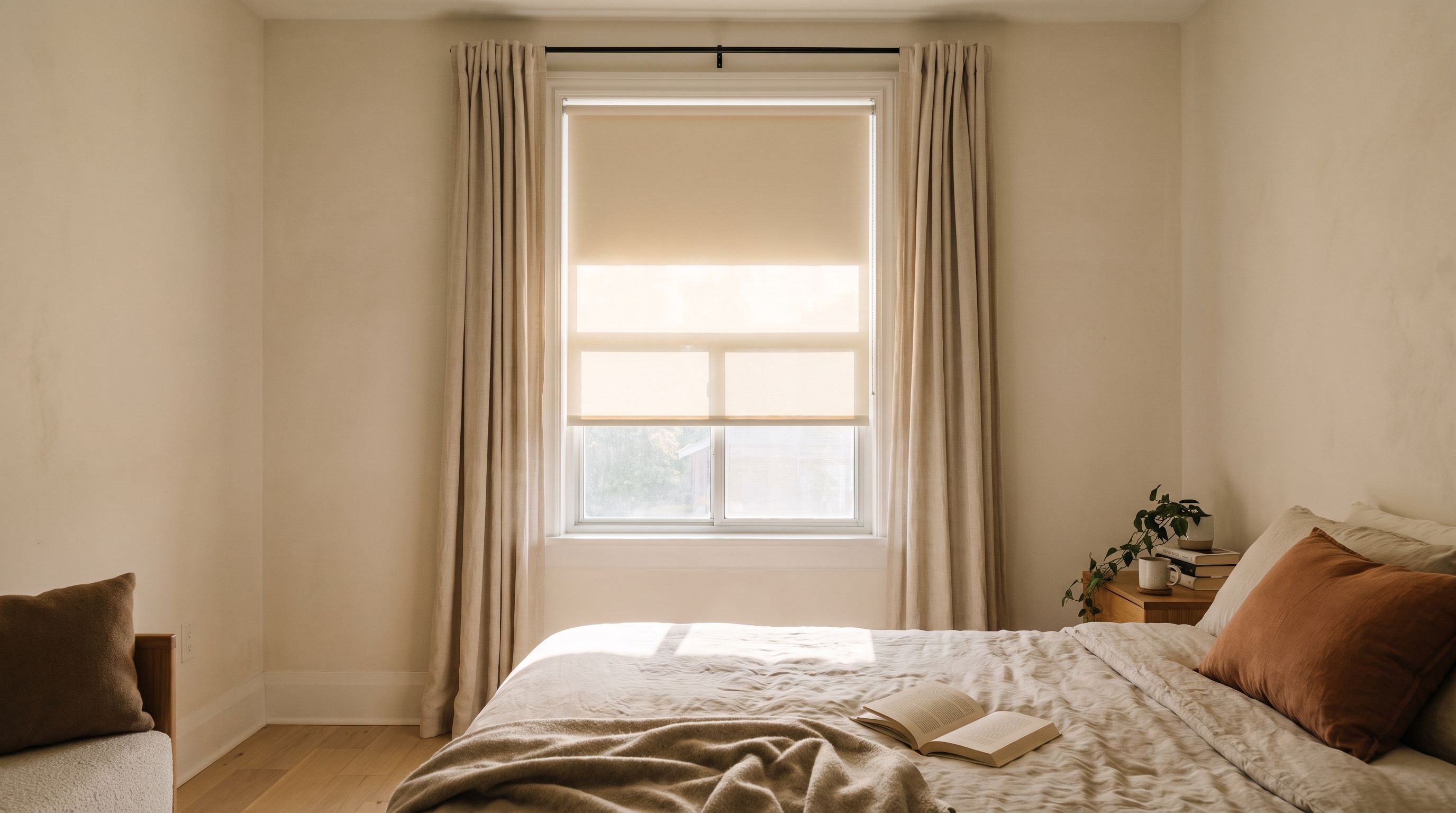
This site's first chapter is a bedroom at six in the morning, and it is first because nothing else a window does matters as much as the hour it wakes you. Every choice on this page runs backwards from the time you meant to get up.
Blinds Company · Rated 4.8 out of 5 on Google
Free in-home measure · open 8am–9pm, 7 days
- Blackout as the starting point
- In this room the opaque fabric is the default and everything else has to argue its way in.
- The edges decide the darkness
- Nothing crosses the cloth itself; what you see at sunrise is the outline around it, and that is a fitting decision rather than a fabric one.
- Cordless where a child sleeps
- A wand, a spring or a motor instead of a looped chain — our standard in any room a child uses, at no extra charge.
- Day sleepers change the fit
- Say so at the measure and the whole specification moves: deeper in the recess, side channels, denser cloth.
In short
For a bedroom the answer is nearly always blackout — a roller or cellular shade in a fabric no light passes through, fitted deep in the recess so the edges give little away, with a control you can work in the dark and nothing corded where a child sleeps. We measure and install them across Toronto and the GTA, and the in-home visit costs nothing.
Inside this pageJump to one of 6 topics
Six o’clock, and who decided it
For a long stretch of the year, Toronto is bright before six in the morning. An east-facing bedroom takes that light full in the face: the sun clears the horizon, finds the window, and switches the room on — and from that moment you are negotiating with it through one thin layer of fabric.
An ordinary blind loses that negotiation politely. Most fabrics dim a room rather than darken it; they turn sunrise into a glow, and a glow is enough to end sleep for anyone who isn’t exhausted. Which is why this page starts at blackout and works outward, not the other way around. In a living room, blackout is one option on a long list. In a bedroom it is the default, and everything else has to argue its way in.
What blackout means at the glass — and at the edges
A blackout fabric is not a darker weave; it is a cloth built so that light does not cross it at all. Hold one up to a bright window and the window is gone. That half of the promise is absolute, and no amount of money improves on it.
The edges are where the promise gets negotiated. A blind is a rectangle hanging in or over an opening, and the sun is a specialist in the space between the two. What reaches the room is a thin outline — down each side, along the sill, over the top — and how much of it you see is decided by the fit rather than the fabric.
Fitted deep in the recess, the outline narrows. Fitted outside the opening and oversized, the top and sides go quiet. With side channels, it goes quieter still.
How dark each of those steps actually gets, and what the last one costs, is the blackout blinds page’s whole subject. The short version for this page: the fabric is the easy promise, the edges are the real one, and the difference between the two is fitting — which is a thing we do, not a thing you order.
The same window at ten at night
The bedroom window works a second shift. After dark the light runs the other way — the room is lit, the street is not, and the window that woke you at six now reports on you at ten. Bedrooms face the street as often as any room in the house, and they are the room people are least willing to have on display.
The good news is that this problem needs no second product. A blackout is opaque in both directions by definition, so the blind bought for the morning closes the evening as part of the deal. What it does add is a habit: a bedroom blind is one you genuinely move twice a day, every day, which turns out to be the strongest argument on this page for making that movement effortless.
A control you can find with your eyes closed
A bedroom blind is operated at the two blurriest moments of the day — last thing, and first thing. Whatever the mechanism, it has to work for a person who is half asleep in a dark room, and that shapes the choice more than any catalogue photograph.
A looped chain is fine at noon and a small hunt at midnight. A wand is findable but talks to the frame when it swings. The two answers that hold up are a spring-loaded cordless bottom bar — grab anywhere, lift or pull — and a motor, which removes the walk entirely. On a schedule, a motorized blackout is quietly wonderful in this room: the blind opens at your hour and the room brightens like a slow lamp, which is a kinder way to wake than any sound.
Where a child sleeps, the choice narrows by rule rather than preference — nothing with an accessible looped cord, ever. Cordless is our standard in any room a child uses, at no extra charge, and we apply it to any room a child merely visits often, because bedrooms swap occupants more than adults expect.
Two layers, and what each one is for
Plenty of finished bedrooms wear both a blind and a curtain, and the pairing is not decoration doubled — the layers hold different jobs.
The blind is the working layer. It sits close to the glass, carries the blackout, and decides the hour the room wakes. The curtain is the dressing layer: it frames the window, softens a room that is otherwise mattress and drywall, adds a real measure of warmth and hush, and covers the blind’s hardware so the working layer can stay plain and inexpensive.
We make and fit both, which matters at the measure for one practical reason: where the blind mounts today decides where a curtain track can go next year. Tell us a curtain is even a possibility and we will position the blind so the two never argue.
What the measure asks about a bedroom
Mostly questions about time, because the window is the easy part.
Which way the room faces, and what hour the light lands on the bed. What hour you would like it to. Whether anyone sleeps here in the daytime, because that answer moves the specification more than any other.
Whether a child uses the room — that one sets the control by rule. Whether curtains are a someday, which quietly decides the mount. And whether there is a socket within reach, in case the motor conversation goes the way it usually goes.
Fabrics are held against the glass in the room’s own light, the fit options are shown at the actual recess, and the quote you keep names the darkness in plain words. No deposit, and nothing owed for the visit.
The mechanism
Bedroom blinds, part by part
Blackout fabric as the starting point, not the upgrade
Fitted deep in the recess, where the edge light lives
Cordless as standard in any room a child uses
Pairs with a curtain when the room wants both layers
Hour by hour
The same window, four times over
7am
The hour you chose, as against the one the sun chose. By late June the light has been in an east bedroom for well over an hour by now, and an ordinary fabric has spent all of it turning sunrise into a glow — which is enough to end sleep for anyone not exhausted. Opaque cloth is what leaves the decision with the alarm clock.
Noon
Nobody is in the room, which is exactly when the specification for a shift worker gets decided. Afternoon light is stronger than dawn light and it holds for hours, so the perimeter a night sleeper forgives becomes the entire problem: fitted as deep as the recess allows, side channels where it is shallow, cloth dense enough not to glow at two.
6pm
The summer bedtime problem, and it belongs to west-facing rooms. The sun is still on the glass at the hour a child is being put down, and the room has been storing the day's heat since noon. One blackout answers both complaints, and in a cellular build the honeycomb takes some of the warmth out of the argument as well.
After dark
The window changes sides. The room is the bright one now, and a bedroom is the last room in the house anyone wants reporting on them — a job the blackout does without a second product being bought. What decides this hour is the control: a cordless bottom bar you can grab anywhere, or a motor, because nobody hunts for a chain at midnight.
Where it belongs
Rooms bedroom blinds answer well
Blackout roller blinds, the plainest route to a dark room
Blackout cellular shades, where the window runs cold as well as bright
Curtains layered over a blind, when the room should look as well as sleep
In the room
How the choice changes the room
The rest of the range
Everything else, by how it moves
Winds onto a tube
Tilts to aim the light
Folds up out of the way
Slides across the opening
And the fitting itself
Our commitment
We measure it. If it does not fit, we remake it.
The visit is free. See the samples at your own window, get the quote, then decide.
Before you call
Questions worth answering before you book.
What is the best blind for a bedroom?
A blackout roller if the question is purely about light, a blackout cellular shade if the room is also cold at night, and a roman made up with a blackout lining if the window is on show. All three stop the light at the fabric; they differ in warmth, in looks and in price, in that order. What we would steer you away from is anything sheer-first — a bedroom can borrow a zebra blind's daytime manners, but it needs an opaque layer somewhere before it has earned the name bedroom.
Will a blackout blind make the room completely black?
Through the fabric, yes — nothing usable comes through a true blackout cloth, and no upgrade improves on that part. Around the fabric is the honest caveat. A blind hangs inside or in front of an opening, and the morning finds the gap between the two, so what reaches the room is a thin outline of light. How much depends on the fit rather than the cloth — a deep recess fit narrows it, side channels close it almost entirely — and that is a fitting decision made at the measure, not a fabric one.
Do children's bedrooms need different blinds?
Different in one non-negotiable way — no accessible cord. Cordless is our standard in any room a child uses and it costs nothing extra: a wand, a spring mechanism or a motor instead of a looped chain. Beyond that the specification is the same as any bedroom, though we would add that children sleep through less light than adults believe, right up until the June evening they refuse to, which is when the blackout earns its keep.
Should the blind be paired with curtains?
If the budget allows both, they do different work and neither replaces the other. The blind owns the hour — it is the layer that decides when the room gets light. The curtain owns the room: it wraps the window in fabric, warms the look, quiets a hard wall and hides the hardware. Bought one at a time, the blind comes first, because a beautiful room that wakes you at six has its priorities backwards.
Is a motor worth having in a bedroom?
It is the room where a motor stops being a convenience and becomes something you use twice a day. Set to a schedule, the blind turns into the gentlest alarm in the house — the room brightens at the time you chose rather than the time the sun chose — and in the evening it closes without anyone crossing a dark room to do it. If one room in the house gets a motor, we would put it here.
I sleep during the day. Does that change the specification?
It raises the bar on everything. Afternoon light is stronger than dawn light and it lasts for hours, so the edges a night sleeper forgives become the whole problem. For shift work the answer is a blackout fitted as deep as the recess allows, side channels where the recess is shallow, and a fabric dense enough that the cloth itself is not glowing at two in the afternoon. Say so at the measure — it changes the fit, not just the fabric.
The bedroom faces west. Is the morning argument wasted on it?
The problem moves to the other end of the day. A west bedroom is bright exactly when children are being put to bed in summer, and it holds the day's heat into the night. The same blackout answers both, and the cellular version adds an insulating layer that takes the edge off a warm evening. The hour is different; the blind is not.
The last chapter
We bring the samples to your windows.
We come to you, measure at your own windows, and go through fabrics and fits together. The visit costs nothing.
$99 off when you order three or more blindsApplied to your written quote at the measure.
Rather just talk?(437) 782-5452Answered 8am–9pm, 7 days
Free in-home measure
Still weighing a blackout roller against a cellular shade for the room you sleep in?
Answered 8am–9pm, 7 days.
Page last checked 16 August 2026.