The range
Blackout blinds
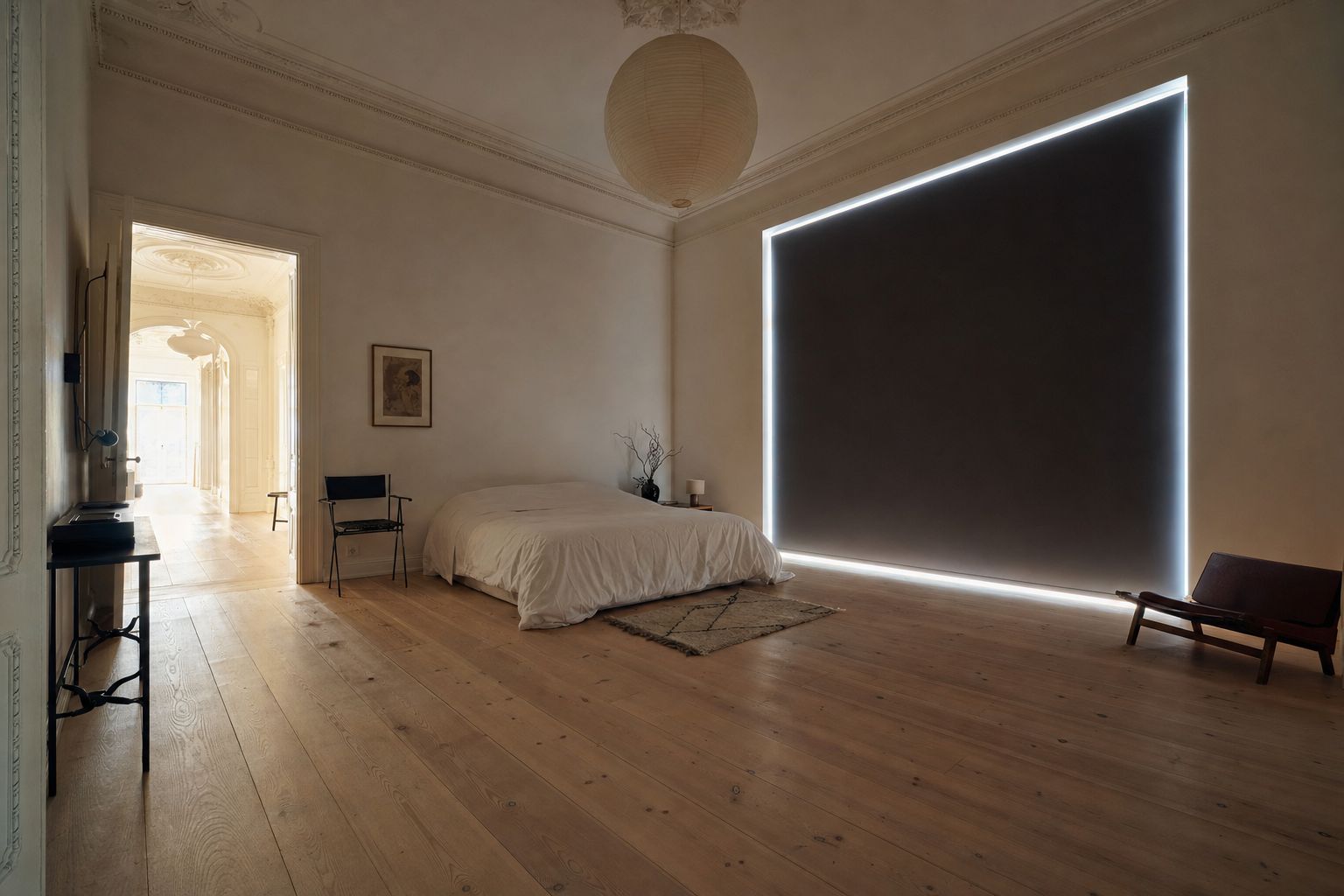
A blackout blind carries a fabric that light cannot cross — but the fabric is only half of the job, because a bedroom goes properly dark only when the edges are dealt with too, and edges are a question of measurement and mounting rather than of cloth.
Blinds Company · Rated 4.8 out of 5 on Google
Free in-home measure · open 8am–9pm, 7 days
- Opaque cloth, no weave
- A true blackout textile is built so that light does not cross it at all, and no amount of July sun changes that.
- The perimeter is the real job
- A blind has to run slightly narrower than its opening to move at all, and at sunrise that clearance turns into a thin bright outline.
- Three ways to close an edge
- Side channels, an oversized wall mount, or a cassette over the roll — the recess depth decides which of them your window wants.
- Cordless or motorized drives
- The same darkness on a spring drive or a motor, and cordless is the standard in any room a child sleeps or plays in.
In short
A blackout blind pairs a fully opaque fabric with a fit tight enough to close the bright outline an ordinary blind leaves around itself — side channels or a deep recess handle that second half — so a bedroom can hold real darkness past sunrise instead of merely turning the light down.
Inside this pageJump to one of 5 topics
Darkness is built, not bought
The intuition most people arrive with is that blackout is a property of fabric — pick the opaque cloth and the job is done. The fabric part is real: a true blackout textile passes nothing, and no amount of July sun changes that. But a window is not a rectangle of cloth. It is a rectangle of cloth surrounded by clearances — the small gaps a moving blind needs so it does not grind against its own frame — and at dawn every one of those clearances becomes a light source.
This is why the same fabric can produce a genuinely dark bedroom in one house and a disappointing one next door. The difference was never the cloth. It was the depth of the recess, the squareness of the opening, and whether anyone thought about the edges before the blind was ordered. We think about the edges first, at the measure, with a tape in the actual opening — because the fix chosen afterwards is always clumsier than the fit chosen before.
The six o’clock problem
Toronto’s summer sun is an early riser. By late June, first light is in an east-facing bedroom well before six, and it does not knock. If your alarm is set for seven, an ordinary blind hands you a daily hour of half-sleep you never agreed to give up — light enough to rouse you, too early to get up.
That stolen hour is the most common reason anyone calls us about this product, and it is worth being precise about what solves it. A dim-out blind turns the volume down; on a bright morning that still leaves the room unmistakably awake. Only an opaque fabric with its edges handled keeps the room on your schedule instead of the sun’s — which, at the height of a Toronto June, is the difference between a bedroom and a sundial.
Three ways to close the edges
Every blackout installation is really a decision about its perimeter, and there are three tools.
Side channels. Slim tracks fixed to the frame that the blind runs inside, so the fabric’s edges travel within a closed groove instead of past an open gap. This is the most complete answer and the one we reach for when a room must be as dark as it can physically be — a shift worker’s bedroom, a nursery on an east wall.
Oversizing on the wall. Mounting the blind outside the opening, wider and taller than the window itself, so the fabric overlaps the surrounding wall on every side. Light now has to travel around a generous overlap and through whatever space remains behind the blind — most of it gives up. This suits windows whose recess is too shallow for a neat inside fit, and older openings that were never square to begin with.
A cassette at the head. The top of a blind has its own leak: light spilling over the roll and down between the fabric and the glass. A cassette encloses the roll on three sides and shuts that route. In a room where the eye has adapted to darkness, the strip of light over the head of a bare blind is more conspicuous than everything else combined, and the cassette is what retires it.
Which combination your window needs is not something to decide from an article — it depends on the recess depth, the squareness of the opening and how absolute the darkness must be, which is why the measure comes before any promise about the outcome.
Where we would talk you out of it
A blackout blind has one setting worth having, and that is the honest limit of it. Down, the room is dark; up, the window is bare; the positions in between shade part of the glass fully and leave the rest alone. In a living room or a home office — rooms whose complaint is glare at some hours and gloom at others — that all-or-nothing character is the wrong shape for the problem, and a zebra blind or a screen roller will serve the room better every daylight hour.
It is also not a privacy product in the daytime sense. With the blind up you have no privacy at all, and most people do not live behind a lowered blackout all day. A street-facing room that wants to be seen less without going dark wants a different fabric doing a different job.
The rule we quote at the door: blackout for the rooms that sleep, something adjustable for the rooms that live.
What it cannot promise
It will not silence the street — an opaque fabric is not a soundproof one, and a blind that meaningfully muffled traffic would be a renovation, not a window covering. It will not cool a room on its own; it reduces the sun’s contribution and leaves the rest to your thermostat. It cannot do anything about light arriving under the bedroom door or from a hallway — it controls its window and nothing else. And it will not give you the soft, glowing half-light some people picture when they say “blackout”; that gentler effect belongs to dim-out fabric, and if it is what you actually want, we would rather tell you so at the measure than sell you the wrong kind of dark.
The mechanism
Blackout blinds, part by part
Fully opaque fabric, with no weave for daylight to find
Optional side channels that close the glow along each edge
Fitted inside a deep recess or oversized on the wall, decided at the measure
Cordless and motorized drives on the same darkness
Hour by hour
The same window, four times over
7am
At a low sun angle the light arrives almost level with the glass, which is precisely the direction the side clearances face. That is why a blind can look flawless at noon and betray a bright outline at first light: the gap down each edge is pointed straight at the source. Side channels are the answer to this hour specifically.
Noon
Overhead sun is the easy case for the fabric and the hard one for the head. Light dropping from above finds the space over the roll and slides down the gap between cloth and glass, which no fabric can do anything about — that particular leak is a cassette's whole reason for existing.
6pm
West glass takes the hardest light of the day at the lowest angle, for an hour and a half at a stretch. It is when a blackout stops being about sleep — a media room, a screen nobody can read, a west bedroom in July. Down is the only useful setting, which is also the honest limit of this product.
After dark
An opaque fabric is opaque in both directions, so the blind bought to keep the morning out keeps the evening's eyes out as well, with nothing further to buy. What it cannot touch is light arriving under the door or down the hallway: a blackout blind governs its own window and nothing else in the room.
Where it belongs
Rooms blackout blinds answer well
East-facing bedrooms that are bright long before anyone agreed to be awake
Shift workers whose night happens while the street is having its afternoon
Nurseries, where a nap depends on persuading the room it is ten at night
In the room
How the choice changes the room
The rest of the range
Everything else, by how it moves
Tilts to aim the light
Folds up out of the way
Slides across the opening
And the fitting itself
Our commitment
We measure it. If it does not fit, we remake it.
The visit is free. See the samples at your own window, get the quote, then decide.
Before you call
Questions worth answering before you book.
Will a blackout blind make my room completely dark on its own?
The fabric will hold up its end — nothing comes through the cloth itself. What betrays most installations is the perimeter. A blind mounted inside the window opening has to be cut slightly narrower than the opening or it would scrape the frame with every use, and at sunrise that clearance turns into a thin, surprisingly bright outline. Whether that outline matters to your sleep is personal; closing it is not guesswork. Side channels along the frame, or a blind oversized and mounted on the wall so it overlaps the opening generously, take care of it — and which of the two your window wants is exactly the kind of thing settled at the measure, not after the blind arrives.
What is the difference between blackout and dim-out fabric?
Dim-out — sometimes sold as light-filtering — softens a window: the room drops to a pleasant half-light and the fabric itself glows. Blackout is a different construction entirely, built so that no light survives the crossing. Held up in a bright showroom the two can look deceptively similar, which is why we bring both to your window and hold them against your own glass at your own worst hour. One shows you a gentle version of the day outside; the other shows you nothing at all.
Are blackout blinds only for bedrooms?
Bedrooms are the obvious case, but not the only one. A media room earns one for the same reason a cinema paints its walls dark. A nursery earns one twice a day. And anyone nursing a night shift knows the particular cruelty of trying to sleep at two in the afternoon behind a blind that was never designed for it — for that job, blackout is not a luxury but the difference between five hours and eight.
Do blackout blinds help with heat as well as light?
Somewhat, and the reason is simple physics rather than a specification we would put a number on. Sunlight that lands on furniture and floor becomes heat inside the room; an opaque blind intercepts that energy at the window instead, so less of it ends up in your living space. A closed blackout blind in July makes an east or west room noticeably easier on the air conditioning. It is not climate control, and we will not pretend it is — but it moves the problem in the right direction while doing its main job.
Can I have daylight in the room and still get blackout at night?
Yes, and the honest way to get it is two products rather than one asked to do both. A blackout roller does its work at night; a [zebra blind](/zebra-blinds/) or a solar screen handles the daytime hours in front of it, on its own bracket in the same opening. One blind that claims to be both usually does each job worse than the dedicated version. The pairing is common enough in bedrooms that we quote it as a matter of course when the room clearly lives two lives.
How quickly can a blackout blind be installed once I order?
Each blind is made to the measurements taken at your window, so there is a making period between the quote and the installation — and rather than quoting you an estimate we might not control, we do the thing we can stand behind: your installation date is confirmed in writing at the quote. You know the date before you commit a dollar, and it is our name on it.
Are they safe in a child's bedroom?
A child's bedroom is precisely where most blackout blinds go, so the question matters. Our default in any room a child sleeps in or plays in is cordless — a spring drive or a motor instead of a hanging chain — and that default costs nothing extra. There is no loop to reach, which is the entire hazard, removed rather than managed.
The last chapter
We bring the samples to your windows.
We come to you, measure at your own windows, and go through fabrics and fits together. The visit costs nothing.
$99 off when you order three or more blindsApplied to your written quote at the measure.
Rather just talk?(437) 782-5452Answered 8am–9pm, 7 days
Free in-home measure
Wondering whether your bedroom needs side channels or just the right fabric?
Answered 8am–9pm, 7 days.
Page last checked 16 August 2026.