The range
No-drill blinds
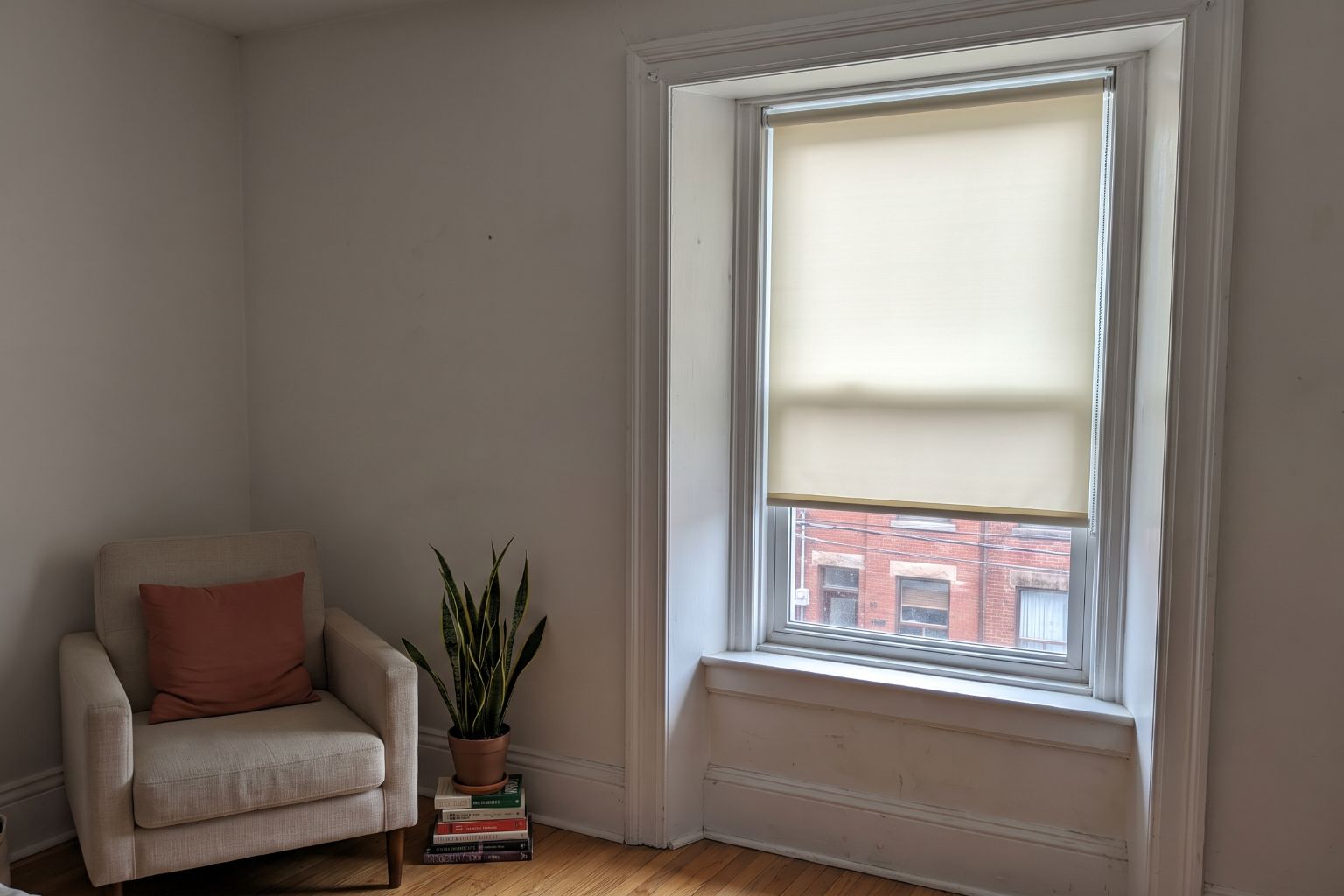
The morning sun does not read your lease. Plenty of Toronto windows sit behind a rule — a landlord's, a condo board's, a window warranty's, or the quieter rule that hundred-year-old trim deserves — that takes the drill off the table without doing anything about the light. No-drill blinds close that gap: mounting systems that hold by grip, clip, magnet or adhesive, and leave the frame exactly as the rule requires.
Blinds Company · Rated 4.8 out of 5 on Google
Free in-home measure · open 8am–9pm, 7 days
- The frame picks the mount
- Tension, clip-in, magnetic or adhesive is decided by what your window is made of, not by preference.
- Nothing to patch afterwards
- No filler, no touch-up paint and nothing for an end-of-lease inspection to find.
- It moves out with you
- No screwed blind can claim that, though a fit made for one recess may want a new bar in the next.
- Limits said out loud
- Width and fabric weight beat grip at some point, and you hear where that point is at the window.
In short
No-drill blinds are ordinary blinds on extraordinary mounts: spring-tension bars that brace across the window recess, slim frames that clip into a uPVC window's glazing gasket, magnetic brackets for steel doors, and adhesive mounts for flat, sound surfaces. Matched to the right frame they hold for years, and when they come down there is nothing to patch on the way out — which is the entire point for renters, condo owners and anyone guarding original woodwork.
Inside this pageJump to one of 6 topics
The rule and the light
The sun does not read a lease. It arrives through a rented bedroom window at six on a June morning exactly as it does through an owned one — but the owned window can take a screw, and the rented one sits behind a clause, a deposit and a final inspection. Condo owners meet the same wall by a different route: in many Ontario corporations the windows and their frames are common elements, the building’s property rather than yours, and drilling into one invites correspondence nobody enjoys. Add the owner of a century home whose original trim is worth more than any blind that could hang on it, and the buyer of new uPVC windows whose warranty ends at the first pilot hole, and you have this page’s whole audience: four people with nothing in common except a window that needs covering and a frame that must not be touched.
Four ways to hold on
Remove the screw and four forces remain, and every no-drill product on the market is one of them wearing different plastic.
Friction. A spring-loaded bar braces outward against the sides of the window recess, and the blind hangs from the pressure. Nothing meets the frame but rubber. Its natural territory is light fabrics in ordinary widths, inside a recess with two decent parallel faces.
The clip. On uPVC and composite windows the glass is retained by a rubber glazing bead, and a slim frame can seat into that bead — the blind rides on the window itself, sits a few millimetres off the glass, and moves with the sash, which is why it is the one system that suits a tilt-and-turn. Weight troubles it far less than it troubles a bar.
The magnet. Steel takes a magnetic bracket, and in a house steel means the entry door more often than any window — conveniently, because a door is exactly where a blind that travels with the thing it covers earns its keep.
Adhesive. High-bond pads fix a bracket to a flat, sound surface — stronger than most people expect on modern paint or bare vinyl, and the only one of the four with a real removal risk on old paint, which is why it is our last suggestion rather than our first.
The arithmetic that says no
Every honest page on this subject needs this paragraph. A screwed bracket can always be beefed up; a tension mount’s grip is fixed by the recess it lives in and cannot be upgraded from the catalogue. The load, meanwhile, is not fixed at all: widen the blind and the fabric weight grows with it, upgrade the fabric to blackout weight and it grows again, and the grip stays exactly where the recess set it.
Somewhere along that line the margin runs out — and the failure is not dramatic, which is the trap. A marginal mount passes its first week without complaint and lets go months later, in the humid depth of summer, at a worse time than any refusal would have cost. This is why we measure rather than estimate, and why some windows on this page’s subject are told “screws”: a no at the window costs a conversation, and a hopeful yes costs you the blind.
The frame picks the system
Taste picks fabrics; the frame picks the mount. uPVC and composite windows, with their glazing gasket, are the best served here — the clip-in frame was engineered around exactly that bead, carries weight well, and tolerates the tilt-and-turn hardware that sweeps most surface-mounted blinds off their own window. Older wooden windows usually offer the opposite gift: deep, square recesses a tension bar braces in happily — provided the faces really are parallel, which is a measurement, because a window that has settled is narrower at one height than another and holds a bar on two points instead of two faces.
Aluminum frames, with no bead and often shallow reveals, are the awkward customer, and sometimes the honest answer there is a screwed fit or a different window. Steel doors take magnets. Painted wood takes adhesive last, and reluctantly. None of this is decided by preference — tell us the frame material when you call, and most of the decision is made before we knock.
Three jobs we will not give it
Wide, heavy blinds. The grip-versus-load arithmetic has a losing end, and big blackout spans live there. A window past the comfortable margin gets screwed brackets, a clip frame where the window type allows one, or a plain no — never a tension bar and crossed fingers.
Drapery. A curtain pole is a lever loaded at its worst angle, and cloth is the heaviest thing hung at any window; no grip mount carries that. If the room wants curtains, it wants real fixings — which in a rental usually turns the conversation back toward a blind that needs none.
Anything outdoors. Every mount on this page assumes still air, steady temperature and dry fixings. Outside the glass, wind alone dismantles all four systems, which is why outdoor blinds bolt into the building’s structure and keep their own page.
Measured like a machined part
A screwed blind forgives a small measuring error — the bracket absorbs it. A no-drill blind has no bracket to absorb anything. The mount only works if the blind meets the opening at the dimensions the system needs, so the measurement carries the entire job, and the visit is built around that: the recess measured at more than one height, because settled windows differ between them; the glazing bead examined if the window is uPVC, because the clip seats into its exact profile; the paint judged honestly before adhesive is so much as mentioned; the frame material recorded first, because it picked the system before anyone opened the fabric case.
What you keep is a written quote naming the mounting method for every window — useful to you, and readable by any landlord or board that wants the method on paper — with your installation date committed in writing on it. The visit costs nothing anywhere in Toronto and the GTA, and if one of your windows genuinely needs the drill after all, that sentence is spoken at the window, free, rather than discovered after the blind is on the floor.
The mechanism
No-drill blinds, part by part
Four mounting systems — tension, clip-in, magnetic, adhesive — matched to the frame, not to a preference
Nothing pierced, so there is no filler, no touch-up paint, nothing for an inspection to find
The blind moves out with you, which no screwed blind can honestly claim
Plainly told limits — width and weight defeat grip, and we say exactly where
Hour by hour
The same window, four times over
7am
First light is the complaint that starts most of these calls, and at a rented window it arrives with a clause attached: no holes, and an inspection at the end of the lease. Every system on this page answers the light without answering to the drill, which is the only reason the category exists at all.
Noon
Midday tests a tension mount with nothing whatsoever, and the quiet hours are exactly what flatter a marginal fit. A bar braced in deep, square reveals has margin to spare; one in a shallow or settled opening is passing a test it will fail in August, which is why the recess gets measured at more than one height.
6pm
The evening a window actually gets opened is when a mount shows its manners. A surface-hung blind fouls a tilt-and-turn sash the moment it swings inward; a clip-in frame seats into the glazing bead and travels with the window. In an apartment where that one sash is the ventilation, it decides the system on its own.
After dark
Dark is where the specification gets named, because "dark" is a specification. A clip-in frame encloses the fabric's edges and closes down the halo of light around them; a tension-mounted blackout roller behaves like any recess-hung blind and keeps a fine line at each side. A shift worker's bedroom chooses between those two before anything is ordered.
Where it belongs
Rooms no-drill blinds answer well
Renters whose lease and deposit both say no holes
Condo owners whose window frames legally belong to the corporation
New uPVC windows under warranty, and century-home trim above a drill bit
In the room
How the choice changes the room
Editorial product studies illustrating the specification — not photographs of client installations.
The rest of the range
Everything else, by how it moves
Tilts to aim the light
Folds up out of the way
Slides across the opening
And the fitting itself

Our commitment
We measure it. If it does not fit, we remake it.
The visit is free. See the samples at your own window, get the quote, then decide.
Before you call
Questions worth answering before you book.
What actually holds it up?
One of four forces, chosen to match your frame. A tension bar braces outward against the two sides of the window recess and hangs the blind on the friction that pressure buys. A clip-in frame seats into the rubber glazing gasket a uPVC window already has, so the blind rides the window itself, a few millimetres off the glass. A magnetic mount holds to steel, which in most homes means the entry door rather than any window. An adhesive mount bonds a bracket to flat, sound paint or vinyl. None of the four pierces anything, which is the entire brief — and each holds a different amount on a different frame, which is why "no-drill" names a category rather than a product.
Will there be any trace when it comes down?
Nothing that needs filling, sanding or repainting — that is the standard the category exists to meet, and tension and clip systems meet it cleanly. Precision about the small print: rubber feet can, over years, leave a soft matte print in paint — pressure, not damage, and nothing a deposit was ever docked for — and a clip lifts out of the gasket it sat in. The honest asterisk is adhesive on old paint. A good pad releases cleanly from sound modern surfaces; on chalky, aged or many-times-painted wood it can bring the top layer with it. That is why adhesive is our last resort on painted frames, and why your written quote names the mounting method for every window, where a landlord or board can read it before anything goes up.
Can I have blackout without drilling?
Yes — and on the right window the no-drill route is the better blackout. A clip-in frame holds its fabric just off the glass with the edges enclosed by the frame itself, which closes down the halo of light that leaks around an ordinary blind's open sides. A tension-mounted blackout roller behaves like any recess-hung blind instead: a fine line of light at each edge, reducible but never abolished. If the room has to be properly dark — a shift worker's bedroom, a nursery at seven on a June evening — say so when you call, because "dark" is a specification, and it is the specification that picks between those two systems.
Do the systems work on every window?
No, and the refusals are structural rather than commercial. A tension bar needs a recess with two reasonably parallel faces deep enough to brace between. A clip-in frame needs the rubber glazing bead that uPVC and composite windows have and wooden or aluminum ones do not. Magnets need steel, which windows almost never are. Adhesive needs a flat, clean, sound surface — and still sits last in our preference on paint. Most GTA homes have windows that take at least one system comfortably; which one, and with how much margin, is a measurement. Where a window of yours genuinely wants screws, you hear that at the visit instead of buying a slow failure.
I rent and I move often — what happens to the blind?
It comes with you, which no screwed blind can honestly claim. Taking one down is a few minutes' work and leaves the frame as the lease demands — that much is the product doing its job. The caveat worth carrying to the next apartment: a no-drill blind is made to grip one specific opening, so a fit that held perfectly in one recess is not guaranteed in the next. Sometimes it transfers, sometimes the new dimensions want a new bar or frame. Budget for the possibility rather than assume it away, and keep the written quote — it records your mounting system and sizes, which makes the next conversation short.
Can a no-drill blind be motorised?
Sometimes, and the answer runs through weight like everything else on this page. A battery motor lives inside the roller tube, which adds mass to precisely the thing the mount has to hold, so friction mounts accept motors reluctantly and only in small sizes. The clip-in frame is the comfortable case: it hangs its load on the window's own glazing bead, which minds the extra grams far less. If your situation is "rental, tall window, out of reach" — and it often is exactly that — bring both wishes to the measure, because the right compromise between them depends entirely on the actual window.
What is the widest window you would trust to a tension mount?
There is no single honest number, because the limit is a relationship rather than a figure. The bar's grip is set by the recess it braces in and cannot be upgraded; the load climbs with every centimetre of width and every layer of fabric weight. A narrow window in deep, square reveals holds with margin to spare; a wide opening in shallow ones may not hold at all; and everything between is why we measure. What we will not do is read a maximum off a table and let the summer humidity test it. If your window sits past the comfortable line, the sentence you hear at the visit is "screws or a clip frame" — not a hopeful yes.
The last chapter
We bring the samples to your windows.
We come to you, measure at your own windows, and go through fabrics and fits together. The visit costs nothing.
$99 off when you order three or more blindsApplied to your written quote at the measure.
Rather just talk?(437) 782-5452Answered 8am–9pm, 7 days
Free in-home measure
Not sure whether your windows take a tension bar, a clip-in frame, or honestly need screws?
Answered 8am–9pm, 7 days.
Page last checked 16 August 2026.