The range
Faux wood blinds
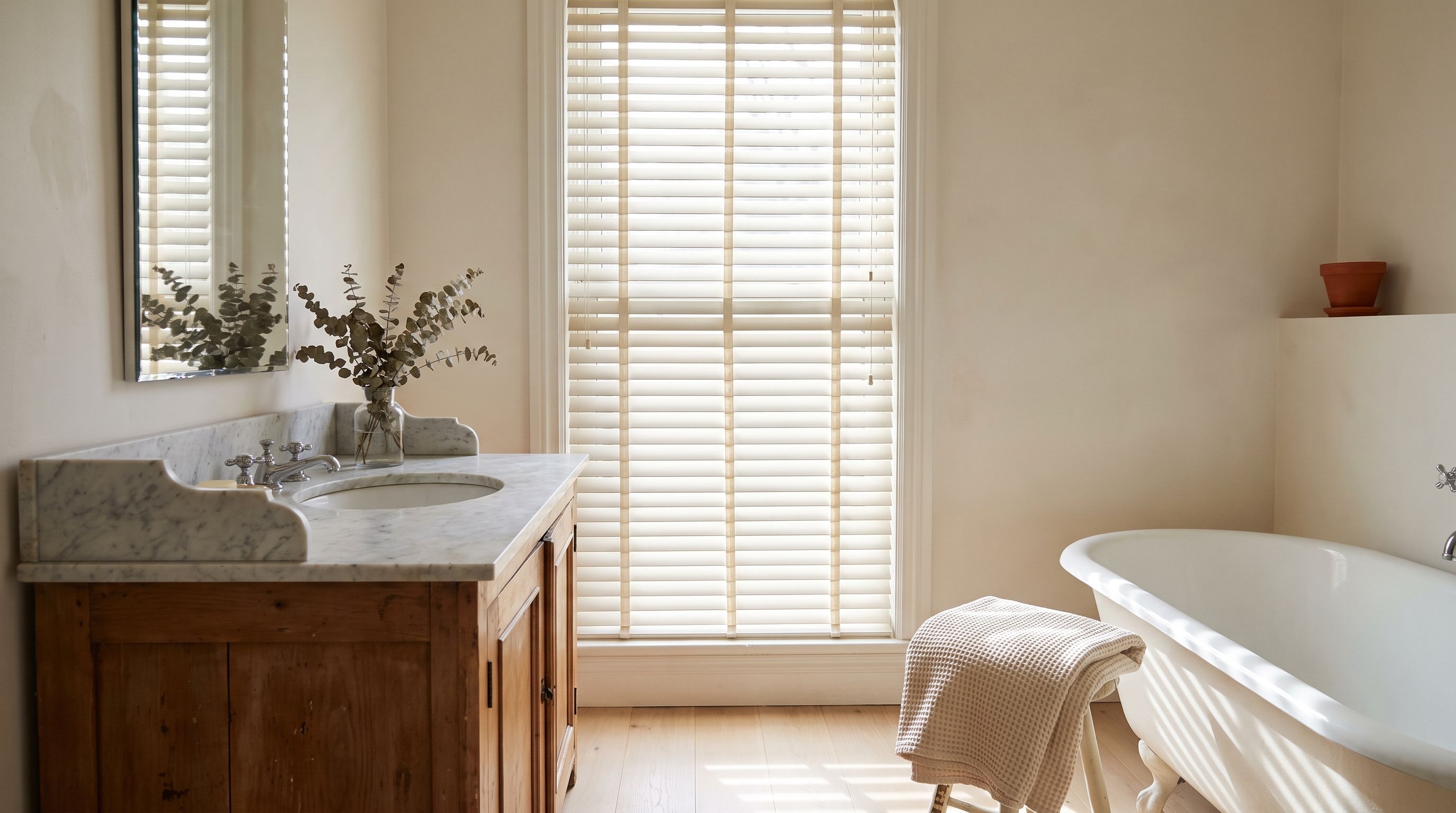
A venetian with slats of PVC composite finished toward timber, chosen less for how it looks than for what it survives: the daily bathroom fog, the fine grease of a working kitchen, the damp of a below-grade room — every condition that slowly ends a real wood blind.
Blinds Company · Rated 4.8 out of 5 on Google
Free in-home measure · open 8am–9pm, 7 days
- Composite, not coated timber
- The slats are PVC composite rather than wood, which is the entire reason the product exists.
- Takes a proper wash
- Warm water, mild soap and a cloth, as often as the room needs it — not a careful dusting.
- Denser than timber
- The weight is real, and past a certain width it changes the build to two blinds or a motorised lift.
- The same tilt as a venetian
- Nothing about the mechanism is different here; the slat material is the whole decision.
In short
A faux wood blind runs composite slats on the standard venetian tilt mechanism. Up close it does not pass for timber and is not really trying to; its case is indifference — steam, splash and damp leave it unchanged, and it wipes properly clean — which makes it the correct slat, not the cheap one, for bathrooms, kitchens and basements.
Inside this pageJump to one of 7 topics
Chosen for the room’s worst hour
Every blind gets admired in the afternoon and lives through the rest of the day. This one is specified for a room’s hardest moments: the bathroom at 7am, fogged to the ceiling; the kitchen window at six in the evening, catching steam off a pot; the basement in March. A faux wood blind is a venetian whose slats are a PVC composite, and the composite is there for one reason — those hours ruin real timber and do nothing at all to this.
How it moves
The mechanism is the standard venetian one, and everything true of it is true here: slats raise to clear the glass and tilt to steer the light, the daily control is the tilt, and the closed position never fully seals — all of it is on the venetian blinds page. Nothing on this page is about movement. The slat material is the entire decision, and it is a bigger decision than the name “faux wood” makes it sound.
The honest comparison with the real thing
Across a room, a good composite slat in a woodgrain finish passes. At arm’s length it does not, and we would rather say so here than have you notice at home: a printed or embossed grain is a pattern, and patterns repeat — the same figure recurring along the slat and again on the next one, where real timber never repeats itself once. If what you want is the object — the depth, the variation, the way grain takes evening light — that is the wood blind, in a dry room, and it is worth its price.
The gap closes almost completely in solid painted finishes. A painted slat shows no grain whether there is timber or composite underneath, so a white or grey venetian in composite is visually the same purchase as the painted wood version — and at that point the composite’s practical advantages stop being a compromise and start being free.
What it stands up to
Steam. Composite does not exchange moisture with the air, which is the entire mechanism behind the cupping that ends timber blinds in bathrooms. The fog can come twice a day forever; the slats stay flat.
The kitchen film. Cooking puts a fine mist of grease into the air that settles and binds with dust; on a stained timber finish it can only be dusted at, gently, while it slowly wins. A composite slat takes a warm, damp, slightly soapy cloth as often as needed and comes back to new.
Damp and cold. Below-grade rooms swing humid in ways that are hard on organic materials and irrelevant to this one. Basement and laundry windows are exactly where it belongs.
Those three rooms tend to arrive as a set, and an order that covers bathroom, kitchen and basement together is incidentally where the $99 off three or more blinds lands.
Choose the finish at the distance the room is seen
The word “faux” makes people inspect the sample from six inches away. The room rarely does. A bathroom blind is normally read from the doorway or the mirror; a kitchen blind sits beyond a counter; a basement window may be above eye level. Hold the sample where the finished slats will actually be and judge it from the place the room is used. A restrained painted finish often looks more convincing there than an emphatic printed grain trying too hard to announce wood.
Scale matters with the same honesty. Narrow slats make a small opening feel ordered and give finer changes of angle. Wider slats draw calmer horizontal lines across larger glass and leave fewer surfaces to wipe, but they also build a taller stack when the blind is raised. Neither proportion is universally better. The window height, the view you want back when the blind is up and the other horizontal lines in the room decide it together.
The last sample test is deliberately unglamorous: clean it. A pale painted slat shows whether a mark lifts in one pass; a textured grain shows whether a cloth catches in its embossing. In a room chosen for steam or cooking film, the finish has to survive the maintenance routine as convincingly as the core material survives the moisture. If the owner dislikes wiping the sample, they will dislike wiping a full blind more.
The weight, which is the real trade
Composite is denser than timber, and every slat carries the difference. On ordinary windows you will never think about it. On a wide one you will think about it every time you raise the blind: the lift becomes deliberate rather than casual, and past a certain width the build itself has to change — the opening split into two blinds, or the lift handed to a motor. None of this is a flaw; it is a property. A quote for a very wide blind in this material that never mentions how it will be lifted is a quote missing its hardest question.
What it will not do
It will not be timber at close range, and the buyer it disappoints is the one who wanted it to be — for a formal, dry room where the window is part of the furniture, real wood is the better object and we will say so at the measure. It will not go dark, because no slatted blind does. And it will not make a wide window feel light: the weight is the honest price of the indifference, and the two belong in the same sentence whenever this product is recommended — which is why, on this page, they are.
The mechanism
Faux wood blinds, part by part
PVC composite slats on the standard tilt mechanism
Indifferent to steam, splash and damp
Takes a proper wash a stained finish never could
Denser than timber — width changes the build
Hour by hour
The same window, four times over
7am
Seven is the bathroom's hardest hour — the mirror gone, fog to the ceiling, condensation running down the coldest surface in the room, which is the glass this blind hangs on. Composite slats make no moisture trade with that air at all, so the thousandth shower leaves them exactly as flat as the first one did.
Noon
Daylight is when the material shows itself. Across a room a woodgrain composite passes; at arm's length the printed figure repeats where timber never would. In a solid painted finish the question disappears entirely — there is no grain to repeat — and the practical advantages stop being a compromise and start being free.
6pm
Dinner puts steam and a fine mist of grease into the air together, and both settle on whatever hangs by the window. Tilt the slats flat and the whole blind wipes as one plane with a warm soapy cloth, then tilt the other way and do the second face — the wash a stained timber finish would never forgive being given weekly.
After dark
Privacy is where any venetian stops short, whatever the slat is made of. Closed slats overlap without sealing, so a lit bathroom still reads as a lit bathroom in outline from the garden. It is a real limit rather than a fault, and on a ground-floor window it is the reason to pair the tilt with something opaque.
Where it belongs
Rooms faux wood blinds answer well
Bathrooms, where the daily steam cycle rules real timber out
Kitchen windows near the sink and the stove
Basements and laundry rooms, damp and hardworking
In the room
How the choice changes the room
The rest of the range
Everything else, by how it moves
Winds onto a tube
Tilts to aim the light
Folds up out of the way
Slides across the opening
And the fitting itself
Our commitment
We measure it. If it does not fit, we remake it.
The visit is free. See the samples at your own window, get the quote, then decide.
Before you call
Questions worth answering before you book.
Will guests be able to tell it isn't real wood?
From the sofa, usually not. Standing at the window, yes — the grain is a printed or embossed pattern, and a pattern repeats where real timber never does. We think the honest framing matters: this is not a fake that succeeds or fails at fooling people, it is a different material with its own case — unbothered by moisture, wipeable, easier on the budget — that happens to wear a wood finish. If close-up conviction is the actual requirement and the room is dry, real timber is the better buy and we will say so.
Why exactly does real wood fail where this survives?
Timber constantly trades moisture with the air around it, and a blind slat — long, thin, wide — makes that trade unevenly, so a bathroom's fog-and-dry rhythm gradually bows it, and the bow never comes back out. Composite makes no such trade. The humidity that is slow poison to a wood blind is simply weather to this one, and the thousandth shower leaves the slats as flat as the first did. That single difference is most of the reason the product exists.
Is it just the budget version of a wood blind?
It usually costs less, and that is genuinely not the frame we choose it by. In a bathroom, a kitchen or a basement it is not the cheaper alternative to timber — it is the only slat that belongs there, and specifying it is correctness, not economy. The rooms where it honestly is the second-best object — dry, formal, the window admired at close range — are the rooms where we would spend the difference on real wood, and we will say which room is which at the measure.
What does the extra weight actually change?
Nothing you would notice on most windows, and a fair amount past that. Composite slats are denser than timber, so a wide blind gathers real mass: raising it stops being an absent-minded gesture, and at some width the design itself should change — either the opening splits into two blinds that lift separately, or the lift goes to a motor. Which answer suits your window is a measuring-tape conversation, and it happens before you order, not after the blind arrives heavy.
How do I clean them?
With less ceremony than anything else slatted. Close the slats one way and wipe the face in long strokes with a warm damp cloth — mild soap if the kitchen has been busy — then close them the other way and do the second face. That full wash, which a stained timber finish would never forgive being repeated, is precisely what this surface is for. Between washes a dusting cloth or a vacuum brush is plenty.
Can they go right inside a shower area?
The bathroom generally, yes — steam in the air is exactly the condition they are built for. Directly inside a shower enclosure, where water lands on them as water, no: the slats would be untroubled, but the headrail and tilt hardware above them are mechanisms, and standing water is unkind to any mechanism whatever hangs beneath it. Ordinary bathroom humidity, including the daily fog on the glass, is fully inside the product's comfort zone.
The last chapter
We bring the samples to your windows.
We come to you, measure at your own windows, and go through fabrics and fits together. The visit costs nothing.
$99 off when you order three or more blindsApplied to your written quote at the measure.
Rather just talk?(437) 782-5452Answered 8am–9pm, 7 days
Free in-home measure
Wondering whether the kitchen window deserves the real timber instead?
Answered 8am–9pm, 7 days.
Page last checked 6 September 2026.