The range
Roller blinds
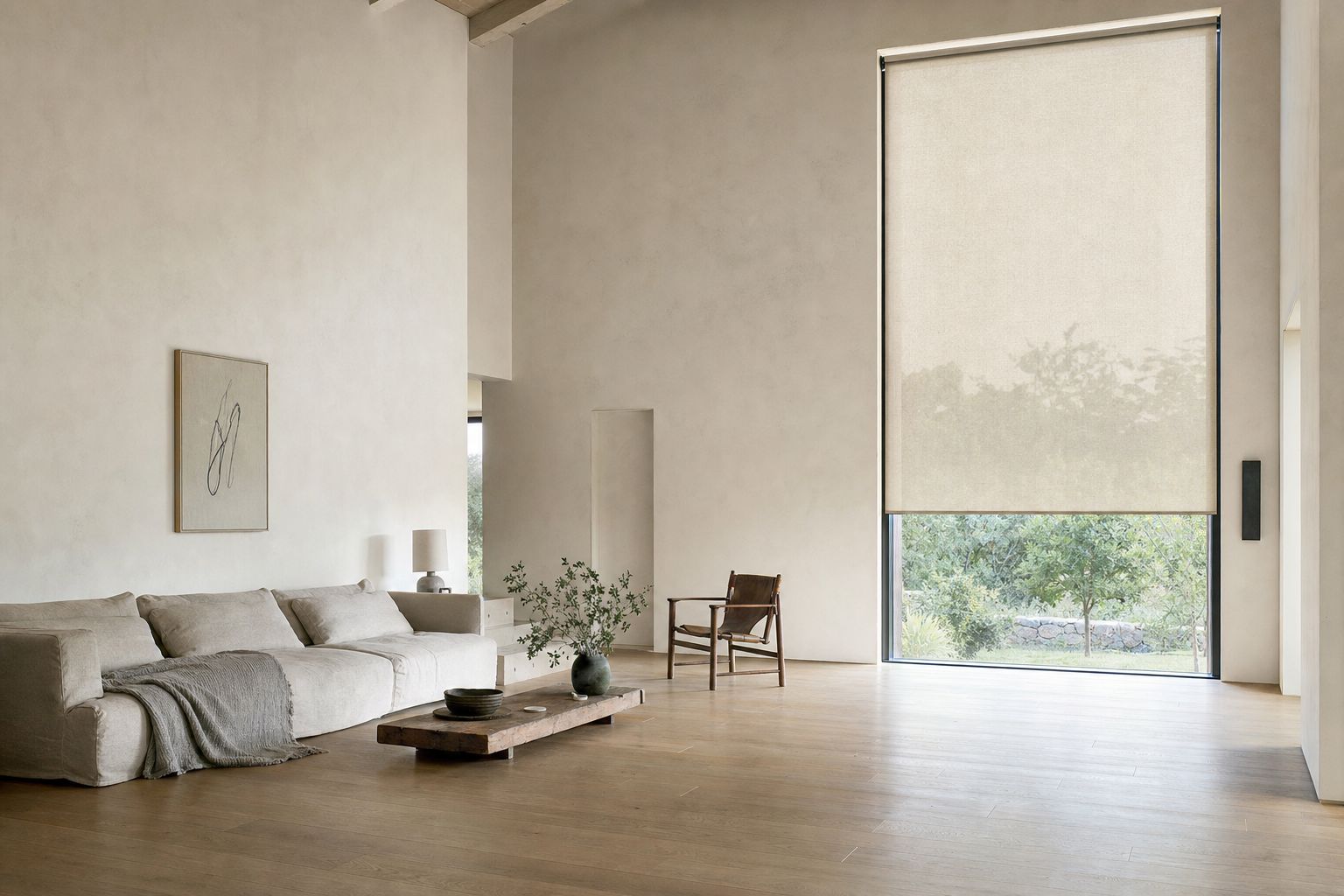
A roller blind is the simplest machine in the catalogue — one rectangle of cloth wound onto one tube — and that simplicity is why it ends up on more windows than anything else we fit: with no mechanism to deliberate over, the entire decision collapses into choosing the right fabric.
Blinds Company · Rated 4.8 out of 5 on Google
Free in-home measure · open 8am–9pm, 7 days
- One tube, one panel
- Nothing to tangle, tilt or misalign — the only mechanical choice left is what turns the tube.
- Chain, spring or motor
- All three ride on the same brackets, so the drive never limits which fabric you can have.
- The widest fabric range we carry
- Solar screen, light-filtering, dim-out and blackout, all on identical hardware.
- Fits a shallow recess
- It asks for less front-to-back depth than anything comparable, so it goes where slatted blinds cannot.
In short
A roller blind is a single flat panel of fabric on a tube, driven by chain, spring or motor, and because the hardware never changes, the cloth decides everything — the same blind becomes a sun screen, a soft light filter or a full blackout depending on nothing but the fabric wound onto it.
Inside this pageJump to one of 6 topics
One tube, one cloth, and everything that follows
Strip any blind down far enough and you find a roller trying to get out. A tube turns; fabric wraps on or pays off; a bar at the bottom keeps the cloth flat and honest. There are no slats to tilt, no bands to align, no folds to dress — which means there is almost nothing to go wrong, and just as importantly, nothing for the eye to snag on. Lowered, a roller reads as a plane of colour or texture, as quiet as a painted wall.
The drive is the only mechanical choice, and it is a small one. A chain loop turns the tube directly. A spring drive does away with the chain — pull to position, and the blind holds. A motor does the same from a remote, a schedule or a phone. All three ride on the same brackets, so the choice never constrains the fabric, and the fabric is where the real decision lives.
The fabric range, from screen to blackout
No other product we make offers this spread of cloths, and the honest way to shop it is by job rather than by swatch colour.
Solar screens are woven with deliberate openness. They exist for glare: the weave knocks down the brightness that lands on screens and eyes while keeping the view and much of the daylight. The tightness of the weave is the whole specification — more open keeps more world, more closed keeps more comfort.
Light-filtering cloths are the opposite bargain. No view survives them in either direction, but the light that comes through arrives softened and even, and the fabric itself becomes a gently glowing surface. They suit rooms that want brightness without an audience — a ground-floor bathroom, a bedroom that likes waking gradually.
Dim-out fabrics push further down the same road: most of the light stopped, a dusk-like room at midday, without the total commitment of blackout.
Blackout cloth completes the run, and it is enough of its own subject — edges, channels, the geometry of real darkness — that it has its own page.
The span between these families is the roller’s real argument. Whatever a window’s problem turns out to be, some cloth in this range answers it, on hardware that never needs to change.
Why the default deserves the name
Most windows do not have interesting problems. They have one problem, the same at breakfast as at dinner: too much glare, or too little privacy, or a neighbour’s kitchen forty feet away. For that great majority, the honest recommendation is the simple product with the correct fabric — not the cleverest mechanism in the catalogue, but the one that solves the actual complaint for the least money and the fewest moving parts.
This is also the product that scales most gracefully across a whole home. One language at every window, a different dialect behind each — and because the mechanism asks for less front-to-back depth than anything comparable, it fits the shallow recesses of newer condos where bulkier products simply do not go.
The edges and roll direction are part of the specification
Blackout, privacy and neatness are all decided partly outside the fabric. A roller cloth has to be narrower than its brackets and tube, which leaves a small strip beside each edge. On an ordinary living-room screen that strip is irrelevant. In an east-facing bedroom it can be the brightest thing in the room. The same blind can therefore be correctly described as blackout fabric and still be the wrong blackout installation.
Mounting closer to the glass usually keeps those edge gaps tighter, provided the recess is deep and clear enough. An outside mount can cover beyond the opening instead, trading a little more presence on the wall for better overlap. Side channels are the final step when darkness, rather than simple dimming, is the job. These are fitting choices, so they should appear on the quote beside the fabric rather than be discovered after it arrives.
The cloth can also roll from the back of the tube, close to the glass, or from the front, dropping clear of the tube. The close roll is compact and helps control the gap. The forward roll can clear a projecting handle, deep trim or another obstruction that would rub the cloth. It also changes which face of a patterned fabric is seen around the roll. A five-second clearance check at the window settles the choice; a product thumbnail cannot.
Finally, the bottom bar needs somewhere clean to land. A projecting crank, tiled sill or uneven trim can push it forward and make an otherwise level blind look wrong. The simple mechanism deserves a precise outline, because the outline is almost all there is to see.
Where it loses the argument
A roller is one cloth with one personality, and some rooms need more than one. The living room that wants daylight at noon and discretion at dusk is better served by a zebra, which carries both moods in a single blind. A bedroom that must go truly dark needs the blackout conversation — fabric and edges — covered on the blackout page, because an ordinary roller in dark cloth is not the same promise.
Doors are the other honest exception. A blind over a door you walk through must be fully raised for every crossing, and a covering that is always up is a covering you did not need. Sliding and patio doors want products that move sideways, and we will say so rather than fit a roller that becomes a shelf ornament by August.
What it will not give you
It will not aim light. Slatted blinds tilt to steer sun at the ceiling; a roller only ever subtracts, from the top of the glass downward, and the strip it covers is covered completely while the strip below stays bare. It will not give a screen-fabric window any privacy after dark, for reasons physics is stubborn about. And it will not furnish a room the way cloth with drape and fold can — a roller is tailored, not dressed, and a window that wants softness is usually asking for a roman shade instead. What it will do is the plain job, plainly, for years — which is why half the answers in this catalogue quietly begin with one.
The mechanism
Roller blinds, part by part
One tube and one panel — nothing to tangle, tilt or misalign
The widest fabric range we carry, solar screen through to blackout
Chain, spring or motor on the same brackets
Needs less depth than anything comparable, so it fits recesses others cannot
Hour by hour
The same window, four times over
7am
East glass takes the sun almost horizontally, so it lands on faces and screens rather than on the floor. A solar screen roller half-down cuts that beam without turning the lights on — the one hour where a roller's exact stopping height matters more than its fabric.
Noon
The sun is overhead and the problem stops being glare and starts being heat. A screen cloth blocks most of the radiant load while leaving the garden visible, which is the trade a curtain cannot make: it is either open or it is not.
6pm
West windows get the hardest light of the day at the lowest angle. A roller comes all the way down and stays there, and because there are no slats there is no line of light lying across the room in stripes.
After dark
Now the window is a mirror and the job is privacy, not light. A blackout cloth on a roller sits flat against the reveal — the seams that leak at night are at the sides, which is a measuring problem, and the measuring is ours.
Where it belongs
Rooms roller blinds answer well
Kitchens and bathrooms, where a flat wipeable panel earns its keep daily
Whole-home fit-outs that want one calm language at every window
Any window whose problem stays the same all day and just needs one good answer
In the room
How the choice changes the room
The rest of the range
Everything else, by how it moves
Tilts to aim the light
Folds up out of the way
Slides across the opening
And the fitting itself
Written for this product
Roller blinds in the GTA
Our commitment
We measure it. If it does not fit, we remake it.
The visit is free. See the samples at your own window, get the quote, then decide.
Before you call
Questions worth answering before you book.
What do the percentages on screen fabrics actually mean?
A solar screen is a woven fabric, and the percentage describes how open that weave is — the share of the surface that is actually hole rather than thread. A more open weave keeps more of your view and more brightness while cutting less glare; a tighter one trades the view for stronger glare control and more daytime privacy. Neither end is better, and the number that suits a north-facing kitchen is wrong for a west wall of glass. It is the kind of choice that settles itself in about a minute with real samples held against your own window, and almost never settles from a chart.
Will a screen fabric give me privacy at night?
No, and we would rather you hear it from us than discover it in the first week. A screen works by an asymmetry of light: in daytime it is brighter outside than in, so you see out and the street sees texture. After dark the asymmetry flips — the lit side is now yours — and the same weave that hid you all day politely presents you to the sidewalk. A room that needs evening privacy needs an opaque fabric, or a screen paired with a second layer that takes over at dusk.
How do I choose between a plain roller and a zebra?
Ask whether the window's problem holds still. A room whose complaint never changes — a monitor that catches glare, a bathroom that just needs covering, a landing — is a roller's natural territory: pick the one correct fabric and the problem stays solved. A room whose complaint migrates through the day, bright at ten and exposed at nine in the evening, is asking for the continuous adjustment a [zebra blind](/zebra-blinds/) was invented for. Simplicity for the constant problem, range for the moving one.
Can every room have a different fabric and still look consistent?
That is arguably the roller's best trick. Because the hardware is the same everywhere, a house can run blackout in the bedrooms, screen in the office and something wipeable over the sink while every window speaks the same visual language — same cassette line, same clean plane of cloth, different job behind each one. Most of our whole-home orders are built exactly this way. It is also where the arithmetic gets friendlier: order three or more blinds and $99 comes off, applied to the written quote at the measure.
How wide can one roller blind be made?
There is a practical limit, and it is set by the tube rather than the cloth: past a certain span a tube begins to bow under its own fabric, and a bowed tube telegraphs the fabric off line. Where an opening runs wider than a single tube honestly serves, we fit two blinds on one aligned bracket line and place the meeting point where the window's own framing already draws a line. What that limit is for your fabric and drop is a question we answer at the measure, from your real numbers — not from a brochure's optimism.
Do I need a cassette, or is an open roll fine?
It is partly taste and partly geometry. An open roll shows the wound fabric at the head — tidy enough in a deep recess viewed from below, more industrial on a wall mount at eye level. A fascia puts a flat panel across the front; a full cassette encloses the roll and also narrows the light gap over the head of the blind. On a bedroom blackout the cassette earns its cost; on a kitchen screen it is mostly a question of which look you prefer, and we will say so plainly rather than upsell the box.
How long should a roller blind actually last?
The mechanism is the durable part — a decent tube and clutch survive years of daily use without complaint, and ours are specified for exactly that. What ages first is fabric, and what ages fabric is sun and handling: a south-facing cloth works harder than a north-facing one, and the pull edge collects the hands. Sensible expectations are years, not seasons, for any window in the house — and when a fabric does eventually tire, the same tube takes a fresh one rather than the whole assembly going in a bin.
The last chapter
We bring the samples to your windows.
We come to you, measure at your own windows, and go through fabrics and fits together. The visit costs nothing.
$99 off when you order three or more blindsApplied to your written quote at the measure.
Rather just talk?(437) 782-5452Answered 8am–9pm, 7 days
Free in-home measure
Not sure which fabric your window is actually asking for?
Answered 8am–9pm, 7 days.
Page last checked 6 September 2026.