The range
Blind installation
The last step of every job we do, and the step where most jobs in this trade go wrong. We fit the blinds we measure and make — one company holding the whole chain — because a blind hung well disappears into the room, and a blind hung badly introduces itself twice a day for as long as nobody fixes it.
Blinds Company · Rated 4.8 out of 5 on Google
Free in-home measure · open 8am–9pm, 7 days
- Level by instrument
- Window heads in older houses have settled, and a blind lined up to a sloping frame will report that slope for the rest of its life.
- The fixing matches the wall
- A screw that holds forever in solid timber pulls straight out of bare drywall, so the anchor is chosen for what is genuinely behind it.
- Full travel before we leave
- Every blind goes all the way down, all the way up and through its tilt while we are still in the room.
- The old set leaves with us
- The blinds that come down and the packaging from the ones going up both go out of the house with us, not into your garage.
In short
Blind installation is where most complaints in this trade actually begin — not in the fabric, in the hanging. A proper install verifies four things: the headrail is level by instrument rather than by trusting the frame, the blind sits square in its opening, the fixings match what the wall or frame is truly made of, and the blind moves smoothly through its entire travel before the job is called finished. We fit the blinds we measure and make — the remake promise this site runs on only holds when the numbers were ours — and if you own blinds that were never right, we will look at them for free and say honestly what can be saved. Licensed and insured — you are letting someone into your house, and that should not rest on faith.
Inside this pageJump to one of 5 topics
The most common complaint in this trade is not about blinds
Ask what people actually resent about their window coverings and the answers are rarely about fabric. A bottom bar that sits visibly off against a straight sill. A blind that fights back through the last third of its drop. A bracket that loosened by increments until the whole thing came down with the morning pull. Every one of those is a fitting fault — the product was correct when it left its box and was let down in the final ten minutes of its journey.
That is why fitting deserves its own page rather than a line inside every other one. The work is quiet, quick and invisible when done right, which is exactly why it gets rushed: nobody photographs a level headrail. But the difference between a blind you stop noticing and a blind that needles you at the same hour every day is decided here, at the wall, with the drill.
What we actually check
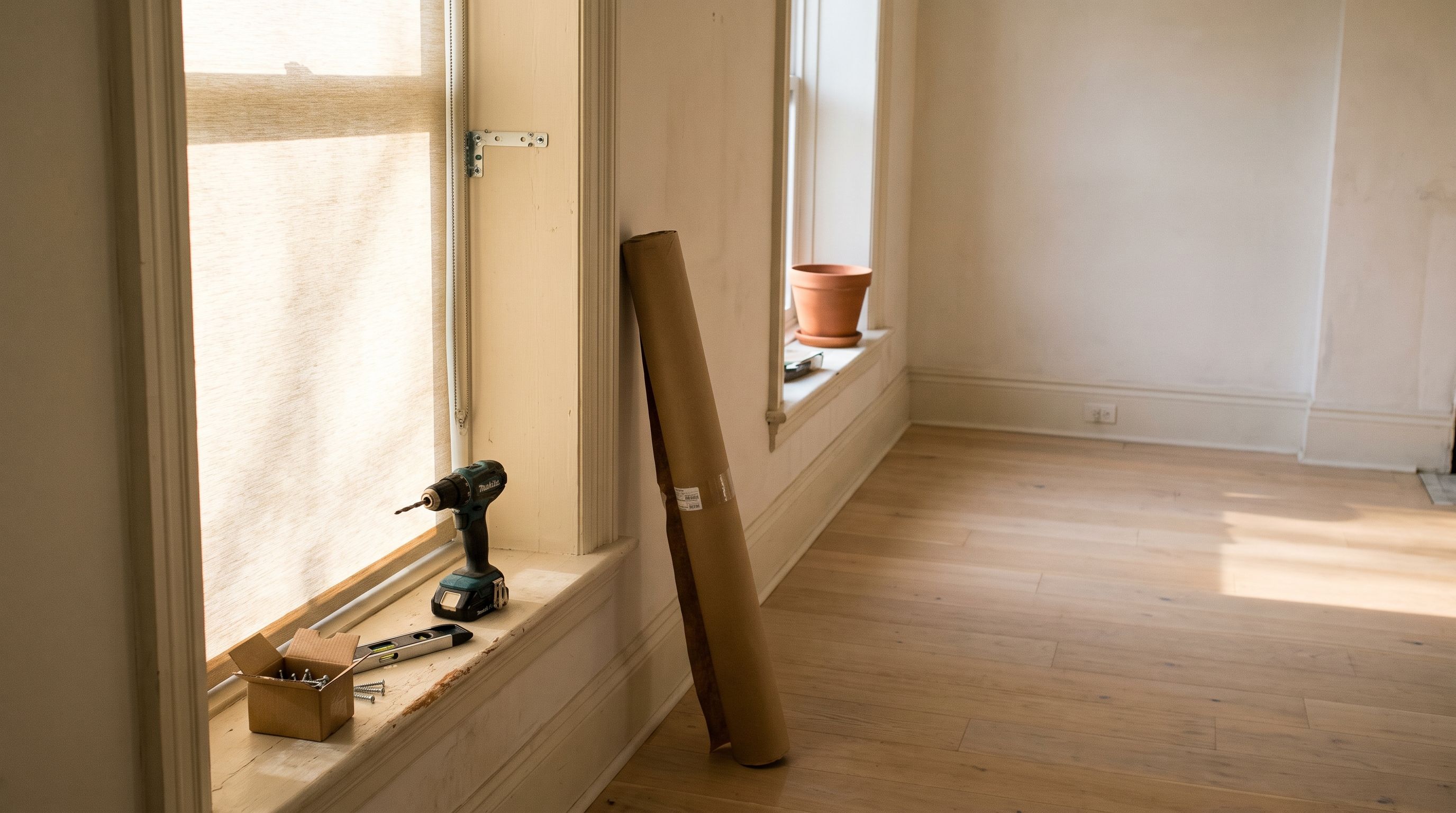
Level, by instrument. The window frame does not get a vote. Older houses across Toronto and the GTA have settled unevenly, and a head that slopes across its own width is ordinary — a blind aligned to it inherits the slope and then reports it, permanently, wherever a straight line runs nearby. The headrail goes in level because a level was on the wall, not because the frame looked about right.
Square in the opening. The blind is centred so the side gaps match, and checked against the opening rather than eyeballed from the floor. Symmetry is the thing a room notices without knowing it noticed.
A fixing that suits the material. This is the check that decides year five. A screw into a solid wood frame holds on its own. Drywall with nothing behind it needs an anchor rated for the hanging weight, not whatever plug was left in the toolbox. Old plaster wants the fixing carried through to something structural behind it, because plaster alone lets go politely and then all at once.
Brick and concrete want masonry fixings and the right drill. Where drilling is off the table altogether — a rental, a steel door, a frame that must stay untouched — no-drill mounting exists, and we will say when it is the honest recommendation.
The full travel, before we leave. Every blind goes all the way down, all the way up, and through its tilt if it has one, while we are still standing there. A blind that binds only near the floor, or a motor limit set a touch short, is invisible to any quicker test — and unforgivable to discover a week later. When the window is motorized, this check grows into commissioning — limits set, controls paired, a demonstration before we go — which the motorized blinds page covers properly.
Why we only fit what we make
The refusal deserves its reasons, because “no” is not a common answer on this site.
Every page here leans on the same promise: if it does not fit, we remake it. That promise is only possible because one company holds the whole chain — the person who measured decided what to make, the workshop built it to those numbers, and the fitter at your wall is checking the work against figures their own company wrote down. A mistake anywhere in that chain lands on us, which is precisely why it so rarely reaches the wall: everyone in it knows there is nobody else to hand it to.
A blind bought somewhere else was measured outside that chain. If it hangs wrong, we cannot remake what was never ours, and the place that sold it will point to the sizes on the order form — which were probably yours. A fitting fee would buy you a carefully hung version of the wrong answer and an argument nobody can win. We would rather decline at the phone call than disappoint at your window.
The blinds you already have
What we offer instead costs nothing: a visit, a tape measure and a straight answer. We measure the openings, look at what is hanging in them, and tell you plainly what is actually wrong — which faults live in the fitting, which live in the blind, and which are size problems that no skill at the wall can reach. Sometimes the news is good and the honest advice is to leave a sound blind alone. You keep the advice whether you order anything or not.
Where the answer is replacement, this is the door it goes through. The inherited set hung by a previous owner to a previous standard; the builder-grade row installed at speed across an entire subdivision and slightly wrong ever since; the window that has simply never had a covering that fit it — each ends the same way: measured properly, made to those numbers, fitted by the people who took them, and the old set out of the house with us.
Someone is coming into your house
Worth addressing directly, because it is the part of this service that is not about windows at all. Installation means a person you have never met, inside your home, with tools. We are licensed and insured, and we say so up front because it is the first thing we would want to know in your position — not as a badge, but as the baseline that makes the rest of the conversation reasonable.
The visit itself is run like a guest who brought a drill: dust caught at the source, floors protected where the work happens, and every box, offcut and old bracket out of the house with us when we go. The room should look like nothing happened in it except that the windows are finally right.
The mechanism
Blind installation, part by part
We fit what we measured and made — one company, one responsibility
Level by instrument, square in the opening, fixings matched to the wall
Every blind operated through its full travel before we call it done
Licensed and insured, stated before you have to ask
Hour by hour
The same window, four times over
7am
Early is where the empty rooms are — a shop before it opens, a floor before the desks fill, a house before anyone leaves for work. It is also the most useful light of the day for the first check: sun raking across a window head shows up a slope that midday flattens out, and that slope is exactly the error a level is there to refuse to inherit.
Noon
The working part of a fitting is mostly not the drill. Brackets are set out, and the wall gets identified for what it actually is — solid timber, drywall with nothing behind it, old plaster, brick — before any fixing is chosen. These are the ten quiet minutes that decide whether the blind is still holding in year five.
6pm
The last hour is the one people remember, because it is the one they watch. Every blind runs its full travel while we are still standing there: all the way down, all the way up, through the tilt if it has one. A fault that only shows at the bottom of the drop is precisely the fault a quicker test never finds.
After dark
The check nobody makes on the day. With the lamps on and the street dark, a window reports its own fit — the side gaps read as light coming from the wrong direction, and a headrail a degree off announces itself against the frame. If it looks wrong to you that evening, the return visit is ours to make.
Where it belongs
Rooms blind installation answer well
Replacing a builder-grade set with blinds measured for the actual openings
Older houses where nothing is quite level and the fitting has to answer for it
Re-hanging blinds we made, after new windows or a renovation
In the room
How the choice changes the room
The rest of the range
Everything else, by how it moves
Winds onto a tube
Tilts to aim the light
Folds up out of the way
Slides across the opening
And the fitting itself
Written for this product
Blind installation in the GTA

Our commitment
We measure it. If it does not fit, we remake it.
The visit is free. See the samples at your own window, get the quote, then decide.
Before you call
Questions worth answering before you book.
Will you install blinds I bought online or from a store?
No — and the reason is worth more than the refusal. Every promise on this site hangs off one fact: the measurements were ours. When a blind does not fit, we remake it without argument, because there is no version of that story where the mistake belongs to you. A blind measured by someone else breaks that chain. If it hangs wrong, we cannot remake what was never ours, the seller will point to the sizes on the order form, and you are left holding a problem two companies each consider the other's. Rather than charge for a carefully hung version of the wrong answer, we will come and look for free — measure your openings, tell you which of the blinds you have could ever work in those windows, and what made-to-measure would take to put it right. The advice is yours to keep either way.
What does a proper installation actually involve?
Four checks, in order, none skipped. The headrail goes in level — measured with an instrument, because window frames in this city are old enough to lie about it. The blind is centred and square in its opening, so the gaps down each side match. The fixing is chosen for what the wall is really made of, since the screw that holds forever in a wood frame is the same screw that pulls straight out of bare drywall. And before we call any window finished, the blind travels its full range — all the way down, all the way up, tilted if it tilts — because a fault that only appears at the bottom of the drop is exactly the fault a quick test never finds.
Why do so many blinds end up crooked or stiff?
Because the frame got trusted and the wall got ignored. Toronto's older housing has settled, and a window head that drops a little across its width is common — an installer who lines the blind up to it faithfully reproduces the error, and the bottom bar then displays it against the sill for the life of the blind. Stiffness is usually the other shortcut: brackets set slightly out of plane with each other, so the mechanism drags at one end of every single pull. Both are fitting faults. The blind gets the blame, but the blind was fine when it came out of the box.
Can you re-hang blinds after new windows or a renovation?
If we made them, yes — and it is done as a fresh fit, not a return to the old holes. A replacement window changes the opening it sits in: the depth of the reveal shifts, sometimes its trueness does too, so the blind's old position is not automatically its right position anymore. We measure the opening as it stands now, set the brackets where the new geometry wants them, and make good whatever the old fixings left behind. For blinds from elsewhere, the honest offer is the free look described above — and a renovation is often exactly the moment a set that never quite worked gets replaced by one measured for the opening it actually lives in.
What happens to the old blinds when you replace a set?
They come down, and unless you want to keep them, they leave with us along with the packaging from the new ones. A replacement visit should end with new blinds on the windows and nothing extra in your garage — taking the old set away is part of the job, not a favour.
Are you licensed and insured?
Yes, and we would rather state it than have you wonder. This service, more than any other we offer, is a stranger with a drill inside your home — asking about licensing and insurance is not rude, it is exactly the question a careful homeowner should put to anyone they let through the door, and a trade that bristles at it has answered it.
Do you install curtains and drapery as well?
Yes — curtains and drapery are made to measure here the same way blinds are, and hanging them is part of the same job, often the same visit. Rods and tracks deserve the wall conversation even more than a blind does: a loaded curtain carries real weight at a few points, and whether the hardware still sits straight in five years is decided by what the fixing went into on day one.
The last chapter
We bring the samples to your windows.
We come to you, measure at your own windows, and go through fabrics and fits together. The visit costs nothing.
$99 off when you order three or more blindsApplied to your written quote at the measure.
Rather just talk?(437) 782-5452Answered 8am–9pm, 7 days
Free in-home measure
Living with a blind that has never hung right, and wondering whether it's the blind or the hanging?
Answered 8am–9pm, 7 days.
Page last checked 16 August 2026.