Where we work
Blinds in Markham
Markham holds both ideas of daylight at once — Main Street houses in Unionville that admit it through tall, narrow sashes one room at a time, and estates in Angus Glen and Berczy Village that take the whole day through a single wall of glass. We measure and make blinds for either century.
Blinds Company · Rated 4.8 out of 5 on Google
Free in-home measure · open 8am–9pm, 7 days
- Two theories of daylight
- A nineteenth-century sash and a two-storey glass wall fail at opposite hours, and one specification will not serve both.
- Heritage frontages want quiet blinds
- On Main Street Unionville the window is the ornament, so the blind sits within the opening and declines the attention.
- Wide and low works by angle
- A south Markham window is managed by tilt rather than by area, which is what venetians and split pairs are for.
- Itemised so it can be staged
- A new build in Greensborough is a great many windows, and the quote is priced per opening so the hard hours can be done first.
In short
Markham's oldest streets were built when daylight was rationed: modest windows, small rooms, each one keeping its own hour of sun and passing the day along like a relay. The newer estates reversed the idea — an open-plan great room in Angus Glen or Greensborough runs from breakfast light to dinner glare inside one space. The first kind of house wants a quiet, individual answer at each window; the second wants one adaptable answer that survives a whole day. Both begin with the same free measuring visit.
Inside this pageJump to one of 6 topics
Two ideas of daylight
Every town builds its windows around a theory of light, and Markham has kept two contradictory ones standing four kilometres apart.
The old theory survives along Main Street Unionville and through Markham Village: daylight as something admitted deliberately, in measured amounts, through tall and narrow openings into rooms with doors. The new theory runs from Angus Glen through Berczy Village, Cathedraltown and Greensborough: daylight as something to be collected wholesale, through the widest glass the wall allows, into spaces with no doors at all.
Neither is wrong. But they fail at opposite hours, in opposite ways, and a blind specified for one theory hangs uselessly in the other. This page is about telling them apart.
The old core: light, one room at a time
A nineteenth-century house runs its daylight as a relay. The kitchen takes the morning; the front room takes the afternoon; the stair hall gets its one bright hour and passes it on. Small rooms and separated doors mean no space has to survive the whole day — each window deals with its own shift and rests.
That is a gentle brief, and it rewards a gentle answer. Each window gets its own small decision: a soft filter where the morning is welcome, something firmer on the one window where the afternoon overstays, often nothing at all on a north face that never misbehaves. The discipline is restraint — the windows are old, narrow and handsome, and the blind should be the least interesting thing about them. From the street, a quiet colour and a consistent line keep a heritage frontage looking like itself.
What we bring to these houses is mostly care: openings measured one by one, because a century of seasons has made each of them slightly individual, and fittings placed kindly, because old frames deserve hardware that respects them.
The estates: the whole day in one room
North of the old village the theory flips. An Angus Glen or Berczy Village great room is one continuous space doing the work of four old rooms — and its glass therefore hosts the entire day, sunrise to sunset, with no wall to hand the light along to.
A room that keeps every hour cannot be served by a blind that keeps one. The morning wants everything open; mid-afternoon wants the heat turned away; the last hour before dinner wants the low sun off the television and out of eyes at the table. The specification that survives all of that is adjustability — banded fabrics that slide between sheer and solid, slats that aim the light rather than abolish it, screens that hold the garden while dimming its glare. And where the glazing climbs beyond arm’s reach, as it does in many of these rooms, a motor stops being indulgent and becomes the way the upper glass gets used at all.
Cornell planned for the porch
Cornell was drawn to an older pattern on purpose — houses near the street, verandas out front, garages banished to rear lanes — and the veranda turns out to be a working part of the window plan. Through the leafy half of the year that roof shades the front glass through the middle of the day, and many Cornell front rooms honestly need little more while the sun is up.
The plan’s trade-off arrives at night. Streets drawn close and walkable put the sidewalk a few strides from the front window, and a lit room after dark is on friendly display to everyone using it. Cornell fronts are therefore mostly an evening specification: day-night fabrics or proper closing layers, chosen so the daytime openness the neighbourhood was designed around is still there at noon.
The rear of these houses faces the lane, which brings its own small hour — bedrooms overlooking a lane light up for it at night, and frosted or banded fabrics settle that quietly.
Milliken Mills and the broad, low afternoon
South Markham’s streets went up mostly in the seventies and eighties, and their signature window is wide, low-set and generous in a different way from either the sash or the glass wall. A window shaped like that meets the afternoon broadside: the sun crosses it slowly, at a flattening angle, and for an hour or two it can put more light into a room than glass twice its height.
The products that suit it are the ones that work by angle rather than by area. A venetian tilted a few degrees strips the beam and keeps the yard; a pair of blinds across one wide opening lets the burning half be dealt with while the calm half stays open; vertical blinds — which many of these houses wore first, and which have aged into far better fabrics than their reputation — still fit the proportions naturally.
One town, one visit
The pleasure of working in Markham is that a single day of measuring can run from a hundred-year-old sash to a two-storey glass wall and back. The visit is the same for both: free, any day of the week, phones answered 8am–9pm. Each opening is measured as its own object, fabrics are held up in the room at the hour it struggles when we can manage it, and you keep a written, per-window quote with the installation date committed on it — no deposit, no card, and no pressure to do the whole house at once.
Old theory or new, the light is yours either way. We just help you decide how much of it gets in, and when.
Hour by hour
The same window, four times over
7am
Unionville and Markham Village run their daylight as a relay — the kitchen takes the morning and hands it along. Rooms that small, behind doors that close, mean no window has to survive a whole day, so a soft filter where the morning is welcome is often the entire brief.
Noon
Cornell put its verandas back at the front of the house on purpose, and through the leafy half of the year that roof does a real share of a blind's daytime work for nothing. Many front rooms there honestly need very little while the sun is high, which is worth knowing before paying for more.
6pm
Milliken Mills meets the late afternoon broadside. Its windows are wide and low-set, so a flattening sun crosses them slowly and can put more light into a room than glass twice the height. Venetians take the beam away by degrees without closing off the yard.
After dark
The estates north of the old village hold every hour inside one room, and after dark the exchange simply runs outward. In Cornell it runs a few strides: the sidewalk was drawn close deliberately, which makes the evening rather than the afternoon the real specification for a front window.
Room studies
Three ways to answer the light
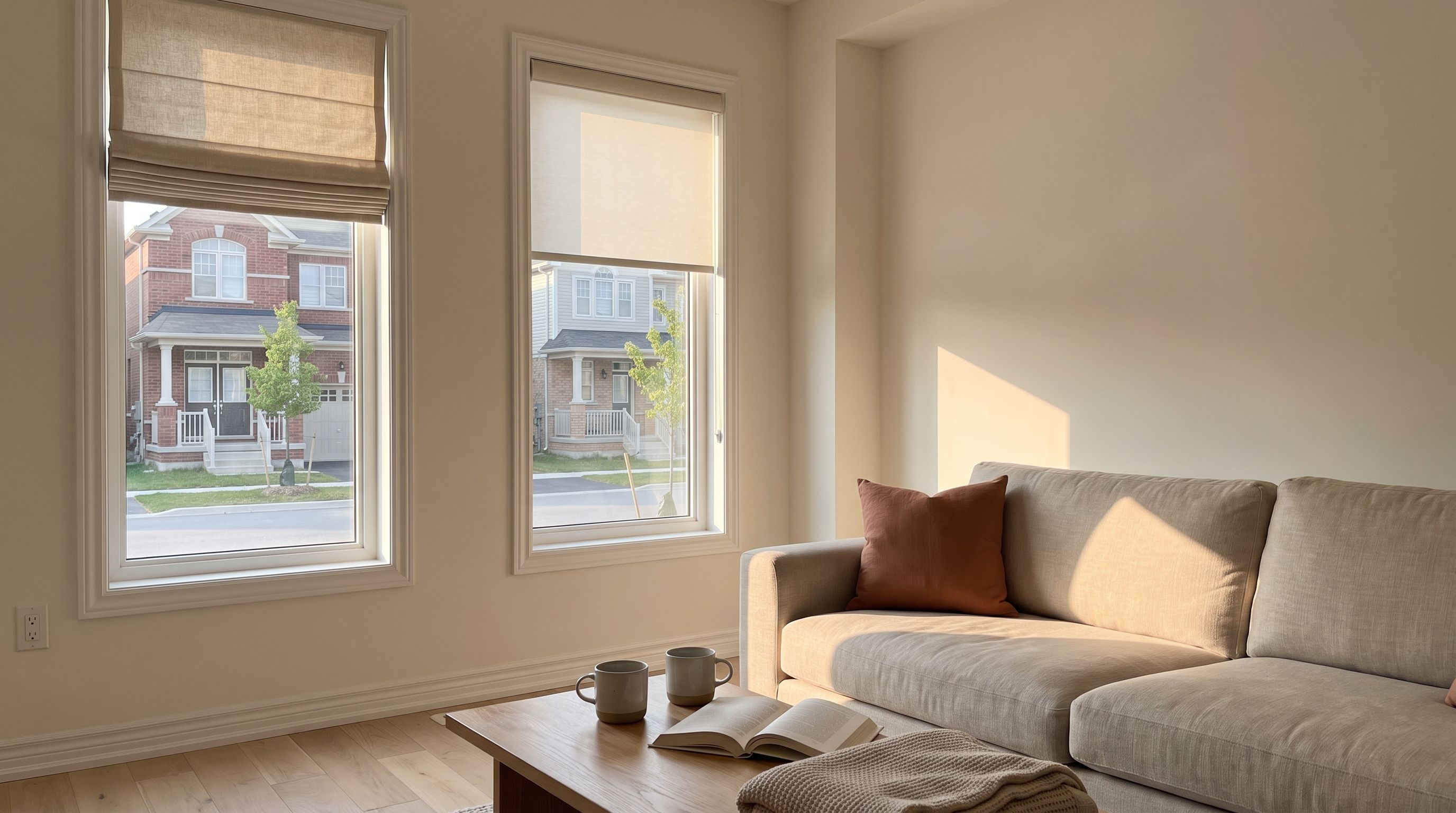
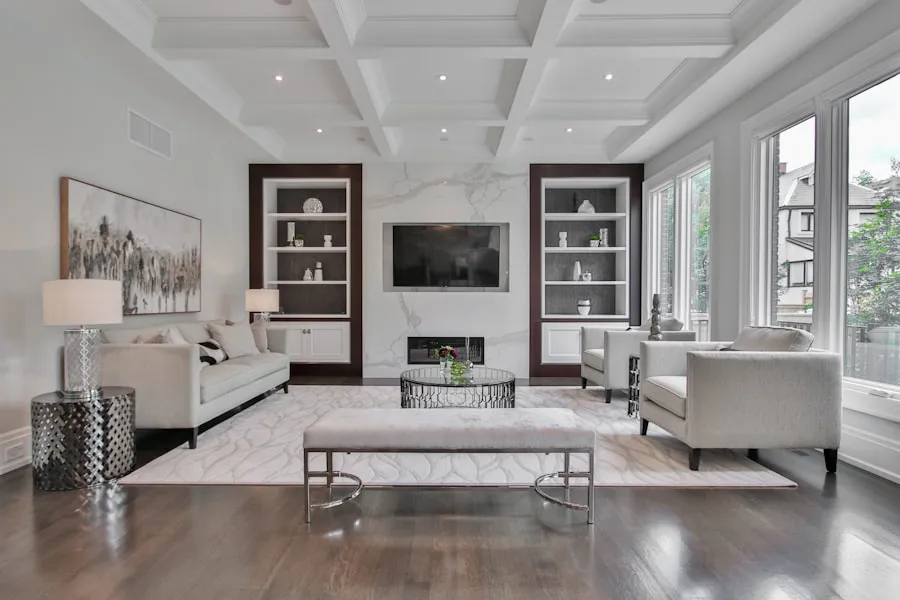
Editorial room studies illustrating the brief — not photographs of client installations.
Inside the city
We measure across Markham, not from a showroom in it.
- Unionville
- Cornell
- Berczy Village
- Angus Glen
- Cathedraltown
- Milliken Mills
- Greensborough
- Markham Village
Those are the parts of Markham we are asked for most often — not the edge of where we go. If your street is not on the list, it is still on the route.
The rest of the range
Everything else we fit in Markham
Winds onto a tube
Tilts to aim the light
Folds up out of the way
Slides across the opening
And the fitting itself
Our commitment
We measure it. If it does not fit, we remake it.
The visit is free. See the samples at your own window, get the quote, then decide.
Before you call
Questions worth answering before you book.
We are near Main Street Unionville. Will blinds spoil the look of the house?
Not if they are chosen to defer. On a street of nineteenth-century frontages the window itself is the ornament, so the blind's job is to manage light while declining attention — plain fabric, a quiet colour on the street-facing side, sized to sit within the opening so the frame still reads as the frame. Nothing about an old house rules blinds out; it just rules out the loud ones.
An open-plan great room is bright at breakfast and blinding at dinner. One blind cannot do both — can it?
One fixed blind cannot; one adjustable blind can. This is precisely the case for fabrics with a range of states — a [zebra blind](/zebra-blinds/) that runs from sheer to solid in a slide, or slats that tilt by the degree — because the room's needs at 8am and 6pm are different rooms' needs. The setting changes through the day; the blind does not have to be changed for another one.
Does a Cornell porch mean the front rooms need less than we think?
In summer, usually yes — the porch roof stands between the high sun and the front glass, and does a respectable share of a blind's daytime work for free. What the porch cannot do is help after dark, when the lit front room faces a sidewalk a few strides away. Cornell front windows are mostly an evening brief: something that closes properly at night, light-handed or nothing through the day.
Our Milliken Mills windows are wide and not very tall. What suits them?
Products that think horizontally. A wide, low window catches the afternoon broadside, and a single big blind across it moves a lot of fabric to fix a problem that often lives in one half of the glass. Venetians tilt to cut a low sun without closing the view; a pair of blinds on one wide opening lets the sunny half work while the shaded half stays open. Wide openings also flatter vertical blinds, which these houses wore originally — the modern fabrics are considerably calmer than the ones people remember.
A whole new build in Greensborough or Cathedraltown is a lot of windows. Where do we start?
Start where the day pinches: the bedrooms that face the sunrise and whichever living space takes the late sun. Those windows change how the house feels within a week. The remainder — landings, baths, the rooms with no bad hour — can follow when budget and patience allow, and the written quote is itemised per window precisely so it can be done in instalments without re-measuring.
Do you make curtains for the older rooms as well?
Yes, made to measure alongside the blinds, and the old streets are where the pairing shines. A tall sash in a hundred-year-old room often wants both layers doing different jobs — the blind managing the sun hour by hour, drapery closing the evening and warming the window's edges in winter. One visit measures both; the same hands install both.
What does the visit cost anywhere in Markham?
Nothing, from Main Street Unionville to the newest phase of Cornell. The measure, the fabrics tried in your own rooms, the advice and the written quote are free, with no deposit and your installation date committed in writing. If the honest recommendation for a window is to leave it exactly as it is, that is what you will hear.
The last chapter
We bring the samples to your windows.
We come to you, measure at your own windows, and go through fabrics and fits together. The visit costs nothing.
$99 off when you order three or more blindsApplied to your written quote at the measure.
Rather just talk?(437) 782-5452Answered 8am–9pm, 7 days
Free in-home measure
If one room in the house is lovely at nine and impossible at four, that is the room to describe when you call.
Answered 8am–9pm, 7 days.
Page last checked 16 August 2026.