The range
Bay window blinds
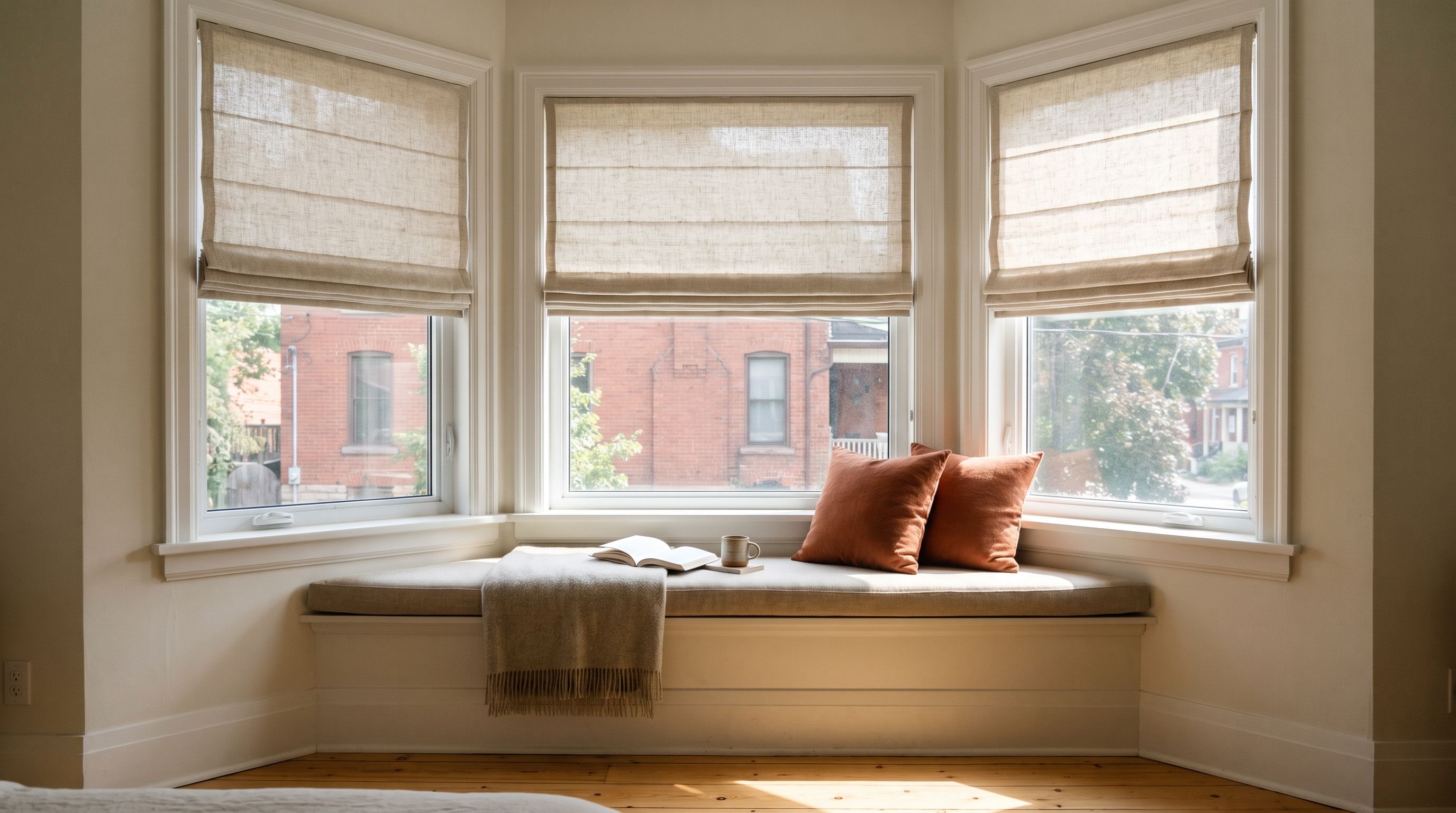
A flat window keeps one hour of light. A bay keeps three, because its faces look three ways at once — which is the whole charm of the thing, and the reason it cannot be ordered as one width, one drop and hope. A bay is a set, and sets are made, not picked.
Blinds Company · Rated 4.8 out of 5 on Google
Free in-home measure · open 8am–9pm, 7 days
- One blind per face
- Two or three different widths, each cut to its own opening, because a bay is a set rather than a window.
- Cut from one fabric batch
- Dye lots disagree by just enough to notice at noon, so the set is ordered together and the colour holds around the angles.
- Hung to one shared line
- Unequal widths vanish when the heads, the hems and the stack heights agree; a stepped hem is visible from the far end of the room.
- Measured in the room
- The angles a settled house has arrived at are on no form, so this is the one window we will not quote from a photograph.
In short
A bay window takes one blind per face — usually two or three different widths — cut from the same fabric batch and hung to one shared line, so the set reads as a single decision. Each face gets its own control, because each faces its own light. The widths and angles are taken in the room; a bay is the one window we will not quote from a form. Free in-home measure across Toronto and the GTA.
Inside this pageJump to one of 6 topics
Three faces, three hours
Stand in a bay through one sunny day and you can watch this site’s whole argument in a single window. The light lands on the east-most face at breakfast, swings onto the wide front pane through midday, and finishes the evening on the west face while the first one has long gone quiet. A flat window has an hour; a bay is a sundial you can sit in.
Which means a bay never has one light problem — it has a schedule of them, one face at a time. Any covering that treats the bay as a single thing forces the whole window to answer for its sunniest face: everything closed because one pane glares. The set only works when each face can act alone, and that one sentence writes most of the rest of this page.
A set, not a window
Up close, a bay is two or three ordinary windows that happen to meet at angles — and they are siblings, not triplets. The front pane is usually the widest; the flanking faces are narrower, and rarely quite the same as each other. The angles belong to the builder and the century, not to the catalogue.
The wrong response is to average it all into one wide covering, behind which the bay disappears. The other wrong response is three stock blinds in the nearest sizes, which fit the way borrowed clothes fit. The set that works is made: each blind cut to its own face’s true width, each drop checked against its own sill, and the whole group planned together so it hangs as a family.
Matched where the eye looks
What makes three unequal blinds read as one intended set is worth spelling out plainly, because it is the entire craft of this window.
Nobody perceives widths. Everybody perceives lines. The set reads as one decision when its blinds hang from a single shared height, when their cassettes sit at one depth, when the raised blinds stop level — stack height matched even though the widths never were — and when the fabric is literally the same cloth. That last one is not fussiness: fabric is dyed in batches, and two batches of the same colour can disagree by just enough to notice at noon. A set ordered together is cut together, and the colour holds around the bay.
Get the lines and the cloth right and the differing widths become invisible. Get them wrong and no amount of matching product will save it — the eye catches a stepped hem across a bay from the far end of the room.
Corners decide how much glass each blind can own
The critical dimension in a bay is not printed on any one window. It is the space where two blinds approach the same corner. Give both coverings their full theoretical width and their cassettes, bottom rails or slats may collide. Pull both back too far and a bright triangular gap appears exactly where the eye expects the set to join.
So the corner is mocked out before widths are final. One blind may pass slightly in front of its neighbour; another pair may stop on a shared sightline; a deep recess may let the hardware sit at different depths while the front edges still read level. Handles and opening sashes join that test, because a beautiful three-part set that prevents one casement from opening is not a successful fit.
This is also where control positions are assigned. Chains, wands or bottom rails belong on the accessible outer sides, not trapped in the narrow meeting points. Planning those small collisions together is what turns three accurate measurements into one usable bay.
When the bay should close as one
There is one honest way to treat a bay as a single object, and it is not a blind — it is a curtain on a track shaped to the bay itself, following the angles around so the fabric draws in one continuous sweep. Closed, it turns the whole projection into a soft wall; open, it stacks off to the sides and gives the architecture back.
It is the right call for rooms that live in the evening — a formal front room, a dining room — and it pairs happily with blinds on the faces for the daytime hours. The track is bent to measurements taken in the room, which is one more reason this window and this company keep meeting in person. We make the curtains as well as the blinds, so the pairing arrives planned rather than improvised.
The measure a form cannot do
A bay is the window that made our in-home habit non-negotiable. Each face is measured as its own opening — its real width, its real drop, at more than one point, because settled houses hold no right angles. The corners are inspected where the blinds will meet. The seat, the radiator and whatever else lives in the bay get noted, since they decide where hems stop. And the set’s shared line is chosen there, in the room, at the height the whole family of blinds will hang from.
None of that survives being typed into a form, which is why we do not ask you to try. The visit is free, it is unhurried even for a bay, and it ends with a written quote, one line per face, nothing owed and nothing assumed.
The mechanism
Bay window blinds, part by part
One blind per face, each to its own width
Hung to a shared line, which is what the eye checks
Cut from one fabric batch, so the colour cannot drift
Controlled face by face, because the light arrives face by face
Hour by hour
The same window, four times over
7am
One face is in the sun and two are not, which is the hour that settles the whole argument for this window. Drop the set to deal with the east pane and you have darkened two windows that were behaving perfectly. One blind down, two up — and because the eye reads the raised pair as a pair, their stacks have to stop at the same height.
Noon
The sun moves onto the wide front pane and the bay starts behaving like a greenhouse: glass on three sides, projecting out past the wall, warming faster than the room behind it. A screen fabric on the front face alone takes the glare and the radiant load off without giving up the reason anybody built a bay in the first place.
6pm
West face, low sun, and a bay admits it at an angle a flat window cannot — the light crosses the room to the far wall instead of stopping at the sill. This is the hour the set gets tended like sails, one face lowered while the other two stay open, which is only possible because each blind has its own control.
After dark
Three panes standing out past the insulated wall make the bay the coldest corner of the room by ten o'clock, and the most public. It is the hour a bay wants to close as one object — every face down together, or a curtain on a track bent to the angles drawing the whole projection shut in a single sweep.
Where it belongs
Rooms bay window blinds answer well
Roller blinds, slim enough to repeat three times gracefully
Cellular shades, for the projecting glass that runs cold
Curtains on a shaped track, when the bay should close as one
In the room
How the choice changes the room
The rest of the range
Everything else, by how it moves
Winds onto a tube
Tilts to aim the light
Folds up out of the way
Slides across the opening
And the fitting itself
Our commitment
We measure it. If it does not fit, we remake it.
The visit is free. See the samples at your own window, get the quote, then decide.
Before you call
Questions worth answering before you book.
Do all the windows in a bay need the same blind?
The same product and fabric, almost always — a bay is read as one object, from the street and from the sofa, and dressing its faces differently breaks it into parts. The same setting, almost never: the faces look different ways, so at any given hour one is in sun and another is not. The resolution is a set of matching blinds that move independently — one appearance, three positions — which is precisely what a bay wants and a single wide blind cannot give.
Can one blind run across the whole bay?
Only by pretending the bay is flat. A single blind has to bridge the front of the projection in a straight line, and when it is down you have bought a fabric wall where the architecture used to be — the recess, the seat and the depth all wait behind it. If a continuous covering is truly the wish, the graceful version is a curtain on a track bent to follow the bay's own shape, which closes the set as one without flattening anything. We make those too.
My bay's windows are all different widths. Will the blinds look odd?
Not if what should match, matches. Eyes do not carry tape measures; nobody standing in the room perceives that one face is a hand wider than another. What the eye checks, instantly and every time, is alignment — whether the blinds hang from one line, whether the hems agree, whether three raised blinds stop level with each other. Cut each blind to its own opening, hang the set to a shared line, and the different widths simply disappear into it.
Can each window be adjusted separately? Motorized together?
Separately is the point — the faces of a bay take the sun in turns, so through a bright day you tend the set like sails, dropping one face at a time as the light comes around. Motorization suits this window unusually well for exactly that reason: three blinds is three times the tending, and a motor group lets one button run the set, one schedule follow the sun, or one face move alone when only one face has the problem.
Curtains or blinds for a bay?
They answer different wishes. Blinds keep the bay itself — the depth and the seat stay visible, the light arriving from three sides stays readable, and each face stays adjustable. A curtain across the bay trades that for softness and ceremony: on a shaped track it draws the whole projection closed as one warm gesture, which suits a formal room in the evening. Plenty of bays wear both — blinds working the daylight, curtains closing the chapter at night.
Why does a bay have to be measured in person?
Because every number a bay quote depends on is a number a form flattens. The faces are rarely the widths they appear; the angles between them are whatever the house has settled into over the decades; the corners decide how far each blind may run before it meets its neighbour. Taken in the room, these are twenty minutes of tape work. Guessed from photographs, they are a set of blinds that almost fits — and on a bay, almost is what crooked looks like.
The last chapter
We bring the samples to your windows.
We come to you, measure at your own windows, and go through fabrics and fits together. The visit costs nothing.
$99 off when you order three or more blindsApplied to your written quote at the measure.
Rather just talk?(437) 782-5452Answered 8am–9pm, 7 days
Free in-home measure
Wondering whether your three windows should get three identical blinds?
Answered 8am–9pm, 7 days.
Page last checked 6 September 2026.