The range
Wood blinds
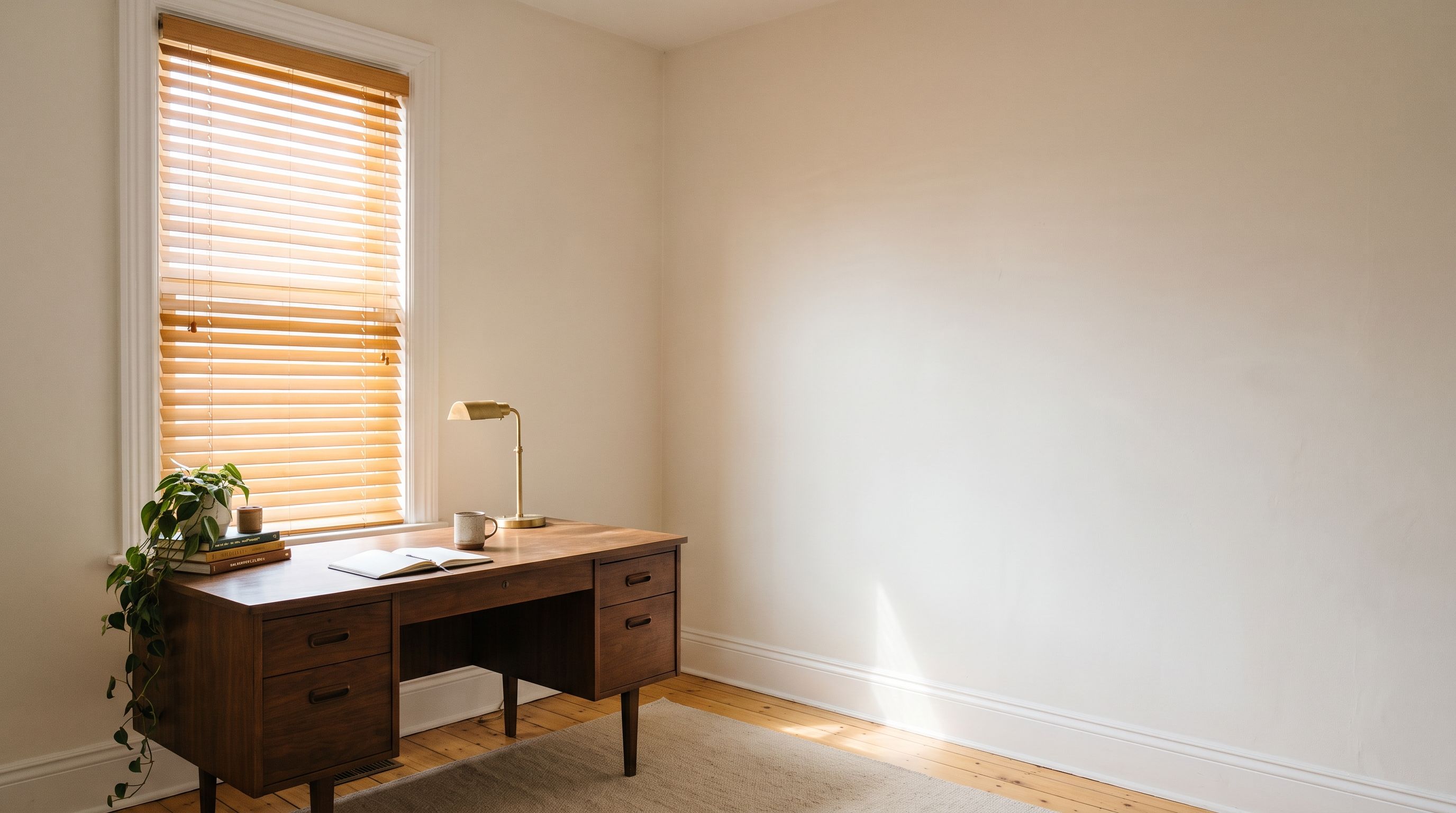
A venetian cut from real timber, which changes little about how the blind works and everything about what it is: slats lighter than they look, warm under low light, and each one grained differently from its neighbours — a window covering with more in common with the dining table than with anything else on this site.
Blinds Company · Rated 4.8 out of 5 on Google
Free in-home measure · open 8am–9pm, 7 days
- No two slats alike
- The grain runs its own way down every slat in the blind, which is the one thing a printed surface cannot copy.
- Lighter than composite
- Real timber carries less weight per slat, so a wide window stays a one-hand lift.
- Stain over paint, usually
- Paint hides the grain the money bought, and a painted composite slat gives the same face for less.
- Never over steam
- Bathrooms, laundries and windows above a sink curl a thin timber slat permanently, so we keep those rooms off the list.
In short
A wood blind is a tilting venetian with slats of genuine timber instead of composite. It is bought for what only real wood has — grain that never repeats, warmth under evening light, a much lighter lift on wide windows — and it carries real wood's one condition: humidity curls it, so bathrooms and steamy kitchens are off the list, and we keep them off it honestly.
Inside this pageJump to one of 7 topics
What the extra money actually buys
A wood blind runs on the same tilt-and-raise mechanism as every venetian — the two controls, the angle trick with low sun, the honest limits around darkness are all covered on the venetian blinds page. This page is about timber, because timber is the whole of the decision.
What you are paying for is variation. A stained wood slat is not a colour; it is a surface, and the grain under the stain runs differently on every single slat, catches the light differently at every tilt angle, and never once repeats. A printed slat can copy any individual piece of wood convincingly; what it cannot do is be different from itself slat after slat down the whole drop. In a photograph the two are twins. In a room, in changing light, over years, they are not — and the people who buy real wood are buying exactly that gap.
The lightness, which nobody expects
Timber’s other advantage is engineering rather than romance: a wood slat weighs a good deal less than its composite twin. On a modest window that is trivia. On a wide one it decides how the blind feels every day — a lift you do with two fingers in passing, rather than a hoist you plan — and it is the reason that, once a dry window passes a certain width, real wood stops being the indulgent choice and becomes the practical one. Past that point the question flips, and it is the printed slat that needs the excuse.
The evening it was made for
Stained timber does something at the end of the day that no other slat quite manages. Low, warm light raking across real grain gives the surface depth — the blind stops being a window covering and starts holding the light the way the rest of the room’s wood does. If the room already owns a timber floor or a good table, a wood blind joins that conversation; tilt the slats toward the ceiling at seven in the evening and the whole room goes the colour of the hour. It is not a measurable property. It is also not nothing, and it is most of why this product survives every cheaper imitation of it.
Where it must not go
Timber breathes. It takes moisture from the air and gives it back, and a blind slat — long, wide, very thin — is close to the worst possible shape to do that evenly. In a room that steams up and dries out on a daily cycle, the slat exchanges moisture faster through one face than the other and slowly curls across its width. Cupping is gradual, permanent, and contagious in effect: one curled slat stops meeting its neighbours, and the blind never closes cleanly again.
So: no bathrooms, no laundry rooms, nothing directly over a kitchen sink or stove, and caution in a damp basement. This is not a care instruction that diligence can beat — it is what the material is — and if a room of yours lives wet, the honest recommendation is the faux wood blind, which was invented for precisely this and looks near enough from across the room. We would rather redirect the sale at your window than remake the mistake later.
Stain, paint, and one honest caution
Stain keeps the grain in view, which — since the grain is what the money bought — is the default answer here. Matching it to a floor is a subtler business than the sample card suggests: the same stain lands differently on different woods, and a blind aimed at “exactly the floor” that arrives a shade off looks accidental, where a blind deliberately darker or lighter looks decided. We hold samples against your actual floor, in the room’s own light, and settle it before anything is ordered.
Paint covers the grain entirely — at which point it is fair to say aloud that a painted composite slat will give the same appearance for less, and we will say it at the measure rather than let you find it in the quote. Painted timber still wins on weight for a wide window; beyond that, the argument for it thins out fast.
Width changes the specification before colour does
A wide wood blind is visually calm, but its headrail still carries every slat. Before stain is chosen, the opening has to answer whether one blind should span it or two should share the line. One broad blind gives an uninterrupted field of grain and one control. A split reduces the weight of each moving section, lets one side open while the other stays private and can follow a mullion so the division looks architectural rather than imposed.
The split only works when the centre lines agree with the window. Put a joint in front of clear glass and it becomes the first thing visible; place it over a frame member and it nearly disappears. The valance, slat height and bottom line then have to remain common across both sections so the pair still reads as one installation. Those decisions are made with the blind raised as well as lowered: the stack at the head should not take away the very view the timber was chosen to frame.
What it will not do
It will not tolerate steam, however carefully it is treated — that room needs the composite. It will not go dark: it is a venetian, slats overlap rather than seal, and a bedroom that needs blackout needs a different product alongside or instead. And it will not stay factory-fresh against years of direct sun — real timber mellows the way the floor it matches does, which the people who choose it tend to count as the point rather than the flaw.
The mechanism
Wood blinds, part by part
Genuine timber slats, stained or painted
No two slats grained alike — the thing prints cannot copy
Noticeably lighter to raise than composite at width
Kept out of steamy rooms on principle, and we say so
Hour by hour
The same window, four times over
7am
Flat morning light is the hour that shows least of what the extra money bought. Under it, a stained timber slat and a good printed composite one are close to twins, and anyone comparing the two at breakfast will struggle to justify the difference. Grain reads as colour before breakfast; it does not read as grain until the light comes in low.
Noon
Overhead sun is the hardest test a slat takes, and real timber accepts it the way a floor does — by mellowing. A blind on a south window will not stay factory-fresh, and the people who choose wood tend to count that as the point. What the material cannot accept is steam, which is why it never goes over a sink whatever the light is doing.
6pm
The hour that sells this product. Low, raking light across real grain gives the surface a depth no print manages, and tilting the slats toward the ceiling turns the whole room the colour of the evening. If the room already owns a timber floor or a good table, this is when the window finally joins that conversation.
After dark
Closed, the room is private and still not dark — a venetian overlaps rather than seals, and timber changes nothing about that geometry. What timber does change is the closing itself: a wood slat weighs considerably less than its composite twin, so shutting a wide blind at the end of the day is two fingers in passing rather than a hoist.
Where it belongs
Rooms wood blinds answer well
Living and dining rooms, where the blind is looked at as much as through
Wide, dry windows that will be raised by hand
Rooms already furnished in timber the window should agree with
In the room
How the choice changes the room
The rest of the range
Everything else, by how it moves
Winds onto a tube
Tilts to aim the light
Folds up out of the way
Slides across the opening
And the fitting itself
Our commitment
We measure it. If it does not fit, we remake it.
The visit is free. See the samples at your own window, get the quote, then decide.
Before you call
Questions worth answering before you book.
Is real wood actually worth it over faux wood?
In the right room, yes, and the right room is a dry one where the window gets looked at. What real timber has that no print can manufacture is a full blind of slats that are each their own piece of wood — grain running its own way on every one, catching every tilt of light differently. Add that a timber blind is markedly lighter to lift, and in a living or dining room the case is strong. In a bathroom or over a sink the case is zero, because the material will fail there, and we will tell you so before you order.
Which rooms are off the list entirely?
Any room with a daily humidity swing: bathrooms above all, laundry rooms, and windows directly over the kitchen sink or stove. Steam works into a thin slat unevenly and curls it — slowly, permanently, and in a way no finish prevents. A damp basement earns a case-by-case answer at the measure. Everywhere dry, timber is simply a preference; in the wet rooms it is a mistake we decline to sell.
Stained or painted?
Stained, unless something specific argues otherwise. Stain is the finish that leaves the grain visible, and the grain is what distinguishes this product from its imitation. Choose paint and the grain disappears — at which point a painted composite slat gives the same face for less money, and the remaining argument for timber is its lighter weight on a wide window. That can be argument enough; it is just worth making knowingly rather than by accident.
Can you match the blind to my floor?
Close, on purpose, rather than exactly, by accident. The identical stain reads differently on a blind slat than on your flooring because the wood beneath differs, so chasing a perfect match usually produces a near-miss that looks unintended. The better result is a deliberate relationship — the blind clearly a shade deeper or lighter than the floor — which reads as designed. We bring the samples to your room and decide it against the real floor in the real light.
How long does a wood blind last?
The timber outlasts everything around it. What wears on a wood blind is the cord system that lifts the slats and holds them — years of small friction, eventually a failure that looks like "the blind broke" but is really string. We supply and install new blinds rather than service old ones, but on a made-to-measure timber blind the slats themselves are usually fine and a new blind would not match their sun-mellowed colour anyway — so a re-cording specialist is worth a call before you order a replacement. It is one of the few window products where keeping the original genuinely beats replacing it.
Do wide windows need anything special?
Less than they would in composite, which is much of timber's practical case. Slat weight is what a wide venetian fights, and timber carries far less of it, so a wood blind stays a comfortable one-hand lift at widths where the composite version becomes work. Very wide openings still deserve a conversation about splitting into two blinds or adding a motor, and that conversation happens at the measure with the actual window in front of us.
The last chapter
We bring the samples to your windows.
We come to you, measure at your own windows, and go through fabrics and fits together. The visit costs nothing.
$99 off when you order three or more blindsApplied to your written quote at the measure.
Rather just talk?(437) 782-5452Answered 8am–9pm, 7 days
Free in-home measure
Torn between real timber and the composite look-alike for one particular room?
Answered 8am–9pm, 7 days.
Page last checked 15 September 2026.