Where we work
Blinds in Vaughan
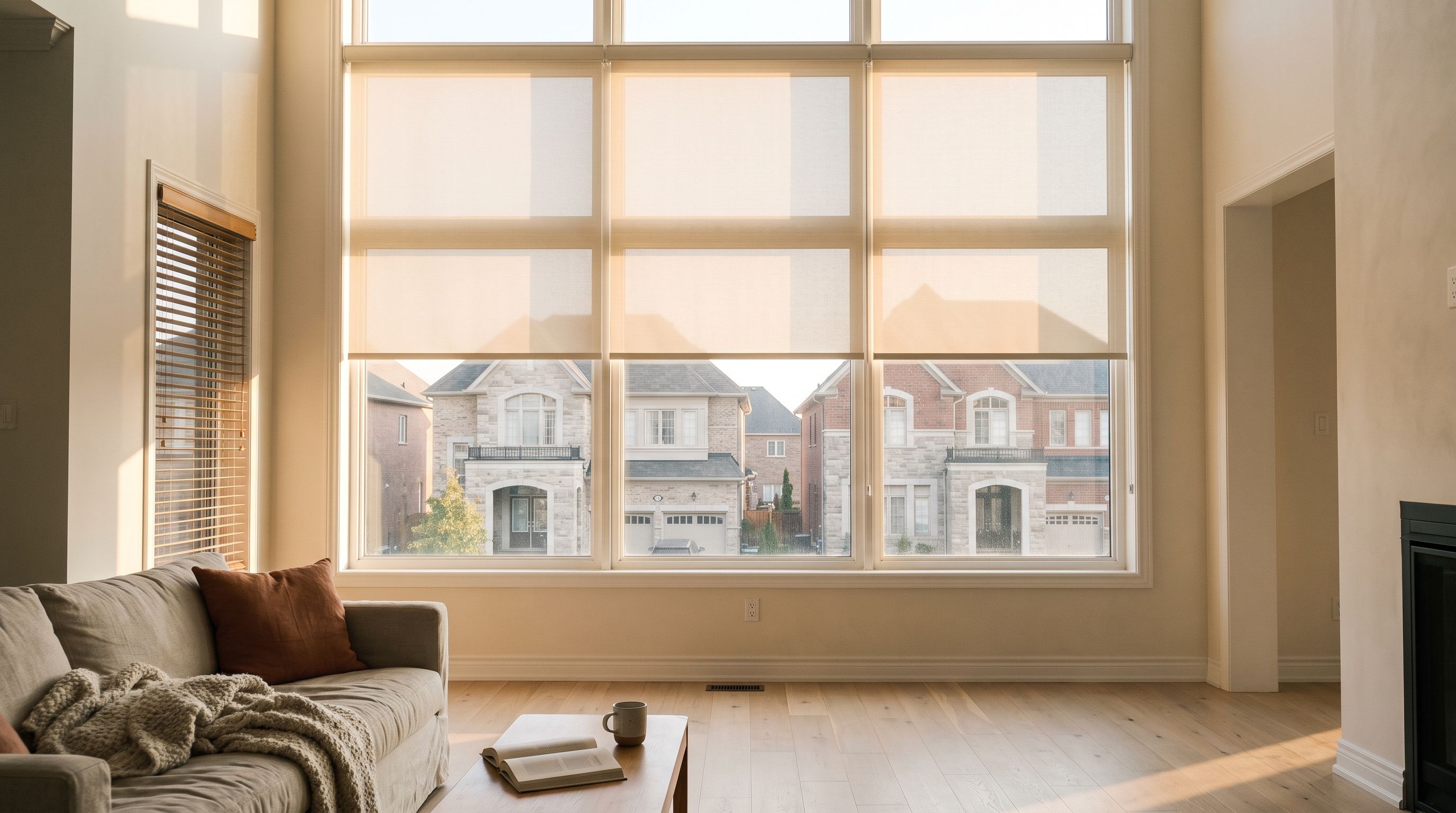
Vaughan builds its rooms around glass — great rooms glazed past the first storey, kitchens that run to the garden in a single sheet, stair windows two flights tall. We make blinds and shades to that scale, measured in your rooms and fitted by the same hands that measured.
Blinds Company · Rated 4.8 out of 5 on Google
Free in-home measure · open 8am–9pm, 7 days
- Several blinds behaving as one
- Two-storey glazing is already divided into panels, and a blind per panel keeps each unit light enough to run smoothly.
- The upper tier will not move
- Nothing four metres up gets adjusted by hand, so it takes a battery motor or a position chosen to suit both seasons.
- The blind is the canopy
- On streets planted three summers ago the fabric does the filtering a mature tree would have done, and is specified tighter for it.
- Kleinburg's west runs to the horizon
- An estate lot with no close neighbour has nothing to throw it shade, so west rooms keep their sun to the last minute of the day.
In short
The newer houses across Vaughan carry more glass per room than almost anywhere we work: double-height great rooms in Patterson and Vellore Village, wide patio runs in Maple, tall halls in Kleinburg's estates. A room like that does not have one difficult hour — the sun crosses it all day, and the glass keeps going up past where a hand can reach. The specification is about scale: fabrics that manage a long afternoon without deleting the view, and motors where the glass climbs out of reach. The measuring visit is free.
Inside this pageJump to one of 6 topics
Rooms built around glass
Most houses have windows. A lot of Vaughan’s newer houses are nearer the reverse — rooms arranged around a deliberate wall of light. The great room glazed to the second floor is practically the signature of the newer streets in Patterson, Vellore Village and Maple, and it is usually the reason the family chose the house.
Nobody should apologise for that room. But it does something no ordinary room does: it keeps every hour of the day at once. Morning slants in across the breakfast table, noon stands overhead, and from two o’clock the west begins its long occupation of the sofa. A single wall of glass is a sundial you live inside — and the furniture, the screens and the people all take their turn as the marker.
The blind for that room is not one decision. It is a system of small ones, and the free visit is where they get made in the right order.
The afternoon is the whole brief
Ask a Vaughan household when the great room stops being usable and the answer is nearly always the same arc: fine at breakfast, glorious at noon, and then a slow surrender from mid-afternoon as the heat builds and every screen in the room whites out.
The instinct is to reach for something heavy, and it is usually wrong. Closing a wall of glass with opaque fabric fixes the glare by deleting the reason the wall exists. A woven screen fabric does the subtler thing — it keeps the garden and the sky legible while it strips the shine off the light and turns away a real share of the heat. The room stays itself; the afternoon just stops shouting.
Where the same space has to sleep — a loft bedroom borrowing the top of the glazing, a media corner — a second, opaque layer goes exactly there and nowhere else. Paying for total darkness across glazing that mostly needs a volume knob is the most common overspecification we talk people out of.
Glass past the reach of hands
The honest thing about a double-height window is that its upper half is architecture, not equipment — no one is ever going to stand on anything sensible and adjust it. A chain ending three metres above the carpet is decoration.
So the split matters: the lower panels, at human height, can be manual and cheap to run. The upper panels either get a motor or they get a promise — that whatever fabric goes up there is one position you can live with in January and July alike, because it will not be moving. Both are legitimate answers. Choosing between them accidentally, after the order, is the only wrong way to do it.
Motors themselves have become pleasantly boring: battery tubes, an occasional recharge, a schedule that draws the west glazing for the worst two hours and opens it again for the evening. On this housing stock they are less a luxury than the missing half of the window.
Streets the shade has not reached yet
Drive from old Thornhill to Vellore Village and you pass through about forty years of tree growth in fifteen minutes — in the wrong direction. The newer the street, the smaller the trees, and a street planted three summers ago filters precisely nothing.
That changes the arithmetic of every west- and south-facing room in the new communities. The light a mature street would hand you pre-softened arrives at full strength, and it will keep arriving that way for a decade or more while the saplings catch up. The blind is standing in for a tree that has not happened yet — which argues for fabrics chosen a step tighter than the same room would want in an older district, and for spending on the elevations the sun actually works rather than evenly around the house.
The older ends of town
Thornhill’s established streets, the old core of Woodbridge and the village edges of Kleinburg run on the opposite clock. The canopy is grown, the windows are room-sized, and the daylight arrives already filtered — so the question that is left is mostly the evening one: rooms lit up after dark on streets where people walk.
There the answer is layered and simple. Something soft for the day, something that genuinely closes for the night, and — in the older openings, where the frames have had decades to relax — measurements taken window by window, because in houses of that age no two are quite the same size, whatever the plans said.
Kleinburg’s estate lots add one more wrinkle worth naming: with open land and no close neighbour, the west light runs unobstructed to the horizon. Sunset is longer and lower there than anywhere else in the city, and a west-facing room that seemed fine at the viewing in March can be an oven at the end of a June day. We specify for the June version.
The towers at the Metropolitan Centre
The VMC brings Vaughan its purest case: entire homes made of glass, facing one direction each. Whatever your compass point is, that is your day — the sunrise poured into an east unit before six, the west descent from lunch to dusk, and after dark the reversal, when the lit room becomes the brightest thing on the block and every window opposite has a seat.
Rollers and honeycomb shades carry the district, screen weaves for the view sides and opaque layers where the unit sleeps. The buildings add their paperwork — insurance certificates, rules about what shows from the street — and we treat that as our errand, not yours, sorted while the quote is being prepared.
One visit covers any of it: an estate hall in Kleinburg, a seventies side-street in Thornhill, a glass box over the subway. The phones are open 8am–9pm, seven days, and the measure commits you to nothing except knowing what the room actually needs.
Hour by hour
The same window, four times over
7am
Morning slants across the breakfast table and is the easiest hour a Vaughan great room keeps. The exception is a unit at the Metropolitan Centre facing east, where a glass box with a compass direction takes the sunrise whole before six — and where the depth available for a blind is measured in centimetres.
Noon
Noon stands overhead and the double-height glazing handles it better than people expect; it is the heat that builds. This is where the split matters: the lower panels stay manual at human height, while the upper tier either takes a motor or takes one position it can hold in January and July alike.
6pm
From mid-afternoon the west begins its long occupation of the sofa, and in Vellore Village and Patterson the young trees will not help for another decade. A woven screen stands in for the shade that has not grown yet; closing the wall with opaque fabric fixes the glare by deleting the room.
After dark
Thornhill's established streets and the old core of Woodbridge run on the opposite clock. The canopy is grown and the daylight arrives already strained, so what is left is the evening — rooms lit up on streets where people walk, wanting something soft by day and something that genuinely closes at night.
Room studies
Three ways to answer the light
Editorial room studies illustrating the brief — not photographs of client installations.
Inside the city
We measure across Vaughan, not from a showroom in it.
- Woodbridge
- Maple
- Thornhill
- Kleinburg
- Patterson
- Vellore Village
- Concord
- Vaughan Metropolitan Centre
Those are the parts of Vaughan we are asked for most often — not the edge of where we go. If your street is not on the list, it is still on the route.
The rest of the range
Everything else we fit in Vaughan
Winds onto a tube
Tilts to aim the light
Folds up out of the way
Slides across the opening
And the fitting itself
Our commitment
We measure it. If it does not fit, we remake it.
The visit is free. See the samples at your own window, get the quote, then decide.
Before you call
Questions worth answering before you book.
What actually works on a two-storey great room window?
Treat it as several blinds behaving as one, not one enormous blind. The glazing is almost always divided into panels, and a blind per panel keeps each unit light enough to run smoothly and lets the lower tier work independently of the upper — which matters, because the top half is doing sun control while the bottom half is doing privacy, and they rarely want the same position at the same hour.
The upper windows are far beyond reach. Does that force motors?
If you ever want them to move, yes — honestly, there is no dignified manual option four metres up. The good news is that motorizing stopped being a construction project some years ago: battery motors live inside the tube, recharge from a plug-in lead a couple of times a year, and take a remote, a wall control or a schedule. A blind that closes itself for the hottest two hours of the afternoon is the version of this that people end up loving.
Our street's trees are years away from giving any shade. What do we do until then?
This is half of Vaughan, and it is worth saying plainly: in Vellore Village or Patterson the saplings will not pull their weight for another decade or two, so the sun your street will one day be shaded from currently arrives whole. Until the canopy grows up, the blind is the canopy. Screen fabrics do the filtering a mature tree would have done — and unlike the tree, they can be told to stop in December.
Is a Thornhill house from the seventies a different conversation?
Usually, and a calmer one. The older streets have their shade already grown, the windows are room-sized rather than wall-sized, and the day's problem is more often the evening — a lit living room facing a mature, quiet, very walkable street. Something that closes properly at night, with a softer filter for the day, tends to be the whole answer.
What about Kleinburg, where the lots are large and open?
Space changes the light. An estate lot with no close neighbour means no building ever throws you shade, so west-facing rooms keep their sun to the last minute of the day — a longer, lower, more golden version of the problem the subdivisions get. It also softens the privacy question: when nobody can see in, fabrics can be chosen for light alone, which frees up half the sample book.
Do you work on the condos at the Vaughan Metropolitan Centre?
Regularly. A VMC unit is a glass box with a compass direction, and the direction is the diagnosis: east glass hands you the sunrise, west glass hands you the entire descent of the afternoon. Depth for a blind is scarce, so rollers and honeycombs lead. Buildings there generally want insurance papers from any trade and have a view about what shows from outside; we handle both as part of the job.
We run a business in Concord. Do you fit commercial spaces?
Yes — offices, showrooms and shopfronts included. Commercial glass is usually wide, west or south facing, and occupied during exactly the hours the sun is working, so the brief is glare on screens and heat load rather than privacy. Fabrics are specified for daily use, and installation is scheduled around your opening hours rather than ours.
The last chapter
We bring the samples to your windows.
We come to you, measure at your own windows, and go through fabrics and fits together. The visit costs nothing.
$99 off when you order three or more blindsApplied to your written quote at the measure.
Rather just talk?(437) 782-5452Answered 8am–9pm, 7 days
Free in-home measure
If the great room turns into a greenhouse by mid-afternoon, that is exactly the room to tell us about first.
Answered 8am–9pm, 7 days.
Page last checked 16 August 2026.