Where we work
Blinds in Brampton
Custom blinds and shades across Brampton, where most of the housing is new enough to be consistent — whole streets sharing a handful of window sizes — and the real work is covering many openings at once, well and identically.
Blinds Company · Rated 4.8 out of 5 on Google
Free in-home measure · open 8am–9pm, 7 days
- One visit, the whole house
- Within a subdivision phase a handful of window sizes repeats street after street, so one appointment can measure every room.
- Plan sizes are not wall sizes
- Windows are set into framed openings by hand, and the few millimetres between one bedroom and the next is the margin an inside mount lives by.
- One face from the curb
- A single fabric across the front lets every room behind it choose its own opacity without breaking the street elevation.
- Downtown is the exception
- The Victorian and Edwardian streets of the old town have settled openings and real casing, so fixings hide in the reveal there.
In short
We measure, make and install blinds across Brampton, and here the typical order is the whole house rather than the single window. Builder-plan subdivisions repeat their window sizes, so one visit can measure every room and one order can dress the entire front of the house to match. The measuring visit is free.
Inside this pageJump to one of 5 topics
A city built in editions
Bramalea was planned as a piece through the sixties and seventies. Heart Lake grew up beside its conservation lands in the decades after. Then came the big editions of the last thirty years — Springdale, Fletcher’s Meadow, Castlemore with its wide lots, Credit Valley along the river’s side of the city, Mount Pleasant gathered around its GO station. Houses built together age together, and their windows match: within one phase of one subdivision, a handful of sizes repeats street after street.
That is not a criticism. It is a gift to anyone furnishing the place, and it changes what a blinds job looks like. In an old city, the question is what to do about one strange window. In Brampton, the question is how to do the same right thing twenty times without it costing twenty times the thought.
The whole house is the normal order
The call we most often get here comes from a family a year or two into a new house, done with living behind bare glass and paper shades. So the visit is built for it: every room measured in one appointment, every fabric decision made with the actual light of the actual rooms, one order, and one installation day that ends the whole project at once.
Doing it as one job buys things a window-at-a-time approach cannot. The street face of the house can be composed deliberately instead of accumulating. The bedrooms can go dark while the kitchen stays bright, on the same hardware, in the same colour from outside. And nothing about the house is half-finished for a year while the remaining windows wait their turn.
Two storeys of glass over the front door
The showpiece windows of the last few decades — the double-height foyer, the great room glazed toward the roofline, the transom stacked over the front window — were drawn for light, and they deliver it. Reach is their real constraint. Anything above the second-floor line either takes a motor or takes a treatment that never needs touching, and pretending otherwise means owning a blind that stays wherever the installer left it.
The arched top light deserves its own sentence: set high over a foyer, it is usually doing its only job — daylight — perfectly well undressed, and covering the rectangles below it is the whole of the sensible answer. Motors, for their part, have become pleasantly ordinary: battery-driven, no electrician, one remote for the wall of glass and a schedule for the hours nobody is home.
Streets too young for shade
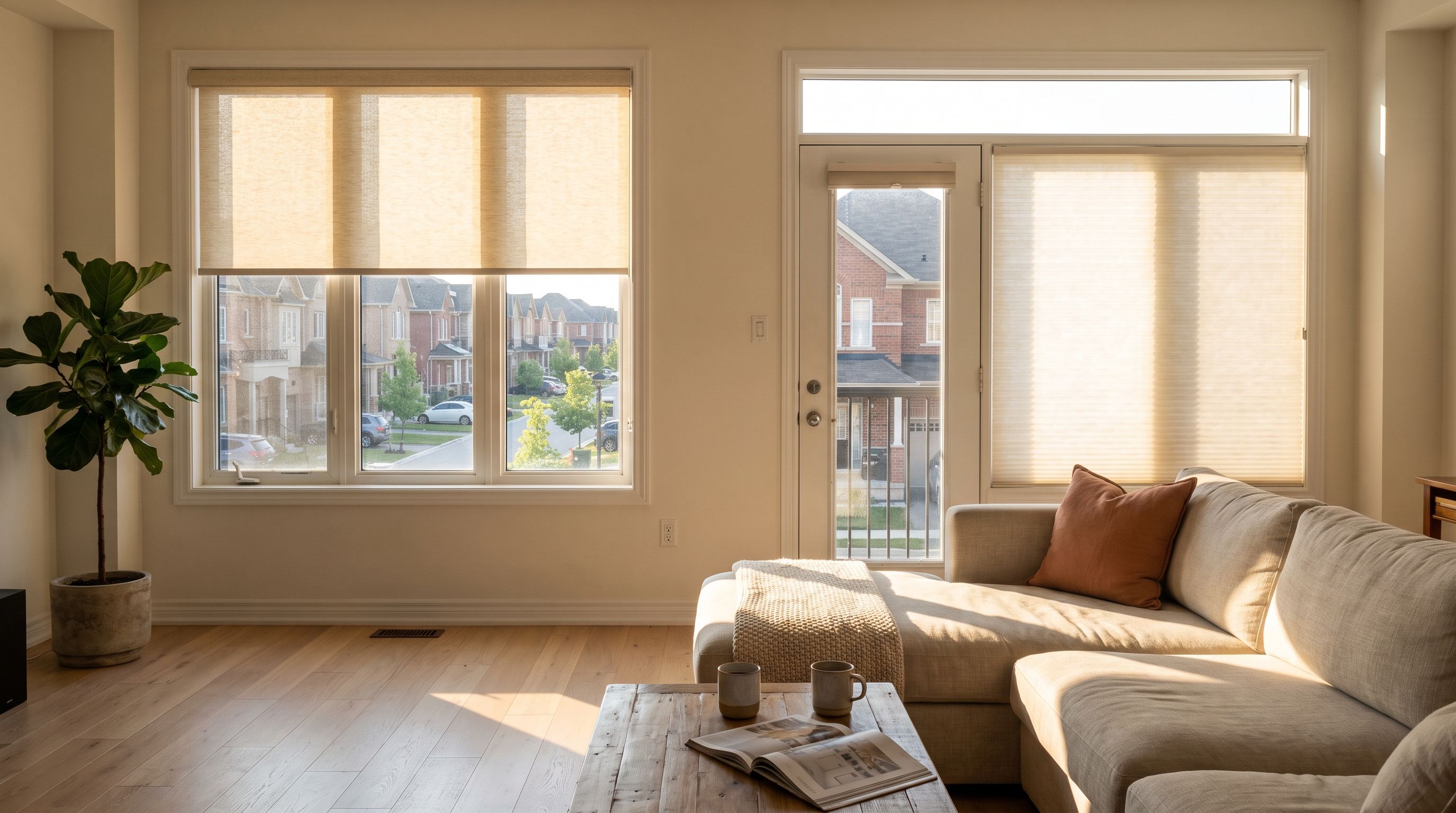
A new subdivision is an honest place to study sunlight, because nothing interrupts it. The trees are saplings on their stakes, the sightlines run to the horizon, and the sun reaches the glass exactly as the compass promises — into east bedrooms before six on a June morning, across the south-facing back garden all day, straight into a west-facing great room through the late afternoon.
So the specification writes itself, room by room. Blackout where people sleep, because no sapling is coming to help for twenty years. Screen or zebra fabrics on the west and south glass, so the hard hours can be turned down without being shut out. And in Mount Pleasant’s tighter streets, where the houses stand close, day-night fabrics answer the privacy of near neighbours without giving up the daylight that makes those rooms work.
The old town is the exception
Downtown Brampton predates every subdivision around it, and its Victorian and Edwardian streets play by the old rules: openings that have had a century to shift, real casings worth protecting, the odd sizes and bays that the rest of the city simply does not have. There we swap habits — fixings hidden in the reveal, each window measured as its own small country, no assumptions carried over from the house next door.
The same visit covers either kind of Brampton, and the same promise stands in both: the numbers are ours, so the fit is ours.
Hour by hour
The same window, four times over
7am
Springdale and Fletcher's Meadow face their bedrooms east in rows, and the street trees are still saplings on stakes. A June sunrise arrives whole, at the same hour, in four bedrooms of the same house — which is why blackout here gets specified once and then repeated, fitted tight to each opening rather than ordered to the plan's idea of it.
Noon
Midday is the one hour a double-height foyer handles gracefully, because the sun stands too high to reach far past the transom. The great room glazed to the roofline is the harder case — south glass at noon is heat before it is glare, and a cellular fabric answers heat where a heavier one only answers light.
6pm
West-facing great rooms take the whole descent of the afternoon with nothing between the glass and the horizon; Castlemore's wide lots and the newer streets in Credit Valley both run to open sightlines. A woven screen turns the shine down without taking the back garden away with it.
After dark
Mount Pleasant's streets stand close together, and once the lights are on a lit main floor reads clearly from the sidewalk and from the house opposite. Day-night fabrics settle that without argument — open and woven while daylight is the problem, closed and solid the moment it stops being one.
Room studies
Three ways to answer the light
Editorial room studies illustrating the brief — not photographs of client installations.
Inside the city
We measure across Brampton, not from a showroom in it.
- Bramalea
- Springdale
- Heart Lake
- Castlemore
- Fletcher's Meadow
- Mount Pleasant
- Credit Valley
- Downtown Brampton
Those are the parts of Brampton we are asked for most often — not the edge of where we go. If your street is not on the list, it is still on the route.
The rest of the range
Everything else we fit in Brampton
Winds onto a tube
Tilts to aim the light
Folds up out of the way
Slides across the opening
And the fitting itself
Our commitment
We measure it. If it does not fit, we remake it.
The visit is free. See the samples at your own window, get the quote, then decide.
Before you call
Questions worth answering before you book.
Do you cover all of Brampton?
Yes — Bramalea, Heart Lake, Springdale, Castlemore, Fletcher's Meadow, Mount Pleasant, Credit Valley and the downtown core, along with the rest of Peel and the wider GTA. The same crew carries your job from tape to installation, and the phones are answered 8am–9pm all week.
What is different about Brampton's windows?
Consistency. Most of the city was built in planned phases from the sixties onward, and within a subdivision the builders worked from a short list of window sizes. The result is a very different job from an old Toronto street — fewer surprises per opening, far more openings per order. The craft moves from wrestling odd shapes to specifying one good answer and repeating it perfectly.
If the windows are all standard sizes, why measure at all?
Because "the same size" on a plan is not the same size in a wall. Windows are set into framed openings by hand, and small differences ride in with every house — a few millimetres between one bedroom and the next is normal. A few millimetres is also exactly the margin an inside mount lives or dies by. Measuring every opening costs us part of a morning and guarantees each blind fits its own window rather than the plan's idea of it.
Can all the front windows match from the street?
They can, and usually should. One fabric in one colour across the front of the house reads calm from the curb, even while every room behind it makes its own choice about opacity — a blackout in the bedroom and a light filter in the study can share an identical street face. That kind of coordination is trivial when one order covers the house and awkward to retrofit piece by piece.
What do you do with a two-storey great room or foyer window?
Treat reach as the design constraint it is. Glass above the second-floor line cannot be worked by hand without a pole nobody enjoys, so tall feature windows either take a motorized shade — battery models install cleanly with no wiring — or a fixed treatment chosen never to need adjusting. Both are honest answers; which one is right depends on how the sun actually crosses that room, which is precisely what we look at during the visit.
We have young kids. Are the blinds safe?
Cordless operation is our default in any room a child uses, at no extra charge — no looped cords at any height a child can reach. Much of the range works by a weighted bottom bar or a wand, and motorization removes the question altogether. It is a short conversation at the measure, and the right time to have it is before the order, not after.
The last chapter
We bring the samples to your windows.
We come to you, measure at your own windows, and go through fabrics and fits together. The visit costs nothing.
$99 off when you order three or more blindsApplied to your written quote at the measure.
Rather just talk?(437) 782-5452Answered 8am–9pm, 7 days
Free in-home measure
A house full of builder glass still waiting for blinds, or one great-room wall you have never known what to do with?
Answered 8am–9pm, 7 days.
Page last checked 16 August 2026.