Guide
Cordless blinds, and the rooms where they are not optional
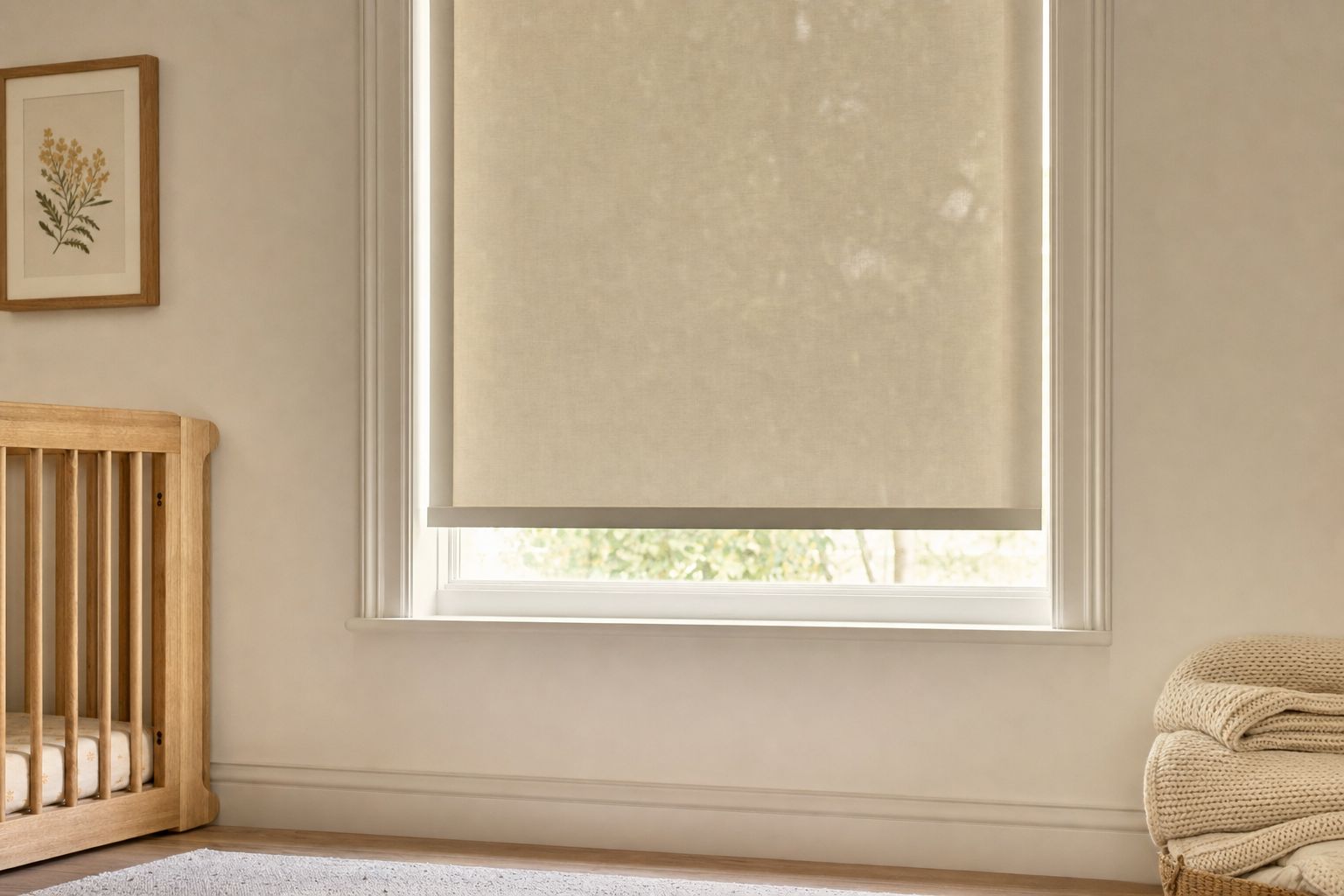
Cordless is the standard build on our blinds for any room a child uses, at no extra charge, and it is available across virtually the whole range — rollers, zebras, cellulars, romans, venetians and blackout blinds alike. The reason is not fashion: a looped cord within a young child's reach is a real, documented strangulation hazard, and Canada's corded window covering regulations, in force since May 2021, now restrict reachable cords and loops on anything sold so tightly that most designs simply abandoned the cord. The rules govern what is sold, not what already hangs in your house — which is why the blinds you own deserve a look this week, not at replacement time.
8 min readUpdated
ByNickolasLead installer & window covering specialist
The risk, in plain language
Strip away the regulation numbers and the industry vocabulary and the hazard is simple to describe. A cord that hangs makes a loop, or can be pulled into one. A loop at the height of a crib rail or a windowsill fits over a small child’s head. A child of one or two who becomes entangled has neither the strength nor the coordination to get free, and cannot shout for help while they fail. The scenario needs no unusual bad luck — a bed moved closer to a window, a nap, a quiet room — and it is precisely the quiet that makes it lethal: these are the hours children are alone by design.
None of that is speculation. Cord strangulation is a documented cause of death and injury in young children, warned about for years by Health Canada and by safety agencies in every country that tracks it. It is rare the way house fires are rare — rare enough to feel abstract, common enough that the building code stopped leaving it to chance. Canada’s response was to stop asking parents to manage cords and to start requiring products that do not present them.
That is the frame the rest of this page hangs on: the safest cord is the one the blind never had.
What Canada changed in 2021
Canada’s Corded Window Coverings Regulations came into force on the first of May, 2021, and they are unusually blunt for a product regulation. Rather than describing best practices, they set hard physical limits on any cord a user can reach: a reachable free cord may not exceed 22 centimetres, and no reachable cord may be able to form a loop bigger than 44 centimetres around — dimensions chosen against the body of a very young child, and tested under the kind of pull a toddler can exert. A cord that passes only because it is out of reach must stay out of reach for the life of the product, not until a cover pops off.
Two consequences matter to anyone buying or owning blinds.
First, the market moved. Those numbers are tight enough that redesigning the cord was usually harder than deleting it, so continuous chain loops, dangling pull cords and exposed inner lift cords largely vanished from what is legally sold in Canada. Cordless stopped being the premium option because it became the ordinary one.
Second — and this is the part sales pitches blur — the regulations govern supply, not possession. It is the making, importing, advertising and selling of non-compliant coverings that is prohibited. Nothing obliges you to remove the corded blind you bought in 2012, and anyone telling you your existing blinds are “now illegal” is selling, not informing. The reason to deal with an old corded blind is standing in the crib, not written in the statute.
How a blind lifts without a cord
The question everyone asks at the sample case, because it sounds like magic and is actually four small machines.
A spring inside the tube. The common answer on rollers, zebras and blackout rollers: a coiled spring balanced against the exact weight of the fabric. Pull the bottom bar down and it holds; give it a short tug and it climbs. The balance is real engineering — a heavy blackout fabric needs a spring specified for it, and a very large blind eventually wants a motor instead, because a spring fighting too much weight turns either sticky or violent.
A lift you push by hand. Cordless venetians and cellular shades raise from the bottom rail directly — lift, and a friction mechanism in the headrail holds the position; press down, and it follows. Tilt moves to a wand.
The wand itself. A rigid rod, turned for tilt or slid for traverse. It cannot loop, cannot knot, and cannot wrap around anything, which is why vertical blinds — wand-driven for decades — passed into the new era almost unchanged.
A motor. The complete answer, and the only one for glass nobody can reach. The blind moves on a remote, an app, a schedule or a voice, and there is simply nothing to grab. It is the one genuinely more expensive option, bought mostly for convenience with the safety arriving free. One honest caveat for bedrooms: motors are audible, and a scheduled blind opening at six in the morning is its own kind of alarm clock.
Our default, and where it applies
The policy on our range is one sentence long: in any room a child uses, cordless is the default build, at no extra charge. Not a checkbox to find, not a line item to justify — the quote arrives that way, and it costs what the corded version would have cost.
The definition of “a room a child uses” is deliberately wider than “nursery”. It is the bedroom, obviously — the room with the most unwatched hours — but also the playroom, the den where cartoons happen, the basement, and the spare room that becomes a cousin’s room every Christmas. At the measure we ask where children sleep and where they wander, and the answer shapes the build room by room. It costs nothing to say yes to, which is the point of making it the default: the safe configuration should not require anyone’s vigilance, including ours.
And because the whole range took the cordless turn after 2021, this is not a constraint on choice. Rollers, zebras, blackout rollers, cellulars, romans, venetians in every material, verticals on their wands — the mechanism you wanted exists without the cord. Nobody trades away darkness, warmth or looks to get a safe bedroom; the trade stopped existing.
Test the control where a hand will actually reach it
“Cordless” describes what is absent, not how pleasant the replacement is to use. The useful test happens at the real window, with the furniture in place and the covering at its normal height.
For a hand-lift blind, find the bottom rail in both states. When lowered it should be reachable without leaning over a crib, desk or deep counter. When raised, it should stop at a height the shortest regular user can retrieve. The movement should stay level when lifted near the centre; if a broad blind invites people to pull from one corner, daily use will feel awkward even when the mechanism is functioning correctly. A wide or high opening may be the point where a motor is practical rather than luxurious.
For a spring roller, try more than one stop. Lower it a third, halfway and near the sill, then release and raise it again. A well-balanced spring should hold the positions the room uses without demanding a sharp tug or racing into the headrail. The fabric weight and drop affect that balance, so the feel of a small sample is a demonstration of the idea, not proof of how a large bedroom blind will behave.
For a wand, rotate and traverse it from the standing position available beside the window. A long wand can be safer than a loop and still be irritating if it lands behind a sofa or collides with a sill ornament. On a sliding door it belongs at the edge reached first when entering, not hidden behind the stack of vanes when they are open.
For a motor, decide how the blind is commanded before choosing the accessory list. A wall control is obvious to guests. A remote is simple but needs a home. An app is useful for grouping rooms; a schedule is useful only if the household keeps the schedule. The blind also needs an accessible way to charge or service its power source. “No cord at the window” should not become “move a wardrobe to reach the charger.”
Finally, look from a child’s height even when the new control has no operating cord. Furniture still changes reach, internal cords may be visible on some folding or slatted constructions, and a window ledge remains climbable. The product has to be supplied in a compliant configuration; the room still has to be arranged sensibly around it. The two checks reinforce each other rather than substitute for one another.
The best cordless control is therefore the one that removes the loop and also gets used. If opening the blind is inconvenient, it will stay closed; if closing it is inconvenient, privacy or sleep suffers. Safety is the first gate, but ordinary daily movement is what makes the safer configuration last.
The blinds you already own
Regulation fixed the store shelf. Your house is yours to fix, and the fix is cheaper and less dramatic than a full replacement round. In order of effort:
Move the climbing furniture first. A cord is only dangerous within reach, and reach is usually supplied by a crib, bed, sofa or toy chest parked under the window. Moving it is free, takes ten minutes, and is the single most effective step on this list. It is also the step to re-check after any furniture rearrangement — a compliant room quietly stops being one when the bed migrates.
Anchor the loops you keep. A continuous chain or cord loop can be held taut in a tension device screwed to the frame or wall, so it cannot be lifted away and cannot slacken into a noose. The devices cost a few dollars at any hardware store. Their weakness is that they are brackets, and brackets get removed when someone repaints — check them after any redecorating.
Replace where children actually sleep and play, first. If the budget replaces one blind this year, it goes in the child’s bedroom, not the hallway. Then the playroom, then everywhere else in the order the rooms are actually used. A whole-house replacement is a fine project; a child’s-room replacement is an errand, and the errand covers most of the risk.
If you would rather have a second pair of eyes on it, walking your rooms and naming which windows are the problem is part of the free measure — and when the honest answer for a window is the tension device rather than a new blind, that is the answer you will get.
Choosing for a child’s room, beyond the cord
Since the cord question now answers itself, the real decisions in a child’s room are about light and sleep, and they are pleasant ones.
The room’s job is darkness on demand — naps happen at two in the afternoon, June bedtimes happen in daylight — which points squarely at a blackout blind with attention paid to the fit at the edges, since dawn slips around a loose blind long before it comes through one. A cordless spring lift handles the daily up-and-down; parents of heavy sleepers sometimes motorize instead, using a scheduled slow-open as a gentler alarm. A cellular version adds warmth over a crib that sits near cold glass.
And one placement rule outranks every product decision on this page: keep the crib, the bed and anything a child can climb an arm’s length from the window. It is the advice safety agencies lead with, it costs nothing, and it makes every blind in the room — old or new, corded or not — safer than any purchase alone can.
Questions
Still asked
Are corded blinds illegal in Canada now?
Owning them is not illegal, and never was. What Canadian regulation now restricts is supply — manufacturing, importing, advertising and selling corded window coverings that let a reachable cord or loop exceed very tight limits. The limits are strict enough that most manufacturers stopped engineering around the cord and removed it instead, which is why showroom ranges turned cordless after May 2021. The blind from 2010 in your hallway broke no law; whether a child can reach its cord is the question that actually matters.
Why exactly are blind cords dangerous to children?
Because a loop at the wrong height fits over a small head, and a young child who becomes entangled cannot reliably free themselves or call out. It happens fast, silently, and usually in the child's own bedroom during a nap or after bedtime — the hours a parent is deliberately not in the room. This is a documented pattern that safety agencies in Canada and elsewhere have warned about for years, not a hypothetical. The risk concentrates where cords hang near cribs, beds and furniture a toddler can climb.
Does cordless cost more?
On our range, no — in any room a child uses, cordless is the default build and adds nothing to the quote. Across the wider market the gap between a chain and a spring lift has mostly closed since the rules changed. The genuine price step is motorization, which adds a motor and a power source and is a different decision: convenience and reach are its arguments, with safety arriving as a bonus.
How do you raise and lower a blind that has no cord?
Four ways, depending on the mechanism. Spring-loaded rollers balance the fabric's weight so a light pull on the bottom bar starts it and it parks wherever you leave it. Cordless venetians and cellulars lift by hand on the bottom rail, with tilt moved to a rigid wand. Wands also drive vertical blinds, as they always have — a rod cannot form a loop. And motorized blinds remove the question entirely, moving on a remote, a schedule or a voice command.
What about the cords hidden inside roman shades and venetians?
They count, and they are the ones buyers forget. A roman shade lifts on cords threaded through rings behind the fabric, and an older venetian carries lift cords through its slats; on dated designs a child pulling the fabric or slats aside can draw a length of that cord out. Modern compliant designs shield the inner cords or replace the lift mechanism outright. When checking a shade you already own, look behind it, not just beside it.
We only visit my parents' house occasionally — does this apply there?
More than almost anywhere, and it is the classic gap. Grandparents' homes tend to have the oldest blinds, the least recent child-proofing, and rooms nobody has assessed at toddler height for decades. One walk through the house looking for reachable cords — then moving furniture away from windows and adding tension devices or replacing where needed — covers the risk for every visit afterwards. It is a one-hour job that tends to happen only once someone names it.
About this guide
Nickolas turns the decisions made at real windows — fit, clearance, direction of light, privacy and reach — into these field guides as Blinds Company'sLead installer & window covering specialist. Each article follows one rule: explain where an option wins and where it does not.
The product this one is about: Blackout blinds
If the blind you are worried about is one you already own, call anyway — sometimes the honest answer is a five-dollar tension device, and we will say so.
The last chapter
We bring the samples to your windows.
We come to you, measure at your own windows, and go through fabrics and fits together. The visit costs nothing.
$99 off when you order three or more blindsApplied to your written quote at the measure.
Rather just talk?(437) 782-5452Answered 8am–9pm, 7 days