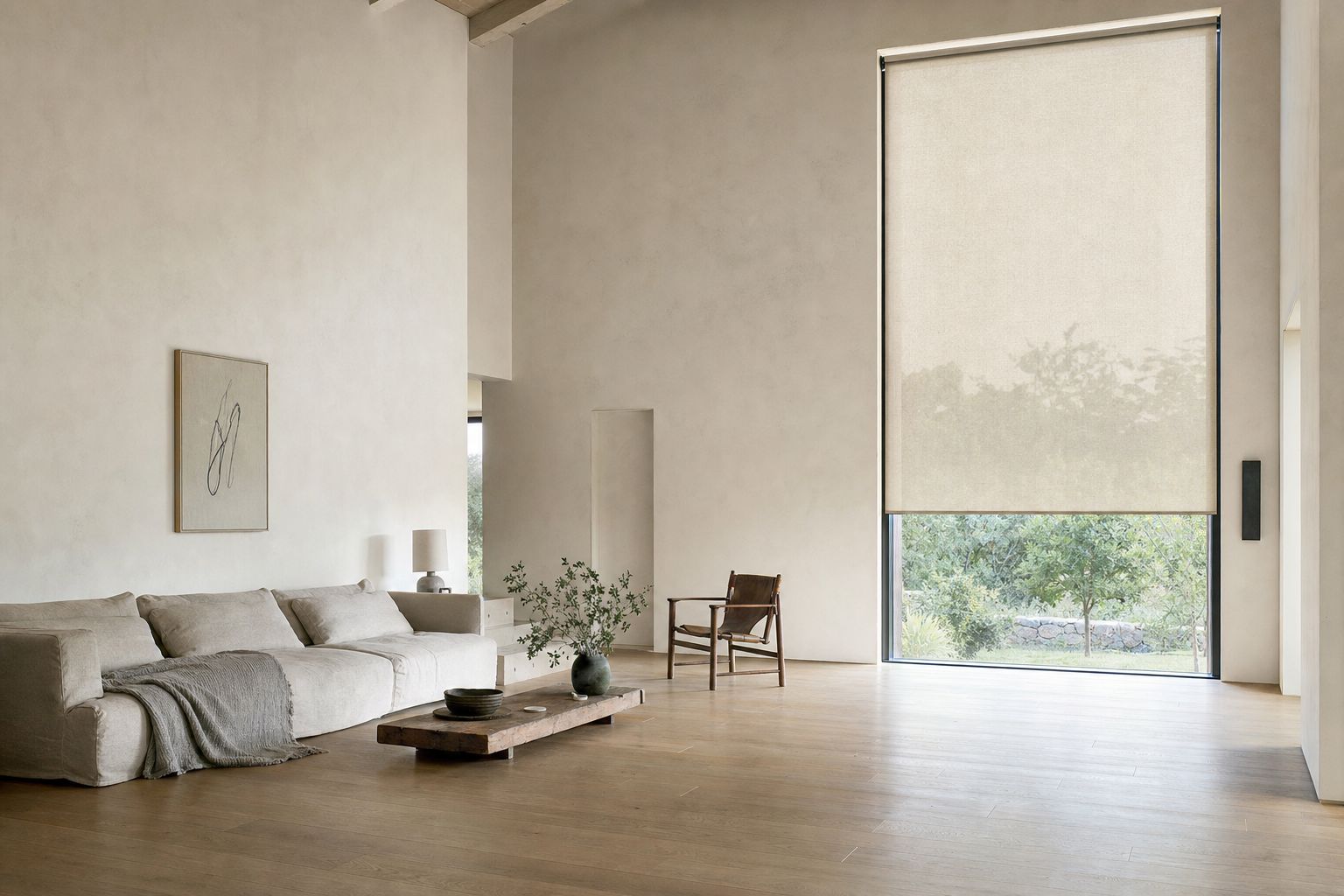
The range
Roller blinds in Burlington
Roller blinds made and fitted across Burlington. Near the lake the light is doubled — it comes off the sky and again off the water, arriving lower and lasting later than inland light — and the view responsible for it is the reason you bought the house. The blind's job is to keep one and lose the other.
Blinds Company · Rated 4.8 out of 5 on Google
Free in-home measure · open 8am–9pm, 7 days
- Chosen against water light
- Samples are judged at your own glass with the lake behind them, because reflected light is not a light any showroom has.
- Dark weaves see out better
- A pale screen glows under hard light and washes the view out, while a dark one stays optically quiet and keeps the horizon crisp.
- Two or three fabrics per house
- The water side and the west side peak in different seasons and almost never agree on a single weave.
- January is the honest test
- Low sun crossing open water is the hardest hour of the year here, so a fabric that survives it survives everything else.
In short
In Burlington we fit rollers specified for lakeside light — screen weaves that hold the view while cutting the glare off the water, denser fabrics for the walls that take the low evening sun — chosen at your own glass, on a free visit.
Inside this pageJump to one of 5 topics
Light that arrives twice
Every window takes light from the sky. A window near the lake takes it twice: once directly, and once bounced up off the water — a second, lower source that ordinary shading was never designed around. Eaves, porches and the window’s own head all assume light from above; the reflection slides in underneath them, onto ceilings, into eyes, across every screen in the room.
The doubling has a calendar. In summer, with the sun high, the reflection is glitter — bright but scattered. The serious season is the cold half of the year, when the sun crosses low over open water and the direct beam and its reflection arrive almost together, at an angle no overhang touches, for hours of the afternoon. Inland Burlington gets a version of this from the sky alone; the lakeside streets get it twice, off a mirror the size of the horizon.
That is the specification a blind inherits here, and it is why fabric chosen casually for these rooms fails in January at four o’clock, which is precisely when the room and the view are at their best.
Keeping the view you are paying for
The obvious answer to glare — block the window — is absurd on the lakefront, where the window is the house’s best feature and a closed blind costs you the very thing the glare rides in on. The roller’s real answer is the screen: a weave engineered to subtract brightness without subtracting scene.
The counterintuitive part is colour. Instinct reaches for white; optics disagree. Under hard light a pale weave glows like a lit lampshade and the view dissolves into it, while a dark weave stays visually silent and lets the lake read through crisp. The honest cost is thermal — pale fabric turns more heat away — so the choice is a genuine trade: the clearest view or the coolest glass.
On the water side, for most people, the view wins. It is also a choice that cannot be made from a description, which is why it gets made holding both samples against your own window at a bright hour.
The seasons swap the problem walls
A lakeside house does not have one light problem; it has a rotation. The water-facing rooms peak in the low-sun months, when the doubled light is at its sharpest. The west rooms peak on summer evenings, when the sun sets up the escarpment side and comes in level, under everything, straight across dinner. Two different geometries, months apart, on different walls of the same house.
One fabric cannot hold both posts. The water side wants the most open weave that tames its glare, because the view is the point; the evening side wants density, because at that angle nothing else works, and its view is a street. A finished house here usually carries a small wardrobe of fabrics — open toward the water, denser toward the west, blackout where sleep happens — each wall dressed for the shift it actually works. The roller blinds page covers the fabric families themselves; the point here is that the compass, not the catalogue, distributes them.
When the lake goes dark
A screen is a daylight instrument, and dusk retires it. The weave that gave you the water all day starts working for the other side — the lit room becomes the visible thing, and on the shore side of the house there are evening walkers, gardens, a path. Nothing about that is a flaw in the fabric; it is what an open weave is.
So the after-dark plan gets designed alongside the daytime one: an opaque second layer on the water side where the room lives at night, or a plain opaque roller in the rooms that only matter after sunset. What we will not do is sell a screen alone into a room that clearly needs its evenings private, and let November explain the physics.
The measure, at the hour that hurts
Everything on this page comes down to judgements that can only be made in your rooms with the lake doing its work — which weave, which colour, which walls need density, where the second layer earns its cost. So that is where the decision happens: samples against your glass, at a bright hour if you can manage one. We measure every opening while we are there, and you keep a written, per-window quote with the installation date committed in writing at the order. No deposit, and the visit itself costs nothing — even if the answer turns out to be two fabrics and fewer blinds than you feared.
Hour by hour
The same window, four times over
7am
Morning on the water side is the gentle half of the day: the sun is over the lake but still climbing, and the reflection is scattered rather than aimed. It is the hour most people choose fabric in, and the least informative one — a weave that behaves at seven has told you nothing about how it holds at four in February.
Noon
High sun puts the glitter on the water rather than in the room, so midday on the shoreline is mostly a heat question, and heat is where the pale samples win. It is the one hour of the day that argues for the lighter of the two fabrics you are holding up, which is worth knowing before the afternoon argues the other way.
6pm
Evening belongs to the other side of the house. The sun sets up toward the escarpment and comes in almost level through the west rooms, under the head of every window, and an open weave chosen for the water passes it straight through. Those walls usually take a denser fabric, and sometimes an opaque one for the worst hour.
After dark
On the shore side the screen changes employers. The lit room becomes the visible thing to the path, the gardens and anybody walking the waterfront, and the weave that showed you the lake all day now shows them the room. That is simply what an open weave is, and it is why the evening rooms get a layer of their own.
In the room
How the choice changes the room
The rest of the range
Everything else we fit in Burlington
Tilts to aim the light
Folds up out of the way
Slides across the opening
And the fitting itself
Written for this product
Roller blinds in the GTA
Our commitment
We measure it. If it does not fit, we remake it.
The visit is free. See the samples at your own window, get the quote, then decide.
Before you call
Questions worth answering before you book.
Will a screen fabric really keep my view of the lake?
Yes — that is the entire reason the category exists. A screen is a measured weave: open enough that your eye reads the scene through it, tight enough to strip the brightness off the water before it reaches the room. From a seated position the horizon stays where it was; what goes missing is the sheet of white that used to sit on top of it. How much view survives depends on the weave and, surprisingly, on the colour — which is why this choice gets made at your glass, not from a card in a showroom.
Why would you put a dark blind in a bright room?
Because dark weaves see through better. A light-coloured screen brightens under strong sun — the fabric itself starts to glow, and the view behind it washes out. A dark weave stays optically quiet, so the lake reads through it clearly even at the harsh hours. The trade is real and worth stating plainly: light fabrics reflect more heat away, dark fabrics keep more view. On a window that exists for its outlook, the view usually wins the argument — but it is your argument to settle, with both samples held up at your own glass.
Is light off the water genuinely different, or is that sales talk?
It is real, and you can test it yourself: the same sun feels harsher by the lake than it does two concessions inland. Water is a mirror laid flat, so a lakeside window takes the sky's light twice — once direct, once reflected up off the surface, from below the height ordinary shading expects. It is at its most theatrical in the cold months, when a low sun over open water can be blinding at an hour inland houses find gentle. Fabric chosen for ordinary exposure meets this and loses, which is the short history of most of the blinds we replace here.
What about the west windows and the evening sun?
Different wall, different problem, and it deserves its own answer rather than the lake's. Low evening sun comes in nearly level, under the top of any window and deep into the room, and an open weave that handles the water's brightness will pass the setting sun straight through. West rooms typically want a denser fabric than the lake side gets — sometimes an opaque one for the worst hour. A house here normally ends up with two or three fabrics doing different shifts, which is not upselling; it is the compass.
And after dark, on the lakefront?
The screen reverses, and you should hear that from us now rather than discover it in November. Once it is brighter inside than out, the weave that showed you the lake all day shows the lit room to whoever is on the shore side — and waterfront paths and gardens have evening traffic. Where a lakeside room matters after dark, we pair the screen with an opaque layer, or fit an opaque roller in the rooms that live by night. Daylight and darkness are simply two different jobs, and honest specification gives each its own answer.
The last chapter
We bring the samples to your windows.
We come to you, measure at your own windows, and go through fabrics and fits together. The visit costs nothing.
$99 off when you order three or more blindsApplied to your written quote at the measure.
Rather just talk?(437) 782-5452Answered 8am–9pm, 7 days
Free in-home measure
If there is an hour when the lake turns your window into a sheet of white, tell us which hour it is. That is the whole conversation.
Answered 8am–9pm, 7 days.
Page last checked 16 August 2026.