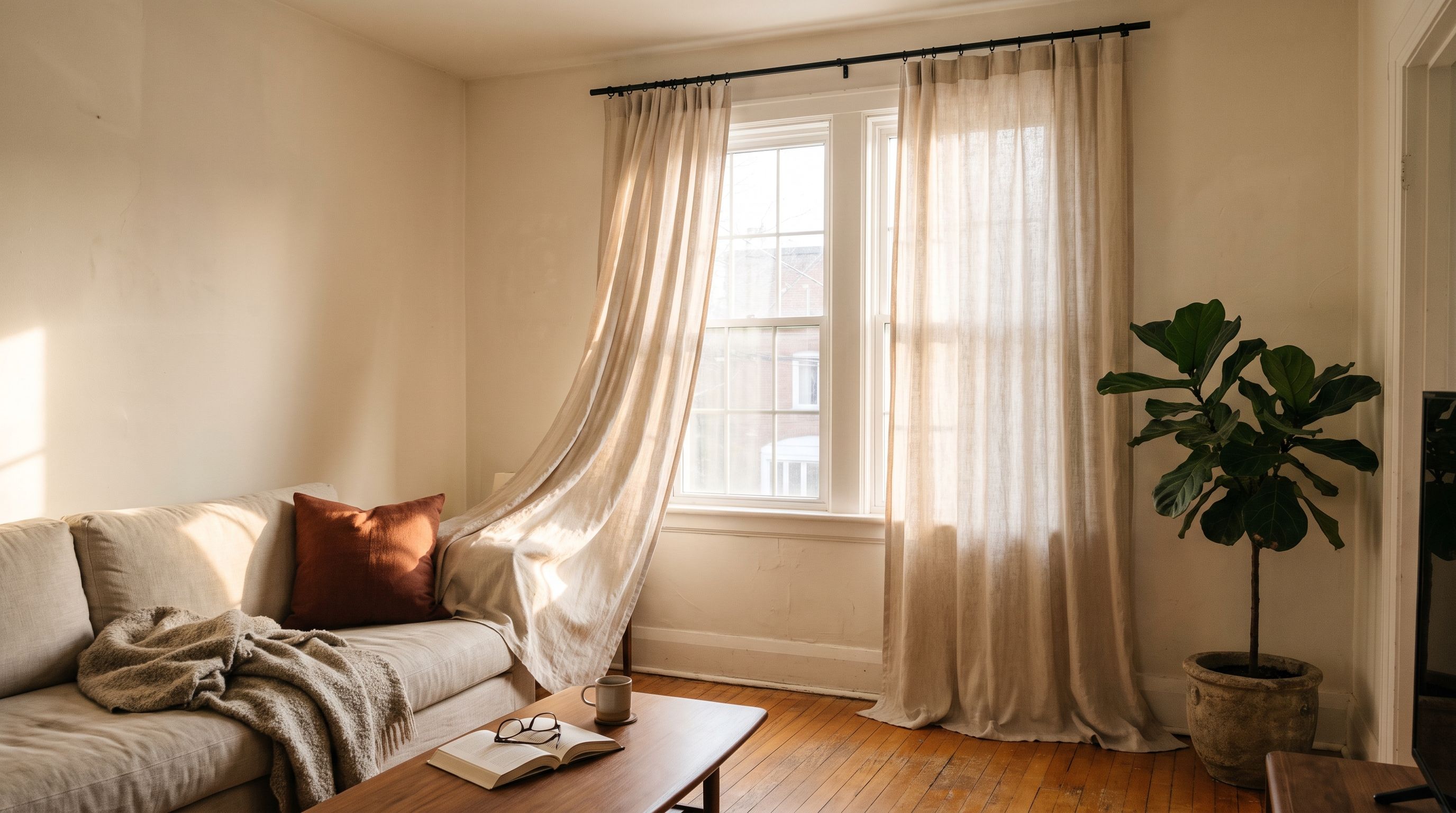
The range
Curtains in Brampton
Made-to-measure curtains for Brampton's formal rooms. The living and dining rooms at the front of a newer house keep evening hours — one oversized window that goes black at dinner time — and cloth, cut full and hung floor-deep, is what turns that glass back into a room.
Blinds Company · Rated 4.8 out of 5 on Google
Free in-home measure · open 8am–9pm, 7 days
- Cut full, not flat
- The fullness is stated in your written quote, because on a window this size it is the one economy that shows from the sidewalk.
- Track runs past the glass
- The wall beside the window is measured too, so the open cloth stands on plaster instead of on the daylight you were keeping.
- Hemmed to your own floor
- On a nine-foot main floor the drop is taken at both ends of the window rather than once in the middle and trusted.
- One street face, many rooms
- What the front of the house shows can stay identical while each room behind it chooses its own weight, lining and opacity.
In short
Curtains earn their place in Brampton's formal living and dining rooms because those rooms are used after dark, when an oversized window turns to black glass — and full-length cloth closes the room, warms it and quiets it in a way no hard covering can.
Inside this pageJump to one of 4 topics
The rooms that keep evening hours
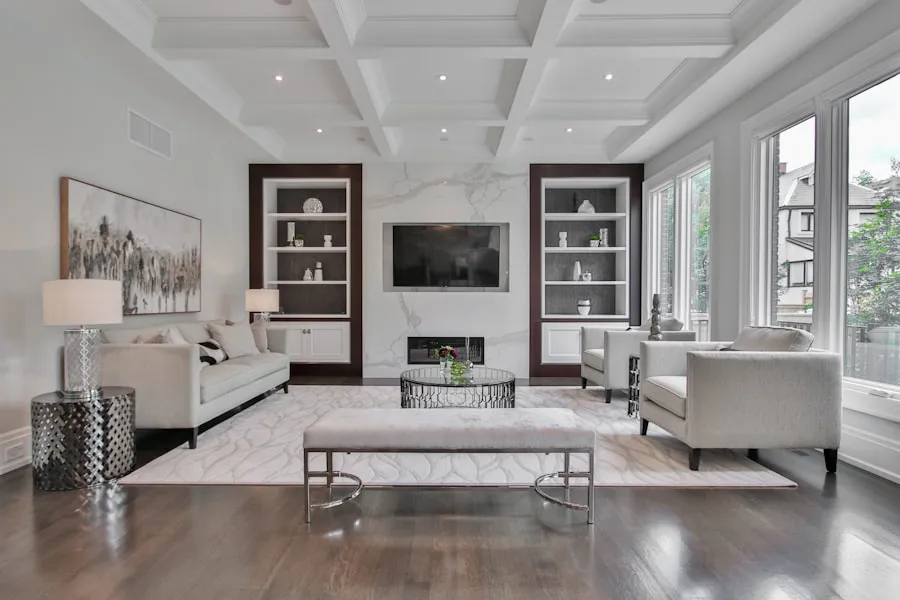
Every Brampton floor plan of the last few decades sets aside its best-dressed space: the formal living room, the dining room, sometimes both run together, placed at the front of the house behind the largest window on the elevation. And those rooms have a schedule unlike anywhere else in the house. The kitchen works all day; the formal rooms clock on at dusk.
Which puts their one oversized window in a strange position. All day it does gentle work — light for a quiet room. Then evening arrives, the lamps come on, and the glass turns. From inside it is suddenly a tall black mirror beside the dinner table; from the street, a lit stage. The window is at its worst at precisely the hour the room exists for.
That inversion is the case for cloth. A blind can cover that glass; curtains change what the room is at night. Drawn, they replace a cold surface with a deep, warm one, they take the echo out of a hard-floored room, and they close the space the way a door closes — which is the feeling a dinner in that room was always supposed to have.
Big glass asks for real cloth
The windows in these rooms are generous even by new-build standards, and scale is the thing that decides whether curtains look inevitable or apologetic.
Full means full. The folds are the product — cloth carrying roughly double its window in width, so that drawn or open it hangs in deep, deliberate waves. On a small window, thin curtains are a small mistake. Across an oversized one they are a large flat one, visible from the street.
Length does the same work vertically. On a nine-foot main floor the track belongs well above the frame and the hem just at the floor, so the cloth runs in one uninterrupted line and the window borrows height it does not have. A curtain stopping at the sill, on glass this size, dresses the window like a kitchen window — and these are not kitchen windows.
None of this is taste for its own sake. It is proportion: an oversized window sets the scale, and the cloth either answers it or is measured against it every time someone walks in.
Somewhere for the curtain to go
The measurement that decides everything in these rooms is one almost nobody takes: where the open curtain stands.
Cloth does not vanish in the daytime; it stacks. And a proper pair on a big window makes a real column of fabric on each side. If the track ends at the window frame, those columns stand on the glass, and the room pays a permanent toll of daylight for its evening comfort — the exact bargain nobody meant to strike.
The fix is planned, not clever: the track runs past the frame onto the wall, far enough that the drawn-back cloth clears the glass entirely. The window keeps its full day; the folds frame it like casework; and the curtain reads as architecture rather than as a thing hung in front of a hole. What it requires is wall — which is why we measure the wall, not just the window, and why the occasional room without spare wall gets that conversation at the measure rather than a surprise at the hanging.
Chosen under the lamps, not the sun
One more habit borrowed from how these rooms are actually used: the fabric is chosen in the evening light it will live in.
A formal room’s cloth is seen by lamplight far more than by daylight, and fabrics are not loyal between the two. A weave that reads silver-grey at noon can sit green under warm bulbs; a red that glowed on the sample table can go heavy by night. The only verdict that counts is delivered in your room, at night, under your own lighting — so that is where and when the shortlist gets held up, full drop, at the window.
The rest of the visit is the unglamorous part done properly: the wall checked for what the track must fix to, the stack planned, the fullness and lining agreed and written down, every window measured on its own line. The quote is yours in writing with the installation date committed on it. No deposit, no card, and the phones are answered eight in the morning to nine at night, every day, when the room is ready for its evening clothes.
Hour by hour
The same window, four times over
7am
Nobody is in the formal room at breakfast, and the curtains are simply standing wherever they were left — which is the state nobody plans for. Drawn back onto the wall they read as columns framing the window; parked across the glass they shade an empty room and dim the front of the house for everyone walking past it to the kitchen.
Noon
Nothing happens in this room at midday except fading. A front window on a Brampton street whose trees are still staked takes the full southern hour with nothing in the way, and the layer at risk is the lining rather than the face cloth — which is half the argument for a sheer on its own track behind the main curtains.
6pm
Dinner is the hour the room clocks on, and the glass has not decided which way it faces yet: light enough outside to read the street, dark enough inside for the street to read you. A curtain with real fullness closes cleanly at that moment. A mean one closes and still shows a lit room through the gaps between its folds.
After dark
Now the window is a tall black mirror at the centre of the house, and every front elevation on the street is being read from the sidewalk. Closed, lined cloth ends the mirror inside and shows one consistent face outside — which is why the lining across the front windows is worth keeping identical even when the rooms behind them are not.
In the room
How the choice changes the room
The rest of the range
Everything else we fit in Brampton
Winds onto a tube
Tilts to aim the light
Folds up out of the way
Slides across the opening
And the fitting itself
Written for this product
Curtains in the GTA
Our commitment
We measure it. If it does not fit, we remake it.
The visit is free. See the samples at your own window, get the quote, then decide.
Before you call
Questions worth answering before you book.
Is it worth curtaining a room we only host in a few times a month?
That room is working more evenings than its dinner-party count suggests. A formal room at the front of the house is the face the street sees every night, and it is walked past, looked into and lived alongside even when nobody sits down in it. Bare, its big window is a black rectangle at the centre of the house every evening; curtained, the same room reads warm from the sofa and from the sidewalk alike. The cloth works nightly — the hosting is just when you notice it.
How much fabric does a big window actually need?
More than looks reasonable on paper, and the difference is the whole result. A curtain needs comfortably more cloth than the width it covers — roughly twice, and sheers more still — because the surplus is what forms the folds, and the folds are what you are buying. Cloth stretched nearly flat to save fabric reads as exactly that from across the room. On an oversized window this is the one corner that cannot be cut, which is why our quotes state the fullness in writing rather than leaving it to goodwill.
Will curtains cost us the daylight in that room?
Not if the stack is planned, and planning the stack is most of the measuring. Open curtains have to stand somewhere, and on a window that fills its wall the only question that matters is whether they can clear the glass when drawn back. Run the track past the frame onto the wall and the cloth stacks against plaster instead of view; the room keeps its window by day and gains its walls by night. When the wall space genuinely is not there, we say so at the measure and design around it, not after the rings are up.
What hangs in front of the glass during the day, then?
In a formal room, usually a sheer on its own track behind the main cloth. It gives the room a daytime state — light in, sightline from the street broken, furniture and floor shielded from the steady sun that fades them — while the main curtains frame the window and wait for evening. Two layers sounds indulgent and is really just the day shift and the night shift of the same window, each doing the half it is good at.
Do the curtains need blackout lining in a dining room?
Almost never — nobody sleeps there, so total darkness is not the job. What the lining is for in these rooms is body and honesty: it makes the folds fall heavier, it protects the face fabric from the sun, and it is what the street sees, so it keeps the front of the house consistent. Save true blackout for the bedrooms, where it is the entire point.
Can the same visit also handle blinds for the rest of the house?
Yes, and it usually should. The natural split in these houses is cloth in the formal rooms and simpler hard coverings in the working ones, and quoting them together means one written document, one set of measures and finishes chosen to sit beside each other rather than argued about later. Curtains, blinds and the hanging of both are all our own work — the measure is free either way.
The last chapter
We bring the samples to your windows.
We come to you, measure at your own windows, and go through fabrics and fits together. The visit costs nothing.
$99 off when you order three or more blindsApplied to your written quote at the measure.
Rather just talk?(437) 782-5452Answered 8am–9pm, 7 days
Free in-home measure
If your dining room's window turns into a black mirror at exactly the hour the room is used, that is the problem this cloth was invented for.
Answered 8am–9pm, 7 days.
Page last checked 16 August 2026.