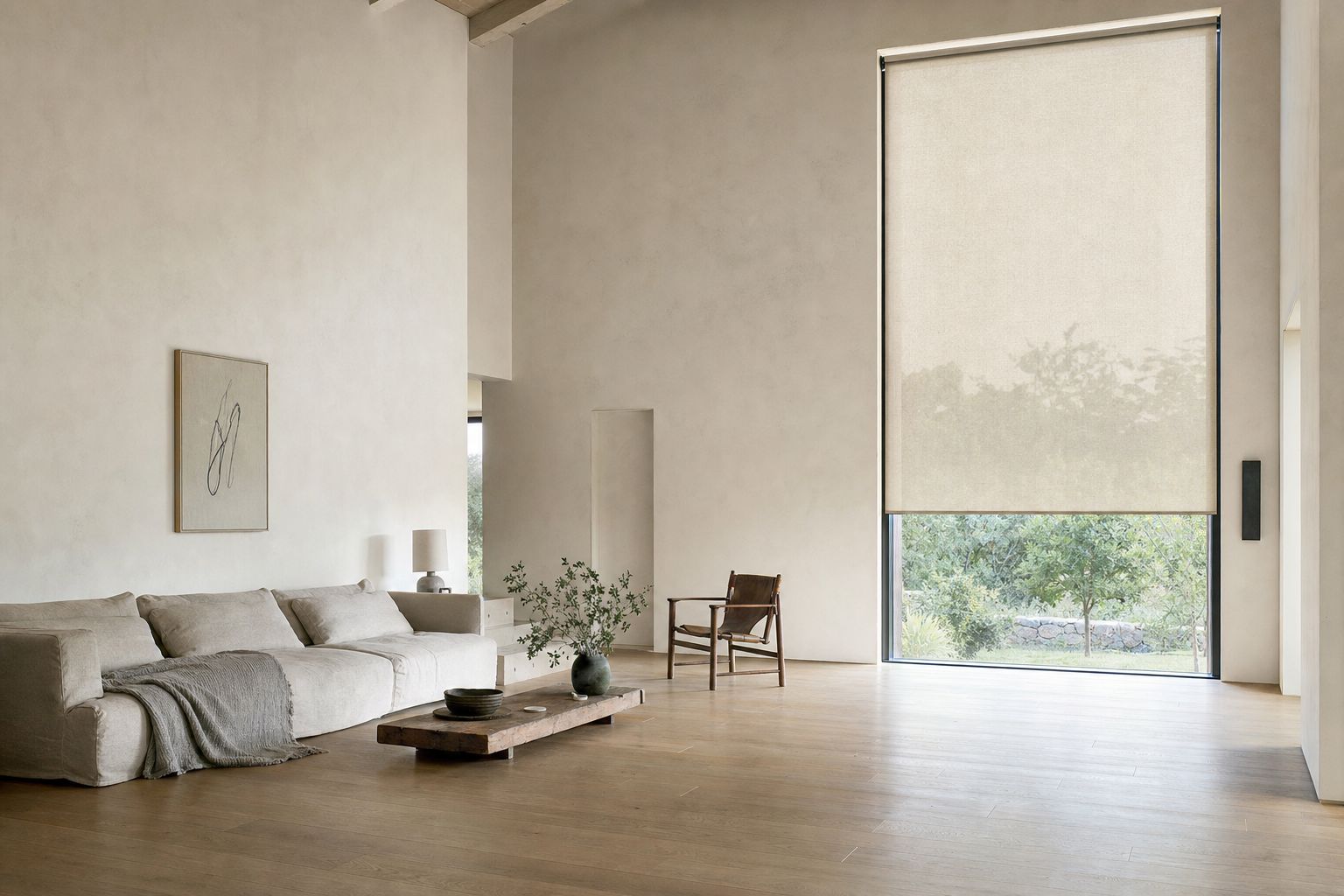
The range
Roller blinds in Mississauga
Roller blinds made to your openings and fitted across Mississauga. The houses here carry wide glass — picture windows, sliders, family rooms glazed almost edge to edge — and on a roller, width decides everything: the tube inside it, the effort of the pull, and whether one blind covers the span or two share it.
Blinds Company · Rated 4.8 out of 5 on Google
Free in-home measure · open 8am–9pm, 7 days
- Tube sized to the span
- Diameter is an engineering decision on wide glass, because a tube that bows telegraphs the fabric off line within a few years.
- Joins land on frame lines
- Where two blinds share an opening, the meeting point goes on a mullion or a centre post the window already draws for you.
- Bottom bars aligned
- A matched pair is set to one horizon, so two blinds read as a single decision rather than as two separate purchases.
- Motor where the weight says so
- Past a certain span the motor is a mechanical recommendation, and it is also the only operator that never pulls from a corner.
In short
Across Mississauga's wide suburban windows we build rollers sized to the span — the tube chosen for the width, one blind or a matched pair decided at the window — and the measuring visit at your home is free.
Inside this pageJump to one of 5 topics
Width is the measurement that matters here
Mississauga’s housing was built with the lot sizes to glaze generously, and it shows at every era: the long picture window of the older bungalows, the wall-wide family room glass of the nineties subdivisions, the sliders onto decks and walkouts everywhere. Ask someone to describe a window in this city and they will tell you how wide it is.
A roller blind is, mechanically, a tube spanning that width, supported only at its two ends and carrying its own fabric. Every other product in the range shares the load somewhere — a roman folds onto itself, slats hang from ladders. A roller’s tube does all the work alone, so width is the specification that decides everything else: what diameter the tube has to be, how the fabric behaves over years of travel, what the blind weighs, and what mechanism can move that weight gracefully.
None of this argues against rollers — a clean fabric plane across a big window is exactly the look these rooms want, and it is why rollers are what we fit most here. It argues for sizing them like the engineering they quietly are.
One blind or two, and where they meet
Somewhere in most Mississauga houses is a window near the edge of what a single roller can span. The decision — one blind at the limit, or two sharing the opening — is worth making deliberately, because both answers are right in different rooms.
One blind gives you an unbroken plane and a single motion. Its cost is a big tube, real weight, and no room for error in the fit. Two blinds split the weight into two easy mechanisms and let each half work independently — shade the sun side of a wide room and leave the other half open — and their cost is the join. The join is honest: a fine line of light where the fabrics meet. Put on a mullion or the centre post of a slider, it vanishes into the window’s own lines; put mid-pane, it is a stripe you will see for a decade.
That is why the one-or-two decision is made standing at your window, looking at where its natural lines fall — not from a size chart.
The door that is also a window
Sliders and garden doors are the second signature of this city’s glass, and they change the roller brief in one way: the blind has to vanish. A window covering can idle half-down all afternoon; a door covering has to get completely clear of a doorway you carry groceries through.
So over a slider the roller mounts above the frame, rolls to a tight coil well clear of the opening, and drops only when you ask. The width questions from above all apply — a double slider is one of the widest openings in the house — and one more joins them: handedness. If only one panel slides, a two-blind split lets the fixed side stay shaded while the walking side stays open, which in practice is how these doors get used from May to October.
Heavy is a decision you can refuse
Wide blinds are heavy blinds; there is no way to cheat the cloth. What you can choose is who lifts the weight.
A chain clutch is geared, so even a big blind moves in civilised pulls — more of them, but each one light. A spring can be balanced beautifully at moderate widths and starts to feel industrial at the extremes. And past a certain span the recommendation we make is a motor, for a mechanical reason rather than a lifestyle one: several square metres of fabric moved twice a day, every day, is a job, and motors do that job identically on the first day and the three thousandth. It is also the option that never pulls the fabric off line, which is how wide rollers stay straight for their whole lives.
Where a child sleeps, the decision is already made: cordless or motorized, as our standard, at no charge.
What gets decided at the window
The measure is where the span meets the specifics: the tube sized to your actual width, one-or-two settled against your window’s own lines, the join — if there is one — agreed while both of you are looking at where it would fall. Fabrics come out at the glass, in the room’s own afternoon.
What you are left with is a written quote, itemised per opening, with the fitting date put in writing when you order. No deposit taken, nothing owed for the visit — and if a stock-size blind would honestly do one of your windows, you will hear that from us at the door.
Hour by hour
The same window, four times over
7am
Morning is the lightest work a wide roller ever does — one pull and the whole span is open. It is also when the weight makes itself known, because a big blind is heaviest at the start of its lift, and a geared chain clutch turns that into more pulls rather than into one pull you have to lean your shoulder into.
Noon
Midday is when a wide window is asked to be two windows. Half the span is glaring and the other half is perfectly comfortable, and a single blind can only answer for both at once — which is the honest argument for splitting the opening at a mullion and letting each half hold its own position all afternoon.
6pm
The slider is in constant use from five o'clock, and a roller over a door has exactly one job at that hour: to be completely out of the way. Mounted above the frame, the roll sits clear of the opening so nobody carrying a plate outside has to negotiate with it, which is what keeps the blind in use rather than permanently up.
After dark
A wide blind down for the evening is where a join either disappears or announces itself. Placed on the centre post of a slider or a frame division, it reads as part of the window. Placed mid-pane, it is a thin line of light drawn across the darkest surface in the room, every night, for as long as the blind lasts.
In the room
How the choice changes the room
The rest of the range
Everything else we fit in Mississauga
Tilts to aim the light
Folds up out of the way
Slides across the opening
And the fitting itself
Written for this product
Roller blinds in the GTA
Our commitment
We measure it. If it does not fit, we remake it.
The visit is free. See the samples at your own window, get the quote, then decide.
Before you call
Questions worth answering before you book.
Can a single roller cover a really wide window?
Up to a point, and the point is set by physics rather than preference. A roller is a tube supported only at its ends, and past a certain span the tube starts to bow under its own fabric — which shows as a blind that scrapes at the middle or tracks off line. The answer is a stiffer, larger tube, up to the width where fabric itself runs out. Where your window sits against those limits is a thing we work out at the measure, not something to guess from a chart.
If a window needs two blinds, where does the join go?
On a line the eye already expects — a mullion, a frame division, the centre post of a slider — so the meeting point reads as part of the window rather than a flaw in the blind. At the join itself the honest truth is a thin line of light between the two fabrics; planned onto a frame line it disappears against the very thing that casts it. We also align the bottom bars so the pair moves as one horizon, which is the detail that makes two blinds read as one decision.
Are rollers practical over a sliding patio door?
Yes, with one rule: the blind must be able to get fully out of the way of a door you walk through every day. That means mounting above the frame with the roll sitting clear of the opening, so the raised blind leaves the whole doorway usable. Down, it covers the glass like any window. The thing we check at the measure is which panel slides and where you naturally walk, because a blind that is technically fine and practically in your way gets left up forever.
Does a wide blind become hard to use?
It becomes heavier — the cloth grows with the area — and what that demands depends on the mechanism. A chain clutch gives you gearing, so a wide blind stays civilised at the cost of more pulls. Past a certain size, the honest recommendation is a motor: not as an indulgence but because the physics of several square metres of fabric says so. And in any room where a child sleeps, cordless or motorized is simply our default, at no extra charge.
Do wide rollers go crooked over the years?
The failure is called telescoping — the fabric walks sideways along the tube until one edge rubs — and wide blinds are more prone to it simply because there is more fabric to walk. It is caused mostly by years of pulling from one corner. A correctly sized tube, a square fit and a centred pull largely prevent it, and a motor prevents it entirely, because a motor never pulls from the corner.
The last chapter
We bring the samples to your windows.
We come to you, measure at your own windows, and go through fabrics and fits together. The visit costs nothing.
$99 off when you order three or more blindsApplied to your written quote at the measure.
Rather just talk?(437) 782-5452Answered 8am–9pm, 7 days
Free in-home measure
If somebody once told you a window of yours was too wide for a roller, that is the window we would most like to measure. Ring us and describe it.
Answered 8am–9pm, 7 days.
Page last checked 16 August 2026.