The range
Curtains in Mississauga
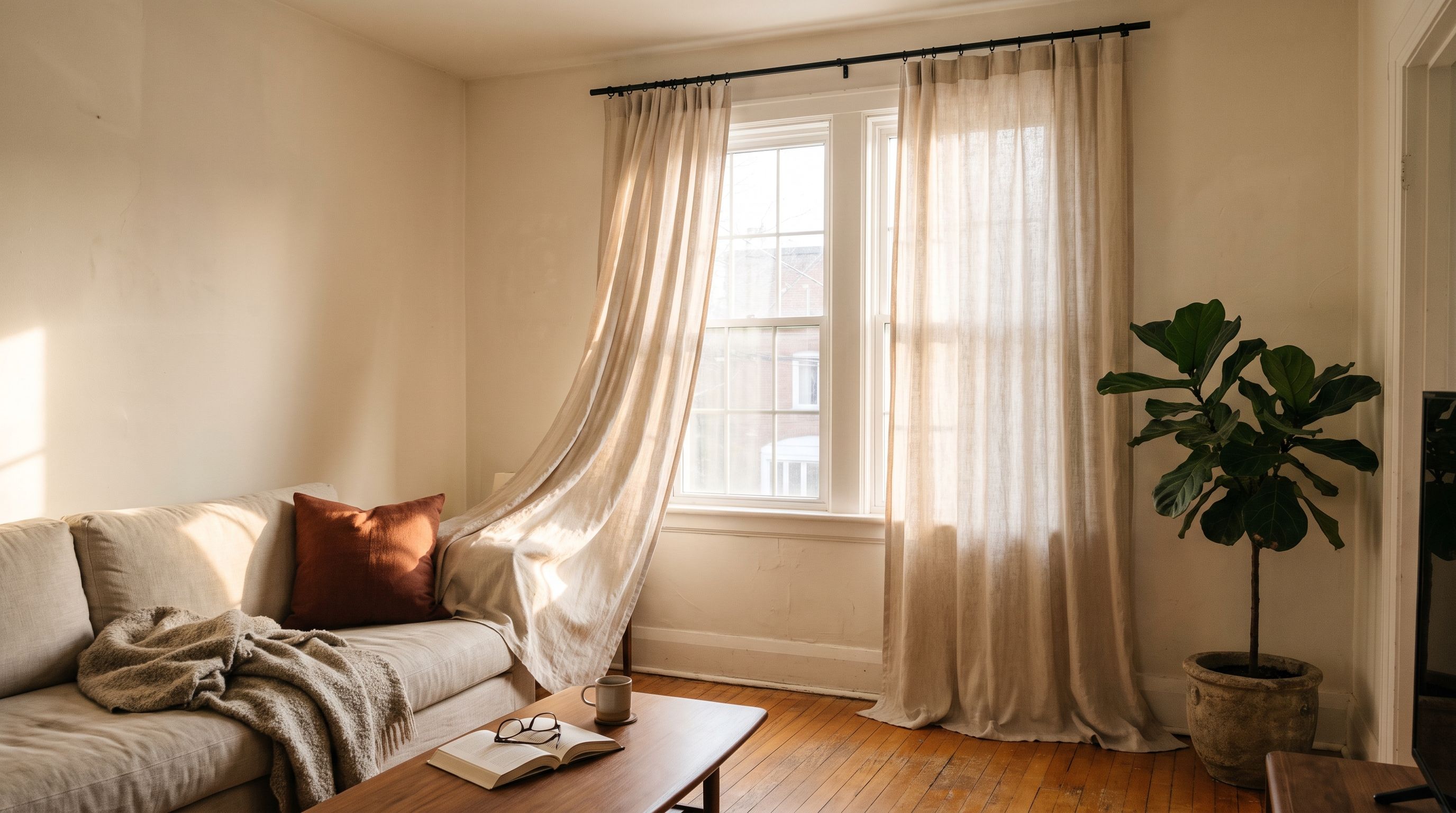
Curtains made, measured and hung across Mississauga. On the big glass of the newer suburbs the hard question is not the fabric — it is where the fabric goes when the curtain is open. A curtain never disappears; it stands beside its window, and the wall has to have room for it.
Blinds Company · Rated 4.8 out of 5 on Google
Free in-home measure · open 8am–9pm, 7 days
- The open state is designed first
- Where the stacked cloth stands gets settled before the closed look, because on wide glass that is the decision that costs daylight.
- Drawn to the fixed panel
- On a slider the curtain stacks over glass nobody walks through, so the operating panel and the path in front of it stay clear.
- One track, several openings
- Two or three windows sharing a wall can carry a single run at a single height instead of three short ones fighting each other.
- The wall is measured too
- The reveal tells you almost nothing about whether a curtain suits a room here; the plaster beside the window tells you everything.
In short
Across Mississauga we plan curtains from the wall outward — the track run past the glass so the open fabric stands clear of it, single or paired draws chosen for how the room moves — measured and hung by the same crew, with a free first visit.
Inside this pageJump to one of 5 topics
The fabric has to live somewhere
Here is the fact the brochure photographs never show: those pictures are always taken with the curtains closed, or artfully half-drawn. Nobody photographs the other state — open — because open is where design either happened or did not. A curtain does not vanish when you draw it back; it gathers into a standing column of fabric with real, unignorable width, and that column will spend most of its life on display.
On a modest window this resolves itself — there is wall everywhere, and the column leans on some of it. Mississauga’s newer housing removed the slack. Great-room glass runs high and wide, window walls stretch nearly post to post, sliders own the back of the house, and the leftover wall beside all that glass is measured in hand-widths. The window is generous; the parking for its curtain is not.
Which is why, in this city, we design the open state first. Where the fabric stands when you are not using it is the decision; the closed state — the one every catalogue sells — follows automatically once the open one works.
The track is longer than the window
The whole trick, once the problem is stated, is almost embarrassingly simple: the track outgrows the glass. Run it past the opening — onto the wall on one side or both — and the open curtain stands beside the window instead of on it. Every centimetre of daylight survives, and as a free side effect the window reads wider than it is, because the eye takes the fabric’s span as the window’s span.
What that extension has to be is particular to each window: cloth volume, lining, single draw or pair all change the size of the standing column, and the wall has to actually offer the space — which in these plans it sometimes only offers on one side. Then the curtain becomes a single draw, all its fabric living on the side with the wall, drawn across the full width at night. Not a compromise; on many of these windows it is simply the correct architecture, decided by looking at the room rather than the window.
Doors you walk through, windows you look through
The back of a Mississauga house is usually a slider or a garden door, and it adds one requirement no window has: a right of way. The curtain must never stand in the path — not when open, and not requiring a two-handed operation every time someone goes out with a plate in one hand.
The plan follows the door’s own habits. One panel is fixed, one moves: the curtain draws to the fixed side and stacks its whole bulk over glass nobody walks through, leaving the moving panel and the path in front of it clear all day. Closed at night, it curtains the entire opening as if the door were any other window. The measure for this is taken standing in the traffic, watching which way the room actually flows — five minutes that decide whether the curtain gets used for twenty years or pushed permanently to one side within a month.
Several windows, one line
The newer plans rarely give a room one window; they give it a rhythm of them — two or three openings sharing a wall, sometimes stepping around a corner. Curtained one by one, each with its own short track and its own little stacks, the wall turns fussy: six columns of fabric guarding three modest openings.
Treated as one run, the same wall calms down completely. A single track at a single height crosses all of them; the fabric stands at the far ends, the wall strips between the windows disappear behind cloth or stand as quiet pauses in one long line, and the room gains a horizon instead of a set of boxes. This is the move that makes ordinary builder fenestration look deliberate, and it costs planning rather than money — the one commodity a measuring visit exists to supply. Where the windows also need daily light control behind the fabric, that is a job for a blind underneath — the roller blinds page covers that layer.
Planning it in your room
Every question this page raises is answered by standing in the room with a tape: how much wall each window really has, which side the fabric can live on, where the household walks, which openings should share a line. We take the measurements, hold the fabrics up at your own glass, and put the whole plan — track lengths, draw directions, every window itemised — into a written quote, with the installation date committed in writing when you order. Nothing owed at the visit, no deposit after it; seven days a week, the looking costs nothing.
Hour by hour
The same window, four times over
7am
The back wall of a Mississauga house usually holds a slider, and the first act of the morning is opening the curtain rather than the door. Drawn to the fixed panel it clears the glass and the walking path in one motion. Drawn to the wrong side it spends breakfast being shoved aside by whoever is going out with a coffee.
Noon
Midday shows you exactly how much window the curtain is costing. A standing column of lined cloth on the glass is easy to miss until you notice the room's brightest hour has a shadow down each edge. With the track run onto the wall the same column stands on plaster, and the span reads wider than the builder drew it.
6pm
Late afternoon asks the curtain to do something it should not be doing. Cloth can be drawn against a west glare, but drawing it costs the view, the room and the reason the glass is that big. This is the hour a blind underneath earns its keep, leaving the curtain free to stay open until it is genuinely dark.
After dark
Closed, a wide run finally does the thing it was cut for: one continuous line of cloth across two or three openings, so a wall of separate black rectangles becomes a single soft surface and the strips of wall between the windows disappear behind fabric. That is only true if the track was planned as one run rather than three.
In the room
How the choice changes the room
The rest of the range
Everything else we fit in Mississauga
Winds onto a tube
Tilts to aim the light
Folds up out of the way
Slides across the opening
And the fitting itself
Written for this product
Curtains in the GTA
Our commitment
We measure it. If it does not fit, we remake it.
The visit is free. See the samples at your own window, get the quote, then decide.
Before you call
Questions worth answering before you book.
Will open curtains cover part of my window?
Only if the track stops where the glass does — which is the standard mistake on big windows. Drawn open, a curtain compresses into a column of folds that has real width, and that column must stand somewhere. If the track ends at the window's edge, it stands on your glass, permanently shading the edge of the very window it was meant to serve. Run the track past the opening and the same column stands on the wall instead, with every centimetre of glass clear. It is the least known and most consequential measurement in the whole product.
How far past the window should the track go?
Far enough that the open fabric hangs entirely beside the glass, and how much that is depends on things a formula cannot see from here: how much cloth the window needs, whether it is lined, whether it opens as a pair or a single draw. A full, lined curtain stacks wider than a light unlined one; a pair splits the bulk into two smaller columns. We work it out for your actual window and fabric at the visit — and check the wall can accept the answer before anything is ordered, which is precisely the step that gets skipped.
Can you put curtains on a sliding door we use all day?
Yes, and the plan starts from the handle rather than the fabric. On a slider one panel is fixed and one moves, and the curtain should draw to the fixed side — a single draw, all the fabric stacking over the glass you never walk through, leaving the operating panel and its path permanently clear. Drawn shut, it covers the whole doorway like any window. Get the handedness wrong and the curtain hangs in the exact spot the household passes through forty times a day, which is why it is the first thing we look at.
Can one track run across several windows?
Yes, and on the window walls common in this city it is usually the better answer. Two or three openings separated by strips of wall can carry one continuous track at one height, dressed as a single run — the wall reads as one long window, the strips between disappear behind fabric, and the room gains the width of the whole gesture. The alternative, a separate short curtain boxed over each opening, chops the wall into pieces and always looks busier than the architecture is.
How do big curtains actually get opened — cord, wand, or what?
For most rooms, a wand at the leading edge or a smooth hand draw on a good track is the honest answer — long runs want quality gliders far more than they want gadgetry. Corded tracks exist and have their place; in any room where a child sleeps we default to cord-free operation at no extra charge. And where a run is genuinely large, or high, or simply used on a strict daily rhythm, a motorized track is the version of the product that gets used instead of admired. We will say which your room justifies, including when the answer is the plain one.
The last chapter
We bring the samples to your windows.
We come to you, measure at your own windows, and go through fabrics and fits together. The visit costs nothing.
$99 off when you order three or more blindsApplied to your written quote at the measure.
Rather just talk?(437) 782-5452Answered 8am–9pm, 7 days
Free in-home measure
If a curtain in your house eats half its window every time you open it, somebody skipped a measurement. Ring us — planning it properly takes ten minutes in the room.
Answered 8am–9pm, 7 days.
Page last checked 16 August 2026.