The range
Roller blinds in Vaughan
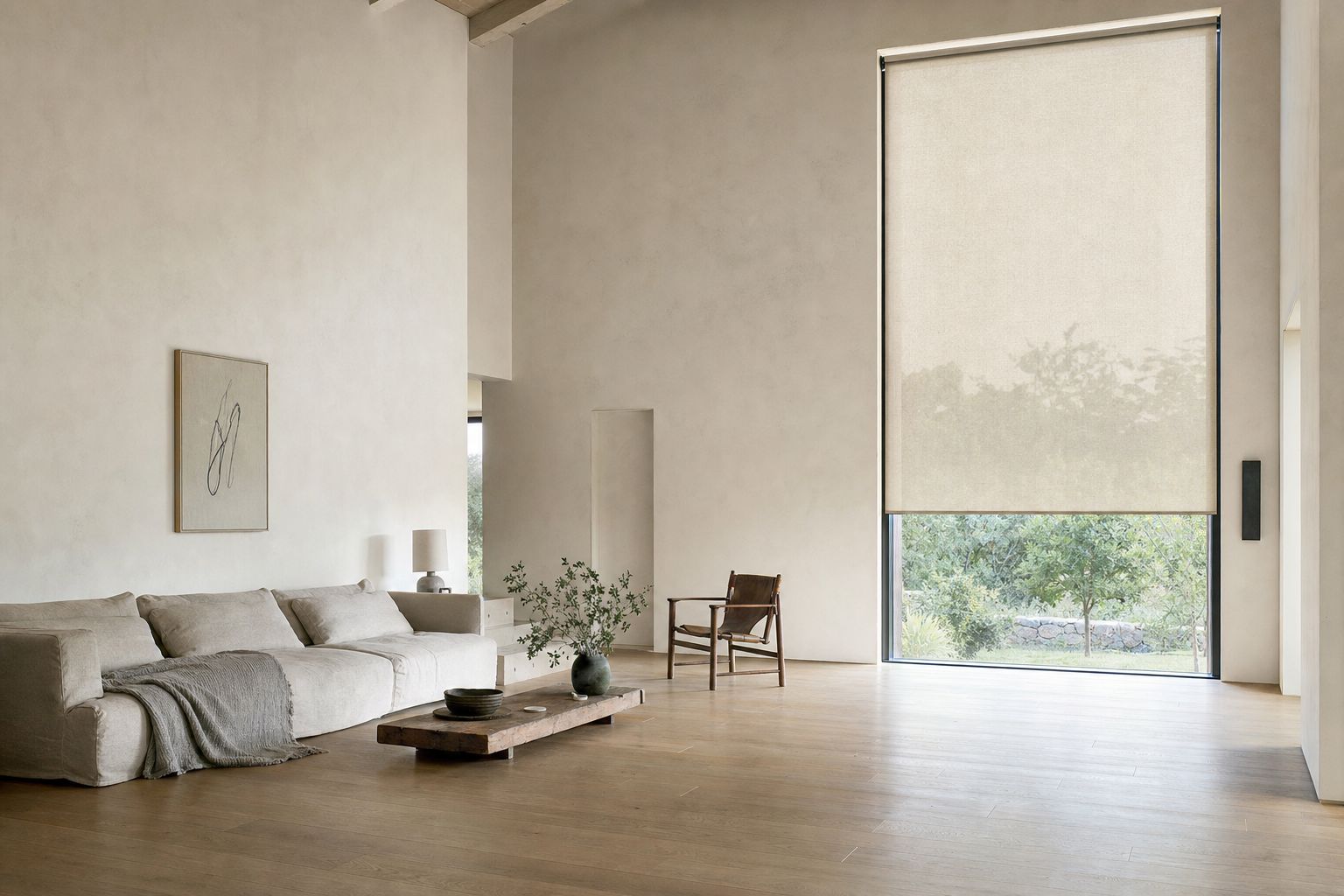
Roller blinds for Vaughan's tall rooms. A double-height great room hangs half its glass above anyone's reach, and the covering that suits it is the one that behaves like part of the window — a flat plane that scales up, takes a motor gracefully, and all but disappears when it rises.
Blinds Company · Rated 4.8 out of 5 on Google
Free in-home measure · open 8am–9pm, 7 days
- One blind per section
- A glazed wall is already divided by mullions and transoms, and the covering follows those lines instead of spanning them.
- Upper and lower quoted apart
- The two banks work different hours, so they take different fabrics and often a different amount of hardware.
- Power planned before the motor
- A battery motor eighteen feet up still has to be reached a few times a year, so running supply to the head of the glass gets raised first.
- The bulkhead gets checked
- A framed one is the cleanest mounting line in the room; a hollow light box around ductwork is not, and a wide blind is a real load.
In short
Roller blinds suit Vaughan's double-height great rooms because they scale: a flat plane of fabric per section of glazing, motorised where hands cannot reach, and almost nothing to see when the wall of glass is open.
Inside this pageJump to one of 4 topics
Half the window is out of reach, and that is the design
The signature room of Vaughan’s newer housing is tall. The great room rises through two storeys, the back wall is glazed most of the way up, and the result is the best-lit room the builder ever drew — with a covering problem nobody drew at all. Half of that glass hangs above any hand, any pole and any sensible ladder position, and it still needs an answer for sun, for heat and for the occasional film night that would rather not begin at full brightness.
What that wall wants from a covering is temperament: something that treats the glazing as architecture rather than as decoration. A roller is the calmest product in the range at scale — a tube, a flat plane of fabric, a slim bar — and when it rises it condenses to almost nothing, which on a wall this deliberate is precisely the point. Nothing gathers, nothing swags, nothing asks to be looked at.
Two hours, two jobs, one wall of glass
Here is the useful way to think about a double-height window, and it is a schedule rather than a floor plan: the upper glass and the lower glass work different shifts.
The upper bank works midday. When the sun is high, that is the glass it enters through — heat gathering in the upper volume in summer, a bright field pouring down across the room, and, over years, the slow fade of whatever the light lands on. Nobody is glared at directly; the problem is cumulative, not acute.
The lower bank works the evening. As the sun drops, the light comes in level, straight across the room at the height of every face and every screen in it — the one hour a day the room can be genuinely unusable. And after dark the shifts end together: the lit room stands in the glass, facing the yard.
Two shifts, two specifications. The upper glass takes a fabric chosen for light and heat, moving rarely, on a schedule or not at all. The lower glass takes the fabric chosen for the western hour and the evening, and it is the bank you will actually touch. Splitting the job this way is not a compromise — it is the reading of the window the architecture was always asking for.
What a roller brings to a wall this size
Scale flatters this product. A few reasons, all of them practical.
It disappears on command. A roller’s raised state is a slim roll at the head of the glass — on a wall whose whole argument is the view, the covering spends most of its life invisible.
It repeats cleanly. A glazed wall is sections, and a roller per section gives identical flat planes meeting on the window’s own lines. When they move together the wall dims as one surface, which no gathered product does at this width without drama.
It takes a motor as though born to it. The tube is where the motor lives, so nothing changes visually, and the out-of-reach bank becomes a schedule instead of a chore. Grouping puts the whole wall on one remote, the lower bank on another, and the film night on a scene if you want one.
It scales honestly — with one condition. Width and drop mean weight, and weight means the tube is an engineering decision rather than a catalogue line. A tube specified for the span runs level for years; an undersized one eventually tells on itself at the bottom bar. Sizing it is our job, and it is decided by measurement, not optimism.
Mounted to the architecture, not to hope
Newer construction gives these windows shallow reveals — often too shallow for hardware — so the mounting conversation moves up: to the wall face above the glass, to the ceiling line, or to the bulkhead many of these rooms run along the top of the glazing.
Each works. Which one is right depends on what is actually there, which is why the measure involves a ladder and a level rather than assumptions. A framed bulkhead is a gift — it puts the head of the blind above the head of the glass, so no daylight leaks over the top. A hollow one is a warning, and finding out which you have is a thirty-second check that saves a bad afternoon. Long runs get their level checked too, because over several metres of glazing a ceiling line can drift, and a wide blind hung to a drifting line advertises it.
None of this is your homework. It is what the free visit is for: the ladder, the level, the tube arithmetic, the motor plan and the honest opinion about which glass needs nothing at all. You keep a written quote with each section of the wall priced on its own line and the installation date stated in ink. Nothing is owed with it — the phones are open eight in the morning to nine at night, seven days, whenever the tall room is ready to be measured.
Hour by hour
The same window, four times over
7am
Early sun is the lower bank's business, arriving at the height of the breakfast table and the sofa. The upper glass at that hour is simply bright, and nobody in the room wants it any other way — the first evidence of the day that the two halves of this wall are two separate specifications rather than one large one.
Noon
Noon belongs to the upper bank. High sun enters through the glass nobody can reach, pours down across the room and gathers heat in the volume above head height. Nothing glares and nobody complains; the cost is cumulative — warmth by August, fade after a few summers — which is why that bank moves rarely and is chosen once.
6pm
The lower bank works the evening shift. The sun drops until it is level with every face and every screen in the room, and this is the bank a hand can actually reach: the one hour a great room becomes genuinely unusable, and the reason the lower glass gets the fabric chosen for the western hour rather than the noon one.
After dark
Two storeys of lit glass is the brightest thing on the street, and from inside it turns into a mirror of your own room. Closing the lower bank gives the evening back to the people in it. The upper glass can usually stay bare, because nothing at that height faces anybody — and that saving is often what pays for the motor lower down.
In the room
How the choice changes the room
The rest of the range
Everything else we fit in Vaughan
Tilts to aim the light
Folds up out of the way
Slides across the opening
And the fitting itself
Written for this product
Roller blinds in the GTA
Our commitment
We measure it. If it does not fit, we remake it.
The visit is free. See the samples at your own window, get the quote, then decide.
Before you call
Questions worth answering before you book.
Can one roller blind cover a two-storey window?
One should not try. A glazed wall that size is built from sections — mullions and transoms divide it already — and the covering follows those lines: one blind per section, meeting on divisions the architecture drew. Asking a single blind to span the whole face means a very long tube carrying a very heavy fabric, and the physics start showing before the fabric does. Sectioned, each blind runs light, level and quiet, and the wall still reads as one surface when they move together.
How do we operate glass that is eighteen feet up?
With a motor, and honestly there is no second answer worth your money. A motorised roller takes a remote, a schedule or a phone, and grouping means the upper and lower banks move together or separately as the hour requires. One practical note we raise early: a battery motor up high still has to be reached a few times a year for charging, so on genuinely tall glass we talk about running power to the head of the window first — easiest during any renovation, and the version you never think about again.
Does the upper glass even need blinds?
Sometimes it genuinely does not, and we will say so. The questions that decide it: is anything in the room fading, does the midday sun land somewhere that matters, does heat build in the upper volume in summer. If every answer is no, the honest specification covers the lower glass and leaves the upper bank bare — the money saved usually motorises the blinds that actually earn their keep.
What does the room look like from outside at night?
A double-height wall of glass with the room lit is the brightest thing on the street, and it works in both directions — from inside, the black glass mirrors the room back at you; from the yard, the room is on stage. Closing the lower bank returns the evening to the people in the room, which is where it belongs, and the upper glass can usually stay bare because nothing at that height faces anyone.
There is a bulkhead running along the top of our glass. Problem or not?
Often it is the answer rather than the problem — a solid, framed bulkhead is a clean mounting line that puts the blind's head above the glass, so no strip of daylight escapes over the top. The caveat is that not every bulkhead is solid; some are light boxes around ductwork, and a wide blind is a real load. We check what is up there before promising anything to it, which is one more reason this measure happens from a ladder and not from a form.
The last chapter
We bring the samples to your windows.
We come to you, measure at your own windows, and go through fabrics and fits together. The visit costs nothing.
$99 off when you order three or more blindsApplied to your written quote at the measure.
Rather just talk?(437) 782-5452Answered 8am–9pm, 7 days
Free in-home measure
If your great room's glass goes up further than your reach does, that is a measuring problem before it is a product problem — and the measuring is free.
Answered 8am–9pm, 7 days.
Page last checked 16 August 2026.