The range
Curtains in Toronto
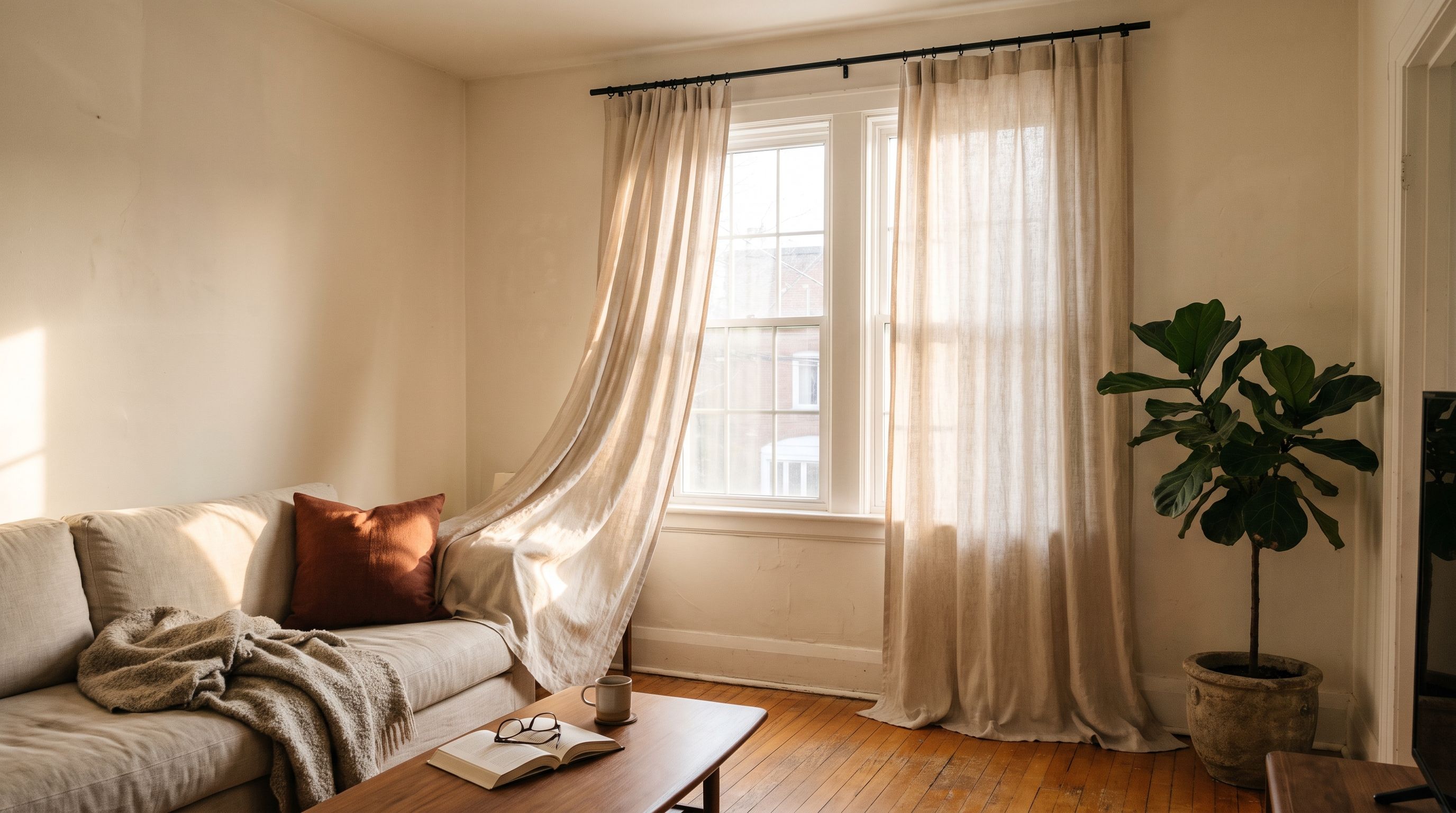
Curtains made, measured and hung across Toronto. The old city's windows are taller than they are wide, and the rooms were designed around that height — a curtain is the only covering that answers all of it, and the best ones here work over a blind rather than instead of one.
Blinds Company · Rated 4.8 out of 5 on Google
Free in-home measure · open 8am–9pm, 7 days
- Hung to the cornice, not the frame
- Rail height is agreed standing in your room against the actual moulding, because that is what makes a tall room read tall.
- Drop taken at both ends
- Old Toronto floors are rarely level, so the hem is cut to the floor the curtain will actually meet rather than a theoretical one.
- Fixed into what the wall is
- Above a century window there can be plaster, lath, brick and timber within a metre, and a lined full-drop curtain is a real weight.
- Planned with the blind under it
- One visit specifies both layers, so the headrail, the track and the stacked cloth are not all claiming the same strip of wall.
In short
In Toronto's older housing we hang curtains as the finishing layer of a tall room — cut to your ceiling and your floor, usually working over a blind that handles the daily light — and the first visit to measure it all costs nothing.
Inside this pageJump to one of 5 topics
The window is taller than you
Stand at the front window of an older Toronto house and the top of the glass is usually well above your head. These windows were made tall on purpose — rooms were lit by daylight or not at all, and a tall window throws light deep into a narrow floor plan. The proportions of the whole room follow from it: high ceilings, tall doors, and a window that is the most vertical thing in the house.
A blind respects the glass. It sits inside the frame, covers the opening, and stops at the trim. What it cannot do is answer the height — the run of wall from the top of the window to the ceiling, the vertical line the room was drawn around. Fabric can. A curtain hung high and dropped to the floor is the one covering that uses the whole height instead of ending politely at the frame, which is why these rooms have worn curtains for a century and still look slightly unfinished without them.
That is the honest case for curtains in this city. Not draught, not fashion: proportion. The house is vertical, and a curtain is the only thing on the window that is vertical with it.
Two layers, two jobs
The mistake people make with curtains — here more than anywhere, because the windows are so prominent — is asking one layer of fabric to do everything: privacy at nine in the morning, glare at two, darkness at eleven. No single curtain does all of that without being closed half the day, and a closed curtain in a front room reads as an apology.
So the arrangement we fit most in old Toronto rooms is a pair. A blind sits inside the frame — a roller or a roman, screen or opaque as the room’s hours demand — and takes every adjustment the day asks for. The curtain hangs over it, opened once in the morning and drawn once at night, and spends the hours in between doing the architectural work. The blind is the instrument; the curtain is the frame it plays in.
This is also, quietly, the economical way round. The layer that moves ten times a day is the mechanical one built for it. The fabric — the expensive, beautiful, made-to-your-window part — is handled twice a day by its edge and lasts accordingly.
The front room, which was built to be looked at
Toronto’s older streets are close. The bay or the tall front window that makes the room is a few strides from the sidewalk, and the room behind it was always meant to be partly on display — that is what a parlour was for.
Curtains manage that display better than anything else on the window. Dressed back in the day, they frame the room from the street and the street from the room. A sheer under them keeps the daylight while taking the detail out of the view in — the Victorian solution, and it has not been improved on for this exact situation. After dark the arithmetic flips, the lit room becomes the display, and the main fabric closes; if the room matters to you at night, that closing layer is the one to spend on.
One practical Toronto note: in a front bay, the curtain usually hangs across the mouth of the bay rather than tracking around inside it. The bay keeps its depth — a place to stand, a windowsill for the cat — and the curtain gets a straight run, which is both the cleaner line and the simpler track. Where the bay itself should stay dressed, that is the blind’s job, section by section.
Cloth against a hundred-year-old wall
Everything above hangs off a rail, and the rail hangs off a wall that has been standing since before anyone alive measured it. Tall curtains are heavy — lining doubles the cloth, and a generous window carries metres of it — so the fixing matters more here than in any newer house, and it is different above nearly every window: sound plaster, hollow lath, brick that takes an anchor beautifully, timber where you least expect it. We find out what is up there before anything is drilled, and the fixing is chosen for the wall rather than taken from the packet the rail came in.
The floor end has its own century of history. Old floors slope, and a curtain cut to one measured drop meets a floor that was never level to begin with. We take the drop at both ends of every window and cut the hem to the floor the curtain will actually meet — the small discipline that separates a curtain made for your room from one made for a drawing of it.
The measure, in a tall room
The visit is where all of it gets decided in the only place it can be: your room, your ceiling height, your wall, your floor. Rail height agreed against the actual cornice. Fabric held up at the actual window, in the light that room actually keeps. The blind underneath specified alongside, so the two layers are planned as one window rather than bought as two products.
You get the whole thing as a written quote, itemised, with the installation date committed in writing when you order. No deposit, and no obligation to get past the first conversation — seven days a week, the visit costs nothing.
Hour by hour
The same window, four times over
7am
In a tall front room the curtain is not what moves at seven. It is opened once and left, and the blind inside the frame takes the morning — because nobody draws two metres of lined cloth back and forth for a low sun that will have moved on by nine. That division of labour is the whole reason these rooms wear both layers.
Noon
Midday is the hour that proves the rail height. Hung just above the glass, a curtain cuts an old room's height in half and the eye reads the whole wall as squat; taken up toward the cornice, the same cloth gives back the proportion the house was drawn with. It is also the decision that cannot be changed later without new holes.
6pm
Low western light runs down a narrow Toronto lot and strikes the curtain edge-on, which is when the folds either read as folds or as a flat panel. The same light lands along the hem, and a floor that dips at one end of the window shows up in it long before it shows up in anything measured from the middle.
After dark
Now the cloth does its own job. Drawn, it covers the wall as well as the window, holds the cold sliding off an original sash, and turns a lit parlour a few paces from the sidewalk back into a private room. The blind behind it handles what is left leaking at the frame, which is the part fabric alone never seals.
In the room
How the choice changes the room
The rest of the range
Everything else we fit in Toronto
Winds onto a tube
Tilts to aim the light
Folds up out of the way
Slides across the opening
And the fitting itself
Written for this product
Curtains in the GTA
Our commitment
We measure it. If it does not fit, we remake it.
The visit is free. See the samples at your own window, get the quote, then decide.
Before you call
Questions worth answering before you book.
Do I need a blind as well as curtains?
In most Toronto rooms, honestly, yes — and not because we sell both. A curtain on a tall window is a large, deliberate thing to move, and nobody draws one four times a day as the sun swings round. The arrangement that works is a division of labour: a blind inside the frame takes the hourly adjustments, and the curtain gets opened in the morning, closed at night, and otherwise left to do what it does best, which is stand there looking like part of the room.
How high should the rail go in a room with high ceilings?
Higher than the window, and how much higher is a judgement made standing in the room rather than a rule. Old Toronto rooms carry their height proudly — mouldings, tall doors, deep baseboards — and a curtain hung just above the glass cuts that height in half visually. Taken up toward the ceiling line, the same fabric makes the room taller instead of shorter. The right height depends on what the wall above your particular window is doing, which is exactly the kind of decision the visit exists for.
Can curtains alone make a bedroom properly dark?
They get you most of the way and not the last of it. A lined curtain swallows a great deal of light, but it hangs free of the wall, so light finds the top and the sides — and on a tall east-facing window there is a lot of morning for it to find. Where a bedroom genuinely has to be dark, we put a blackout blind inside the frame to seal the glass and let the curtain do the room. Each layer does the half of the job it is actually good at.
Will heavy curtains stay up on hundred-year-old walls?
Yes, if the fixing goes into something that deserves it, and finding that something is our job rather than yours. The wall above a tall window in an old Toronto house varies — plaster, timber, brick, sometimes all three within a metre — and a full-length lined curtain is a real weight hanging on a few screws. We choose the fixing for what your wall is made of, and if a rail we fitted ever comes away, that is ours to put right, not yours to explain.
My floors slope. What happens to the length?
We measure the drop at both ends of the window rather than once in the middle, because in an old house those are usually two different numbers. Then you choose how the curtain meets the floor it actually has — hanging just clear, or touching — and the hem is cut to your floor rather than to a theoretical level one. A curtain that skims the boards at one end and floats at the other is what happens when somebody measured a Toronto room as if it were new.
The last chapter
We bring the samples to your windows.
We come to you, measure at your own windows, and go through fabrics and fits together. The visit costs nothing.
$99 off when you order three or more blindsApplied to your written quote at the measure.
Rather just talk?(437) 782-5452Answered 8am–9pm, 7 days
Free in-home measure
If your front room has a window worth more than whatever is hanging on it now, say so. We will come and look up at it with you.
Answered 8am–9pm, 7 days.
Page last checked 16 August 2026.