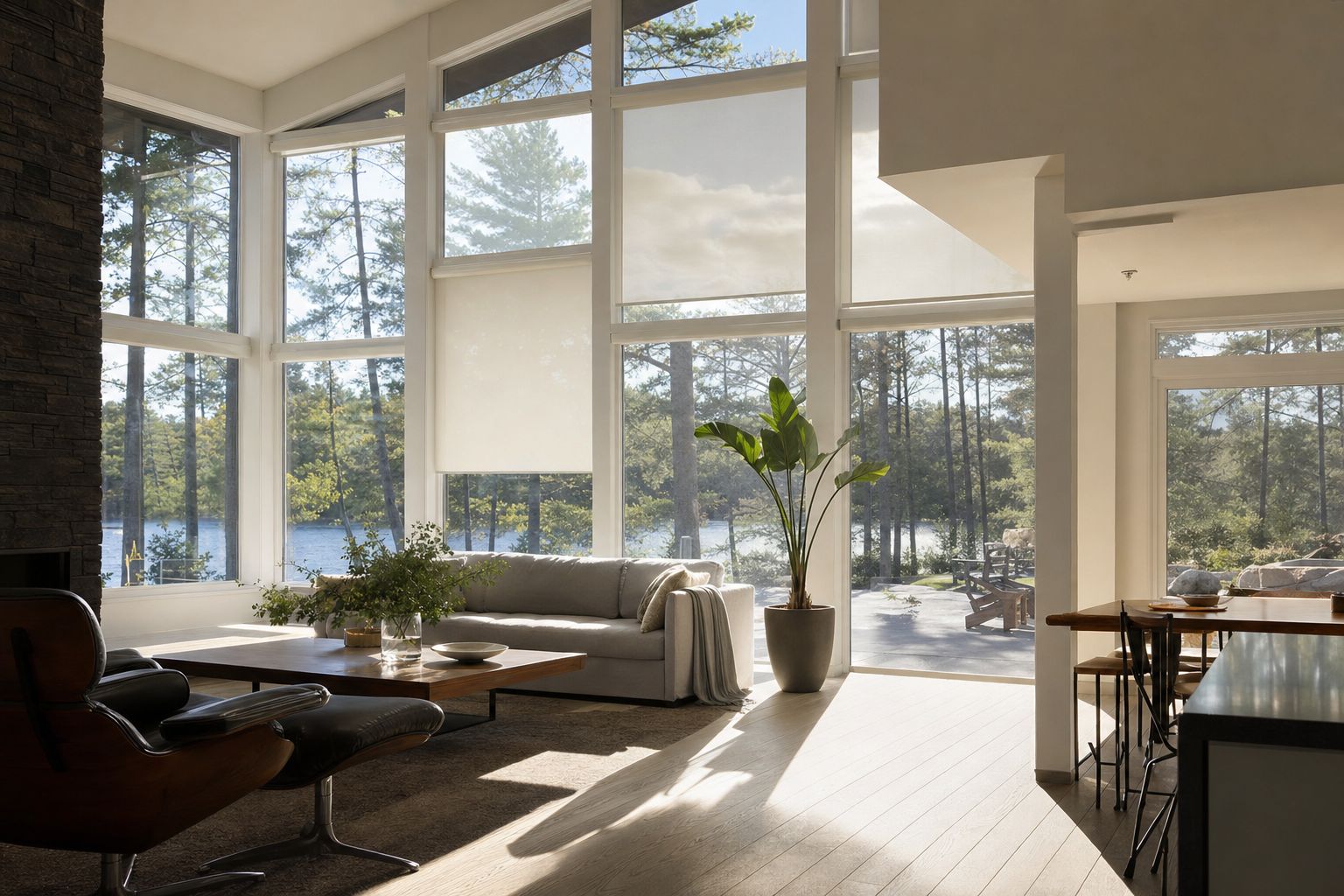
The range
Motorized blinds in Toronto
Motorized blinds measured, fitted and programmed across Toronto. The honest test for a motor is not how big the window is or how new the building — it is how many times a day the same blind gets the same adjustment from your hand. Past about two, the motor has stopped being a luxury.
Blinds Company · Rated 4.8 out of 5 on Google
Free in-home measure · open 8am–9pm, 7 days
- Counted touches, not window size
- The blind you adjust at the same hour every day is the candidate; the one you touch twice a year is not, and we will say so.
- Battery, no wiring
- Nothing is chased through century plaster or condo concrete — the motor and its power both live sealed inside the blind's own tube.
- Schedules follow the sun
- Sunrise and dusk swing by hours across a Toronto year, so the schedule tracks them as moving targets instead of a fixed clock time.
- Programmed with you standing there
- Limits, groups and schedules are set at the installation in your own rooms, and adjusted after if living with them teaches you better.
In short
We motorize blinds across Toronto where daily repetition earns it — bedroom blinds that open at the same hour every morning, west rooms that close at the same hour every evening, tower glass where six blinds should move as one — and the first visit to work out which is free.
Inside this pageJump to one of 5 topics
Count the touches
Strip away the technology and a motorized blind is a simple proposition: a machine that repeats an adjustment you were already making. Which gives you the whole purchasing test in one question — how often do you make it?
The blind you adjust twice a year does not need a motor; nothing about it improves. The blind you adjust every single day, at the same hours, for the same reasons — that one is doing shift work, and it is the honest candidate. In Toronto the dailies are remarkably consistent: the east bedroom that needs to open when you wake and seal when you sleep. The west room that has to close against the low sun at the same hour every evening, then open again once the glare has set. The street-facing room that wants privacy at dusk without fail, every day, whether anyone remembered or not.
Count your own touches for a week and the house sorts itself: two or three windows keeping strict hours, and everything else ambling along fine by hand. Motorize the shift workers. Leave the rest.
Six windows that should be one
The tower half of Toronto changes the arithmetic in a specific way: repetition across space rather than time. A condo wall is often one view cut into four, six, eight identical panes, each wearing an identical blind — and closing them by hand is the same adjustment made six times in a row, twice a day, forever.
Motors turn that wall back into a single thing. One command, and the whole elevation moves together — which is not a small pleasure the first time you see it, and is still not a small pleasure the five hundredth. Grouping is the real product here: blinds in fours and sixes, a whole wall as one gesture, at its best in exactly the many-identical-windows architecture this city builds.
Two tower practicalities, briefly. Battery motors sidestep any wiring conversation entirely, which in a concrete building is worth a great deal. And some buildings have rules about how coverings look from outside — worth checking before ordering, and nothing a fabric choice cannot usually satisfy.
The battery question, answered plainly
People assume motorized means electrical work. In Toronto housing it almost never does, and the reason is the housing itself: nobody wants a wire chased through century plaster, and nobody can chase one through condo concrete. The market answered with the battery tube motor — the motor and its power both sealed inside the blind’s own tube, nothing running to the wall, charged in place a few times a year with a cable.
That is our default recommendation across the city, old house and tower alike, because it asks nothing of the building. Wired motors keep one honest use case: a renovation already underway, walls already open, where running power to the window heads costs nearly nothing and removes charging forever. If that is your situation, say so at the visit — it is the one moment wiring is worth doing, and it does not come around twice.
The hour that will not stay still
A schedule is where a motor stops being a convenience and starts being the product. But Toronto’s light does not keep clock time: sunrise swings by hours across the year, and the six o’clock June sun is a half-past-seven December one. A blind that opens at a fixed 7am is right for a few weeks a season and wrong the rest.
The good schedules follow the sun instead of the clock — dawn and dusk as moving targets the blinds track through the year without being reset. The bedroom opens with the actual morning, whenever the morning happens to be; the front room closes itself at each day’s own dusk, which is the single most useful automation in the house, because dusk privacy is the adjustment most reliably forgotten by hand.
All of it gets set up at installation, with you there, to your hours — and adjusted after, if living with it teaches you something the first guess missed. That programming session is part of the fitting, not an extra.
What the visit sorts out
We come to you, walk the windows, and have the counting-the-touches conversation honestly — including naming the windows where a motor would be money spent on nothing, and the manual blinds that would serve better. The quote you keep is written and itemised, the installation date is committed in writing when you order, and nothing is paid before you agree. Phones are answered seven days a week; the visit costs nothing at all.
Hour by hour
The same window, four times over
7am
The blind worth motorizing announces itself at seven, because it is the one somebody gets out of bed to open. Set to track the actual sunrise rather than a clock time, it opens with the morning Toronto is having that week — and a June morning and a December one here are nearly two hours apart on the same schedule.
Noon
Midday is the hour that argues against the motor, and it deserves saying out loud. Most windows in a house sit at noon exactly where they sat at breakfast, untouched by anybody, and a motor on those is money spent on nothing. Count your own touches for a week: the middle of the day is where the list gets shorter.
6pm
Evening is the repeat offender. A west room glares at the same hour every day, or a downtown wall of identical panes needs the same adjustment made six times in a row. One of those is a schedule and the other is a group, and both come from the same fact — the adjustment was never a decision, only a chore.
After dark
Dusk privacy is the adjustment most reliably forgotten by hand, and on a lit older street it is the one that matters most. A motor set to the day's own dusk closes the street-facing rooms whether anyone is home, awake, or thinking about it — which is the single automation people say they would keep if they could keep only one.
In the room
How the choice changes the room
The rest of the range
Everything else we fit in Toronto
Winds onto a tube
Tilts to aim the light
Folds up out of the way
Slides across the opening
And the fitting itself
Our commitment
We measure it. If it does not fit, we remake it.
The visit is free. See the samples at your own window, get the quote, then decide.
Before you call
Questions worth answering before you book.
Can you motorize the blinds I already have?
Sometimes, and we will tell you plainly which case yours is. A motor lives inside the blind's tube, so the question is whether your existing tube can take one — some can, straightforwardly; many were never built for it, and forcing the marriage buys you a compromised blind at close to the cost of a proper one. When retrofitting is the good answer we say so, and when replacing the blind is honestly cheaper over its life, we say that instead, at the visit, before anything is ordered.
What happens when the power goes out?
Less than people fear. A battery motor is not on the house's power at all, so an outage changes nothing — the blind works through it. A wired motor holds its position and waits; the fabric does not fall, the settings are not lost, and when the power returns the schedule picks up where it left off. In a city that gets the occasional dramatic ice storm, the battery option's indifference to the grid is one of its quieter arguments.
How loud is the motor?
A low hum for the few seconds the blind is moving, then silence. The real-world test is the bedroom at six in the morning: does the blind opening wake you gently, or is the motor itself the alarm? A decent modern tube motor passes — it is the light that wakes you, which was the point. We are happy to run one in front of you at the visit, since no written description of a sound has ever settled anybody's mind.
How often do batteries need charging?
With ordinary daily use, months between charges — a blind that moves twice a day sips its battery rather than drinking it. The practical shape of it: a couple of charging sessions a year, a warning from the blind well before it stops, and a charge that happens in place with a cable rather than a ladder and a screwdriver. Heavier fabric, taller drops and more daily movement shorten the interval; we will tell you what to expect for your actual windows rather than quote a brochure.
Do they work with a phone, or with voice assistants?
Yes — through a hub, the blinds join the same ecosystem as the rest of the house, take a schedule, answer an app from anywhere, and respond out loud to the usual assistants. Equally honestly: none of that is compulsory. A motorized blind with a small remote on the wall, and no account, app or hub anywhere in the house, is a complete and rather pleasant product. The layers of cleverness are optional, and each one can be added later without changing the blind.
Is a motor the safe choice for a child's room?
It is the safest configuration a blind can have — no cords, no chains, nothing hanging within reach, and the controls live wherever the adults decide. In any room where a child sleeps, cordless or motorized is our default at no extra charge; the motor simply adds that the blind can do its dawn duty without anyone entering the room, which parents of early wakers tend to describe as the best feature in the house.
The last chapter
We bring the samples to your windows.
We come to you, measure at your own windows, and go through fabrics and fits together. The visit costs nothing.
$99 off when you order three or more blindsApplied to your written quote at the measure.
Rather just talk?(437) 782-5452Answered 8am–9pm, 7 days
Free in-home measure
If the same window gets the same adjustment from you every day of the week, stop doing its job for it. Ring us and name the hour.
Answered 8am–9pm, 7 days.
Page last checked 16 August 2026.